6 Six Sigma in manufacturing vs services: what actually
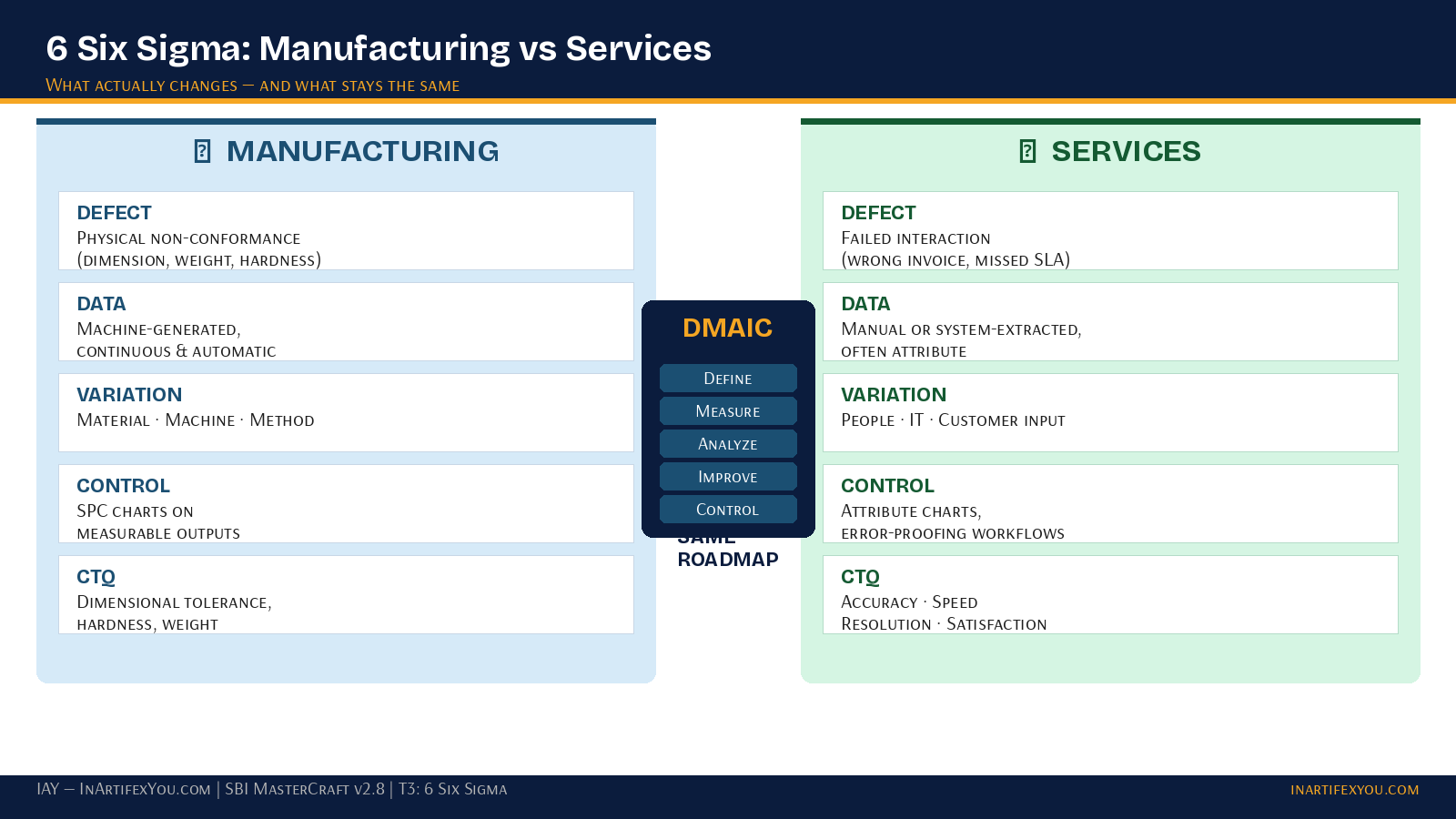
Six Sigma applies to both manufacturing and service environments, but three things change significantly. First, defect definition: in manufacturing, a defect is a physical non-conformance (a dimension out of tolerance, a broken component). In services, a defect is a failed interaction — a wrong invoice, a missed deadline, an unresolved call. Second, data availability: manufacturing processes generate automatic measurement data; service processes often require manual collection or transactional system extraction. Third, variation sources: manufacturing variation comes from machines and materials; service variation comes from people, systems, and customer behavior. The DMAIC roadmap stays the same. What changes is how you define, measure, and control quality in a world where the product is invisible.
Six Sigma was born on the manufacturing floor at Motorola in 1986. By the early 2000s, General Electric had proven it worked in financial services, healthcare, and logistics. Today, it is industry-agnostic — but applying it without understanding the translation traps will cost you months of wasted effort.
Here is what actually changes — and what does not — when you move Six Sigma from a factory to a service environment.
What Changes: The 3 Critical Differences
MANUFACTURING
Defects are physical and visible
Data is machine-generated and continuous
Variation sources: material, machine, method
Control: SPC charts on measurable outputs
CTQ: dimensional tolerance, hardness, weight
SERVICES
Defects are transactional and often invisible
Data is manual or system-extracted
Variation sources: people, IT, customer input
Control: attribute charts, error-proofing workflows
CTQ: accuracy, speed, resolution, satisfaction
Defect Definition: The Hardest Part
In manufacturing, a defect is binary and objective: the part either meets spec or it does not. In services, you must define what 'failure' means before you can count it — and different stakeholders will disagree.
Best practice: use a Critical-to-Quality (CTQ) tree to cascade from customer need to measurable defect. For a billing process: Customer need → Accurate invoices → Defect: any invoice with a dollar error > $0.
Data Collection: Close the Gap
Manufacturing Six Sigma practitioners inherit decades of automated SPC infrastructure. Service practitioners usually start with spreadsheets and manual tally sheets. This is not a disadvantage if you plan for it:
• Use transactional system reports as your primary data source (CRM, ERP, ticketing systems)
• Define a clear sampling plan: how many transactions, over what period, collected by whom
• Run a Measurement System Analysis (MSA) to verify that your manual data collection is repeatable
DMAIC: What Stays the Same
The roadmap does not change. Define, Measure, Analyze, Improve, Control. What changes is the toolkit within each phase:
• Measure phase: use P-charts and U-charts instead of X-bar and R charts for attribute data
• Analyze phase: fishbone diagrams focus on people and procedures, not machines and materials
• Improve phase: solutions often involve workflow redesign, training, or IT system changes
• Control phase: Standard Operating Procedures (SOPs) and visual management replace SPC control limits
The ROI Is the Same
A 2019 ASQ study found that Six Sigma projects in service industries deliver average cost savings of $125,000 to $250,000 per project — comparable to manufacturing. The method works. The translation requires intentionality.