Advanced Lean Training KPI targets and baseline: what
to track first
To track Advanced Lean Training results, start by establishing three baselines before training begins: Overall Equipment Effectiveness (OEE), First-Pass Yield (FPY), and average cycle time for your target process. OEE below 65% signals significant improvement opportunity — world-class is 85%. Track FPY weekly; anything below 95% is your first improvement target. For cycle time, measure current state before the first Kaizen event so you have a valid before-and-after comparison. After training, add Lead Time and Cost of Poor Quality (COPQ) as secondary metrics. The most common mistake: tracking activity (hours of training completed) instead of outcome (process performance improvement). Training hours are an input. OEE, FPY, and cycle time are outputs. Measure what changes in the process, not what happens in the classroom.
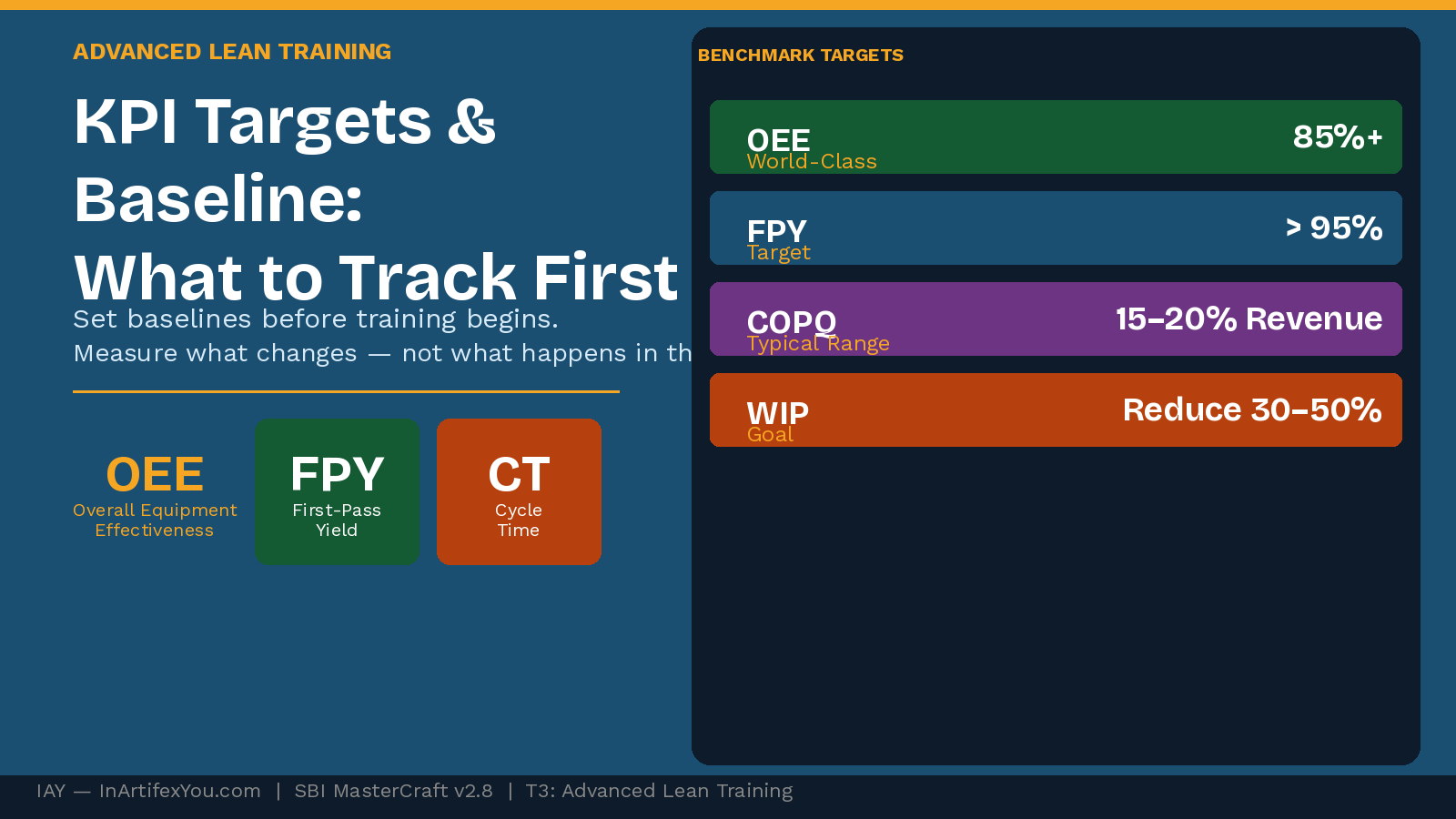
Advanced Lean Training fails when organizations cannot answer one question six months later: what changed? Without a measurement baseline established before training begins, you cannot demonstrate ROI, justify continuation, or identify which tools actually landed.
This page answers the practical question every operations leader faces: which KPIs prove Advanced Lean Training is working, and how do you establish the baseline that makes the improvement visible?
The Three Baseline KPIs to Establish Before Training Begins
Measure these three before the first training session. They are your before-and-after proof:
|
KPI |
What It Measures |
Baseline Target |
World-Class Benchmark |
|
OEE (Overall Equipment Effectiveness) |
Availability × Performance × Quality |
Establish current — typically 45–65% |
85%+ |
|
First-Pass Yield (FPY) |
% of units completed without rework |
Establish current — target > 95% |
99%+ |
|
Cycle Time |
Average time per unit from start to finish |
Measure current state before Kaizen |
Varies by process |
Why OEE Is Your Primary Lean Training KPI
OEE combines three losses — availability loss (downtime), performance loss (slow running), and quality loss (defects) — into one number. A plant running at 60% OEE has 40% of its capacity being consumed by waste. Advanced Lean Training tools — TPM, SMED, 5S, Kaizen — each attack a different component of OEE. This makes OEE the ideal single-number indicator of whether the training is translating into operational change.
Track OEE weekly, not monthly. Monthly averages hide the week-to-week variability that tells you whether improvements are sustained or sporadic.
Secondary KPIs to Add After 60 Days
Once your primary three are being tracked consistently, introduce:
- Lead Time — total time from order to delivery. Advanced Lean Training should compress this through pull system design and flow improvements.
- Cost of Poor Quality (COPQ) — internal failures (rework, scrap) + external failures (returns, warranty) + appraisal + prevention costs. Typically 15–20% of revenue at unimproved organizations.
- Inventory Turns — how many times inventory cycles through in a period. Higher turns signal better flow and less waste tied up in WIP.
The Measurement Trap to Avoid
The most expensive mistake in Lean Training ROI measurement is tracking training activity instead of process outcome. Hours of training completed, participants certified, modules finished — these measure inputs, not results.
Your executive team does not care how many people attended Value Stream Mapping training. They care whether lead time dropped, defects declined, or OEE improved. Set the baseline before training. Measure the outcome after. The gap is your ROI.
Quick Baseline Checklist
1. Document current OEE for the target production line or process
2. Calculate FPY for the last 4 weeks — use consistent defect definitions
3. Time-stamp your cycle time measurement — you need a pre-training average
4. Record COPQ — even a rough estimate establishes a starting point
Agree on who measures what, how often, and where data is recorded
A 30-minute measurement setup session before training begins is worth more than a 30-page post-training report. Set the baseline. Train. Measure again. The numbers tell the story.
Back to hub: Advanced Lean Training.
🔗INTERNAL LINK SUGGESTIONS
- Advanced Lean Training ROI: skill assessments and project pipeline targets.
- Advanced Lean Training in manufacturing vs services: what actually changes.
- Hands-on simulations for Advanced Lean Training (SMED, VSM, Kanban).
|
||||||||||||||||||||||
The Continuous Improvement Certification at InArtifexYou gives you a complete, practical system to map, baseline, improve, and sustain any process — and the verified credential to prove you can lead it.
inartifexyou.com/continuous-improvement-certification-online.html |
||||||||||||||||||||||
|
||||||||||||||||||||||
|
IAY — InArtifexYou.com | SBI MasterCraft v2.8 | T3: Advanced Lean Training |