Agile organization KPI targets: velocity, lead time,
and adaptability baselines
Agile organization performance is measured through three primary KPIs: delivery velocity, end-to-end lead time, and an adaptability indicator. Delivery velocity measures the average number of value-adding outputs — features, improvements, resolved cases, completed projects — delivered per sprint or time period. Establish a baseline over eight to twelve cycles before drawing conclusions. End-to-end lead time measures elapsed time from when work enters the system to when it exits as delivered value — target a 30% reduction in the first year of agile adoption. The adaptability indicator measures how quickly the organization responds to unplanned changes in demand or priority — tracked as the average days from change request to implemented response. Secondary KPIs — team satisfaction score, defect escape rate, and deployment frequency — are added after the primary three are stable and consistently tracked.
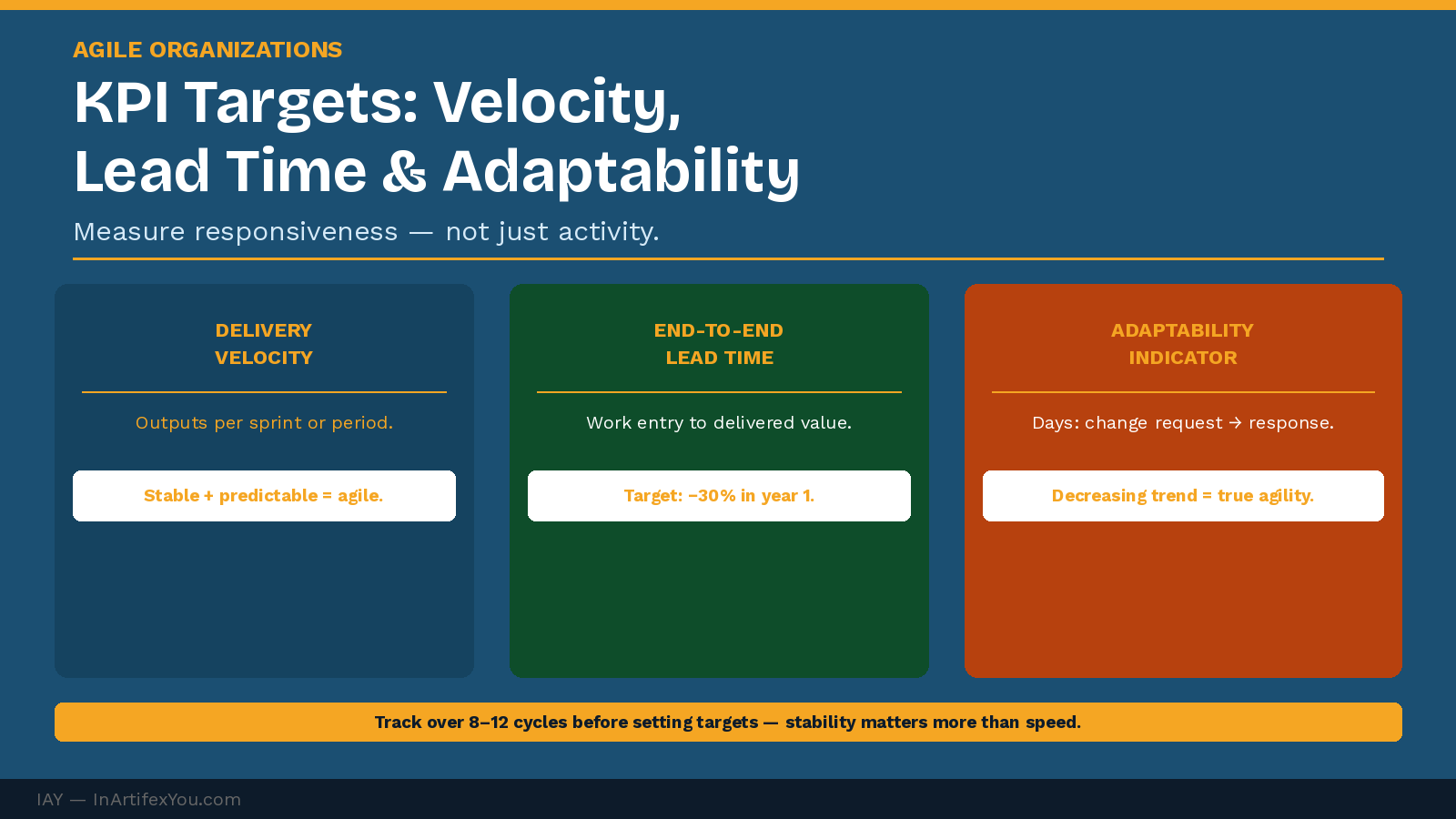
An organization that calls itself agile but cannot measure its responsiveness is using the word as a culture descriptor rather than an operational standard. True organizational agility is measurable — and the measurement starts with three baseline KPIs established before any agile transformation begins
The Three Primary Agile Organization KPIs
|
KPI |
What It Measures |
Baseline Method |
First-Year Target |
|
Delivery Velocity. |
Average outputs delivered per sprint or period. |
Track over 8–12 cycles before setting targets. |
Stable and predictable — not necessarily increasing. |
|
End-to-End Lead Time. |
Time from work entry to delivered value. |
Measure current average over 20+ work items. |
30% reduction from baseline. |
|
Adaptability Indicator. |
Days from change request to implemented response. |
Track every unplanned priority change for 90 days. |
Decreasing trend — context-dependent target. |
Delivery Velocity: Stability First, Speed Second
The most common mistake in measuring agile velocity is treating it as a speed metric — assuming higher is always better. Velocity is actually a predictability metric. A team that consistently delivers 40 story points per sprint is more agile than one that delivers 60 one sprint and 20 the next, because predictability enables reliable planning and commitment to customers.
Establish velocity over a minimum of eight sprints before using it for planning. In the first four to six sprints of a new agile team, velocity fluctuates as the team calibrates. Use that period for observation, not target-setting.
End-to-End Lead Time: The Customer Experience Signal
Lead time in an agile organization measures the full elapsed time from when a customer or stakeholder request enters the system to when it is delivered as working value. It is the most direct indicator of organizational agility from the customer's perspective.
- Track lead time at the work item level — not the sprint level.
- Segment by work item type: features, bugs, and urgent requests typically have different lead time profiles.
- Use a lead time distribution chart, not just an average — the tail of long lead times reveals systemic bottlenecks.
Adaptability Indicator: The True Agility Signal
Delivery velocity and lead time measure how efficiently the organization processes planned work. The adaptability indicator measures how gracefully it handles unplanned work — which is the real test of organizational agility.
Adaptability Indicator Formula
Adaptability = Average days from unplanned change request to implemented and delivered response.
Track every unplanned priority change, scope addition, and external disruption event for 90 days.
A decreasing trend in this metric is more meaningful than any absolute target — it proves the organization is learning to respond faster.
Secondary KPIs to Add After Stabilization
- Team satisfaction score: measured monthly — sustained low scores predict velocity decline and attrition before they appear in output data.
- Defect escape rate: percentage of defects that reach the customer versus those caught internally — a leading indicator of quality system health.
- Deployment frequency: how often the organization delivers to production — higher frequency signals mature agile infrastructure.
Back to hub: Agile Organizations.
- Agile organizations in manufacturing vs services: what actually changes.
- Change management patterns that avoid initiative fatigue.
- OKR examples that reinforce quality and flow.
🔗 INTERNAL LINK SUGGESTIONS
|
||||||||||||||||||||||
The Continuous Improvement Certification at InArtifexYou gives you a complete, practical system to map, baseline, improve, and sustain any process — and the verified credential to prove you can lead it.
inartifexyou.com/continuous-improvement-certification-online.html |
||||||||||||||||||||||
|