Deming's 14 Points: how to apply them in a modern
quality system
Deming's 14 Points are a management philosophy framework — not a checklist — designed to transform organizational systems from short-term, output-focused management to long-term, process-focused improvement. Applied to a modern quality system, the most impactful points are: Point 1 (Constancy of Purpose) — define a long-term quality improvement mission and hold to it regardless of short-term financial pressure; Point 3 (Cease Dependence on Inspection) — build quality into processes rather than inspecting defects out; Point 5 (Improve Constantly) — embed the PDCA cycle as the operating discipline for all processes; Point 6 (Institute Training) — train people on process operation before holding them accountable for output; Point 7 (Adopt Leadership) — shift managers from supervisors of output to leaders of process improvement; and Point 11 (Eliminate Numerical Quotas) — replace output targets with process capability targets that make meeting the quota a natural consequence of a capable process.
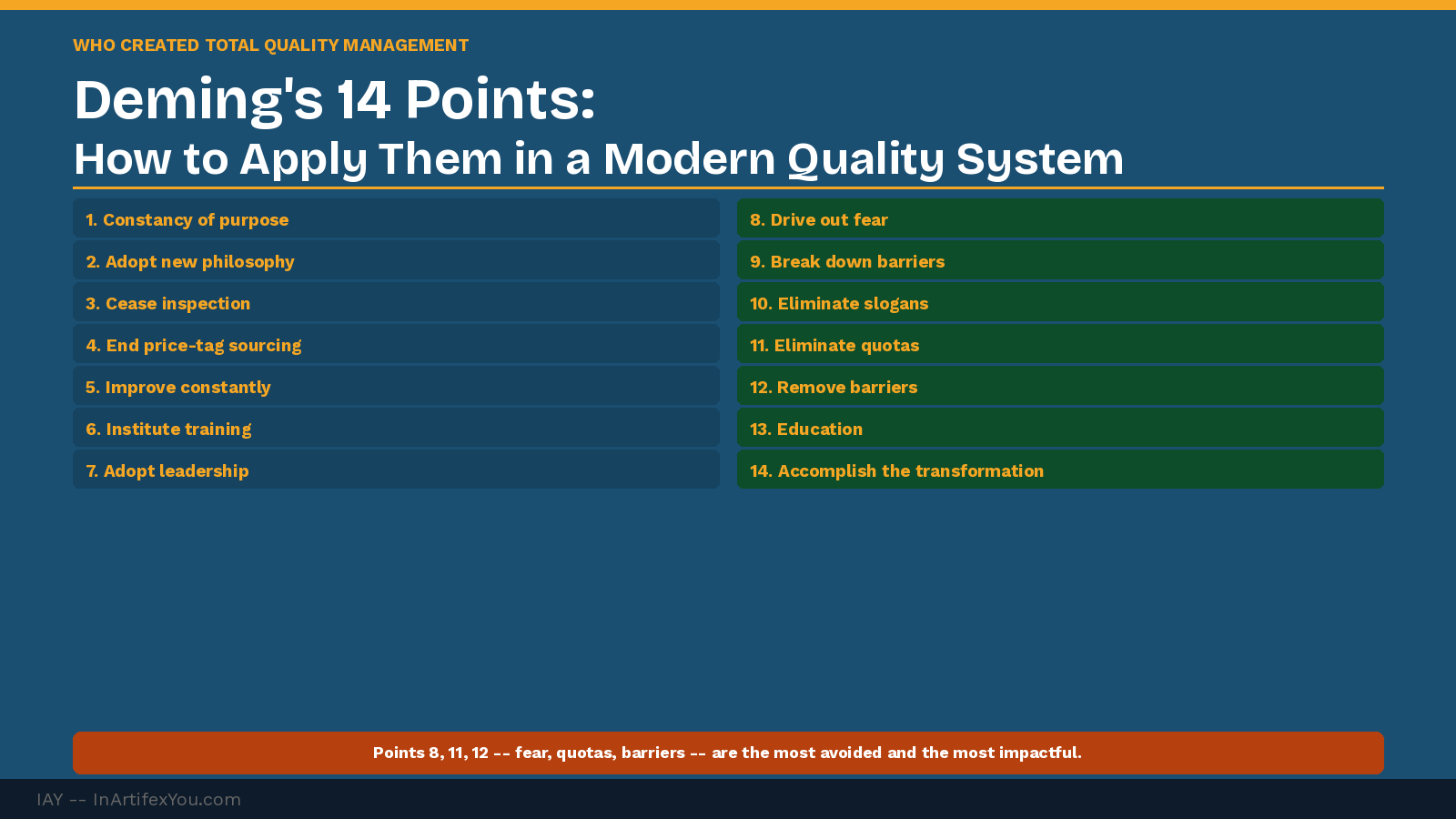
Deming's 14 Points remain the most comprehensive management transformation framework in quality history — and the most consistently misapplied. Organizations that treat them as a list of policies to implement miss their intent entirely. The 14 Points are a system: each point reinforces the others, and implementing only the convenient ones while ignoring the uncomfortable ones (particularly Points 11 and 12, which challenge performance appraisals and merit ratings) produces partial results.
The 14 Points — Modern Application
|
Point |
Statement |
Modern Application |
|
1. |
Create constancy of purpose for improvement. |
Define a 3–5 year quality improvement mission. Fund improvement projects even when margins are tight. |
|
2. |
Adopt the new philosophy. |
Zero defects is the standard — not an aspirational target. Every defect is a system failure, not a worker failure. |
|
3. |
Cease dependence on inspection. |
Implement SPC so processes control themselves. Shift quality assurance from detection to prevention. |
|
4. |
End lowest-price supplier selection. |
Select suppliers on quality capability, delivery reliability, and long-term relationship potential — not unit price. |
|
5. |
Improve constantly every process. Embed PDCA in every function. |
Set an annual improvement rate target for every key process metric. |
|
6. |
Institute training on the job. |
Train operators on the process — not just the task — before measuring their output performance. |
|
7. |
Adopt and institute leadership. |
Managers lead process improvement. They remove barriers — they do not supervise outputs. |
|
8. |
Drive out fear. |
Psychological safety is a quality requirement. Workers who fear reporting problems hide defects. |
|
9. |
Break down barriers between departments. |
Cross-functional improvement teams. Shared quality objectives across functions. |
|
10. |
Eliminate slogans and targets. |
Replace 'zero defects by Q4' with 'Cpk above 1.67 on all critical processes by Q4.'. |
|
11. |
Eliminate numerical quotas. |
Replace output quotas with process capability targets. Output follows from a capable, stable process. |
|
12. |
Remove barriers to pride of workmanship. |
Give workers the tools, training, and authority to produce quality work without obstacles. |
|
13. |
Institute vigorous education. |
Continuous learning program for every level — not one-time training events. |
|
14. |
Take action to accomplish transformation. |
Quality transformation is a leadership decision — it requires senior commitment, not delegation. |
The Application Principle
Points 8, 11, and 12 are the most impactful and the most avoided.
Fear, numerical quotas, and barriers to workmanship are the three systemic causes that produce the most quality failures in most organizations — and they all require leadership courage to address, not just quality tools.
Back to hub: Who Created Total Quality Management.
| ||||||||||||||||||||||
The Continuous Improvement Certification at InArtifexYou gives you a complete, practical system to map, baseline, improve, and sustain any process — and the verified credential to prove you can lead it.
inartifexyou.com/continuous-improvement-certification-online.html | ||||||||||||||||||||||
|