Executive reporting: dashboards that win sponsorship
A Lean dashboard that wins executive sponsorship shows three things: financial impact (documented savings with finance sign-off), strategic alignment (which company objectives each project supports), and pipeline visibility (what is in progress and what is planned). Executives do not need to see DPMO, Cpk, or control chart data — they need to see dollars saved, dollars in progress, and the trajectory of the improvement program. The one-page executive dashboard format consists of four quadrants: (1) YTD savings vs. target, (2) active project status with RAG indicators, (3) top 3 wins this quarter with dollar amounts, and (4) next quarter pipeline with estimated value. Update it monthly. Present it in person whenever possible. The dashboard is not a report — it is a sponsorship renewal conversation.
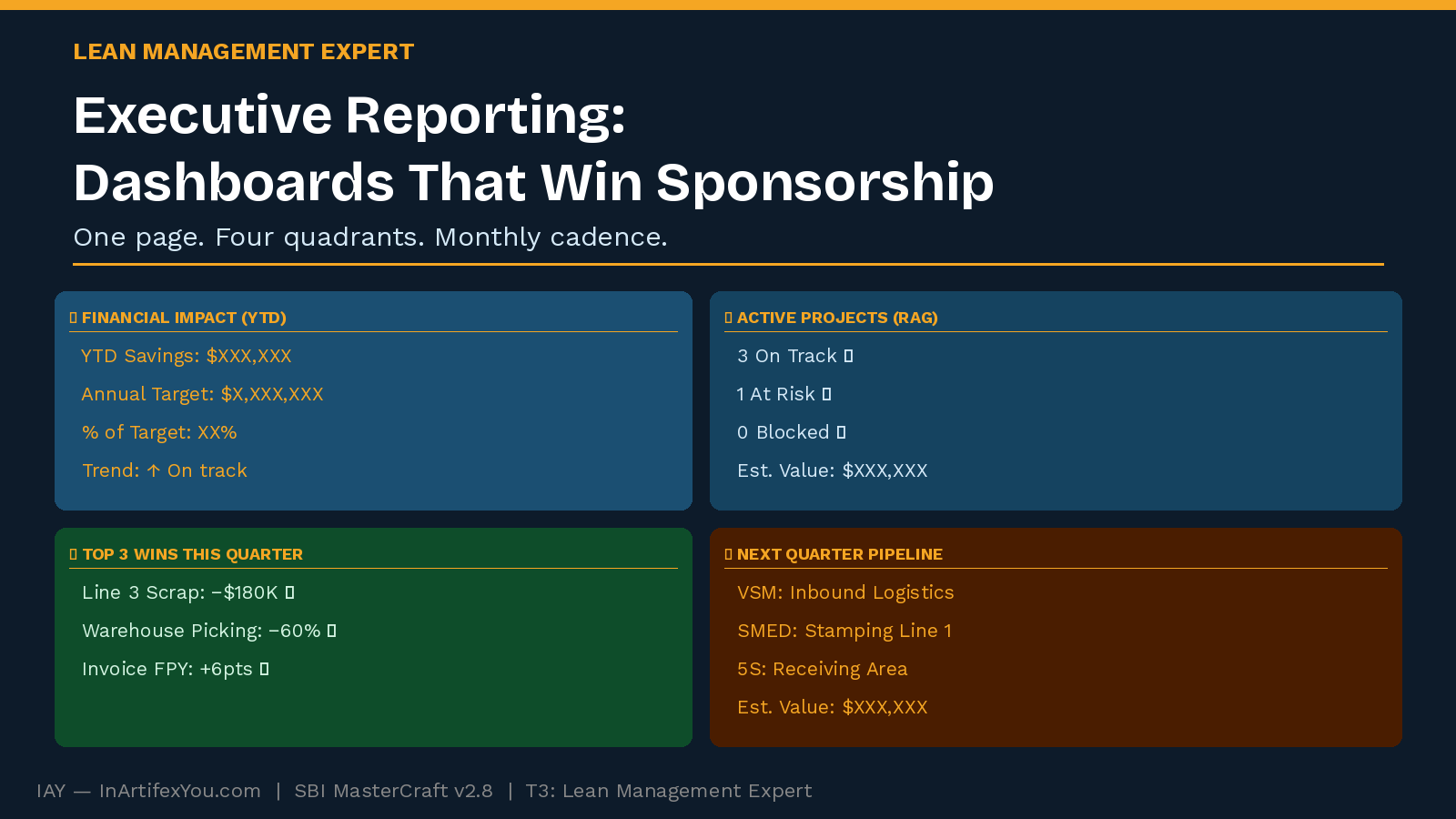
The Lean Management Expert who cannot communicate results in executive language will always be underfunded. The sponsor who does not understand the ROI of improvement will not protect the budget when pressure comes. The dashboard is the bridge between technical work and business language.
What Executives Actually Need to See
Most Lean dashboards are built for practitioners — they show tools used, events completed, and process metrics that require technical knowledge to interpret. Executive dashboards must be built for a different audience: people who make resource allocation decisions and think in financial terms.
|
KPI |
What It Measures |
Starting Benchmark |
World-Class Target |
|
OEE (Overall Equipment Effectiveness). |
Availability × Performance × Quality rate. |
45–65% for most plants. 85%+. |
— must be able to facilitate. |
|
First-Pass Yield (FPY). |
% of units completed without defects or rework. |
Varies — establish current state first. |
95%+. . |
|
Cycle Time. |
Average time to complete one production unit. |
Measure current state over 25+ cycles. |
Continuously improving. |
The One-Page Executive Dashboard Structure
One page. Four quadrants. Monthly cadence. This format consistently earns sustained sponsorship:
FPY Formula
FPY = (Units Completed Without Rework ÷ Total Units Started) × 100.
Track at the process level first, not the plant
level. A plant-level FPY of 94% may hide a single process step running at 70% —
which is your highest-priority improvement target.
- Awareness: Can explain the concept and its purpose.
- Working Knowledge: Can apply with guidance or reference material.
- Proficient: Can apply independently in real situations.
- Expert: Can teach, coach, and adapt to novel situations.
Rate yourself on each skill above. For any gap below your minimum LME level: identify one project in your current pipeline where you can close that gap. Skills develop in projects, not classrooms.
The Language That Wins Sponsorship
Replace technical Lean language with financial and strategic language in every executive conversation:
|
WHAT YOU SAY (Lean language) We improved OEE by 12 points. We completed a DMAIC project on line 3. We ran a Kaizen event in the warehouse. FPY went from 91% to 97%. We reduced DPMO from 15,000 to 3,200. |
WHAT THEY HEAR (Business language) Production capacity increased by 12% — equivalent to adding half a shift without headcount. We eliminated $180K in annual scrap on Line 3 — verified by Finance on March 12. Warehouse picking errors dropped 60% — customer complaints from that area are down to zero. We recovered $240K per year in rework costs on that product line. Defect rate dropped 79% — COPQ on that process went from $95K to $20K annually. |
The Sponsorship Renewal Conversation
The dashboard is not a document to email. It is a conversation starter. Present it in person — even 15 minutes with the right sponsor — quarterly. The agenda is always the same: here is what we achieved, here is what we are working on, here is what we need from you.
Sponsors who see consistent results in financial language do not cut Lean programs. Sponsors who receive technical reports they cannot interpret do.