Ishikawa's quality tools: how to apply the fishbone
and quality circle
Ishikawa's two primary quality tools are the fishbone diagram (cause-and-effect diagram) and the quality circle. The fishbone diagram organizes potential root causes of a quality problem into six categories — known as the 6Ms: Man (people), Machine (equipment), Material (inputs), Method (process), Measurement (data systems), and Mother Nature (environment). To construct a fishbone diagram: write the problem statement at the head, draw the six M branches, brainstorm potential causes under each branch with the team, identify the most probable causes using data — not consensus — and verify each suspected root cause with a scatter diagram or designed experiment before implementing a countermeasure. The quality circle applies the fishbone in a team context: a small group (5–10) of frontline employees from the same work area meets regularly to identify, analyze with the fishbone, and solve quality problems within their direct sphere of control.
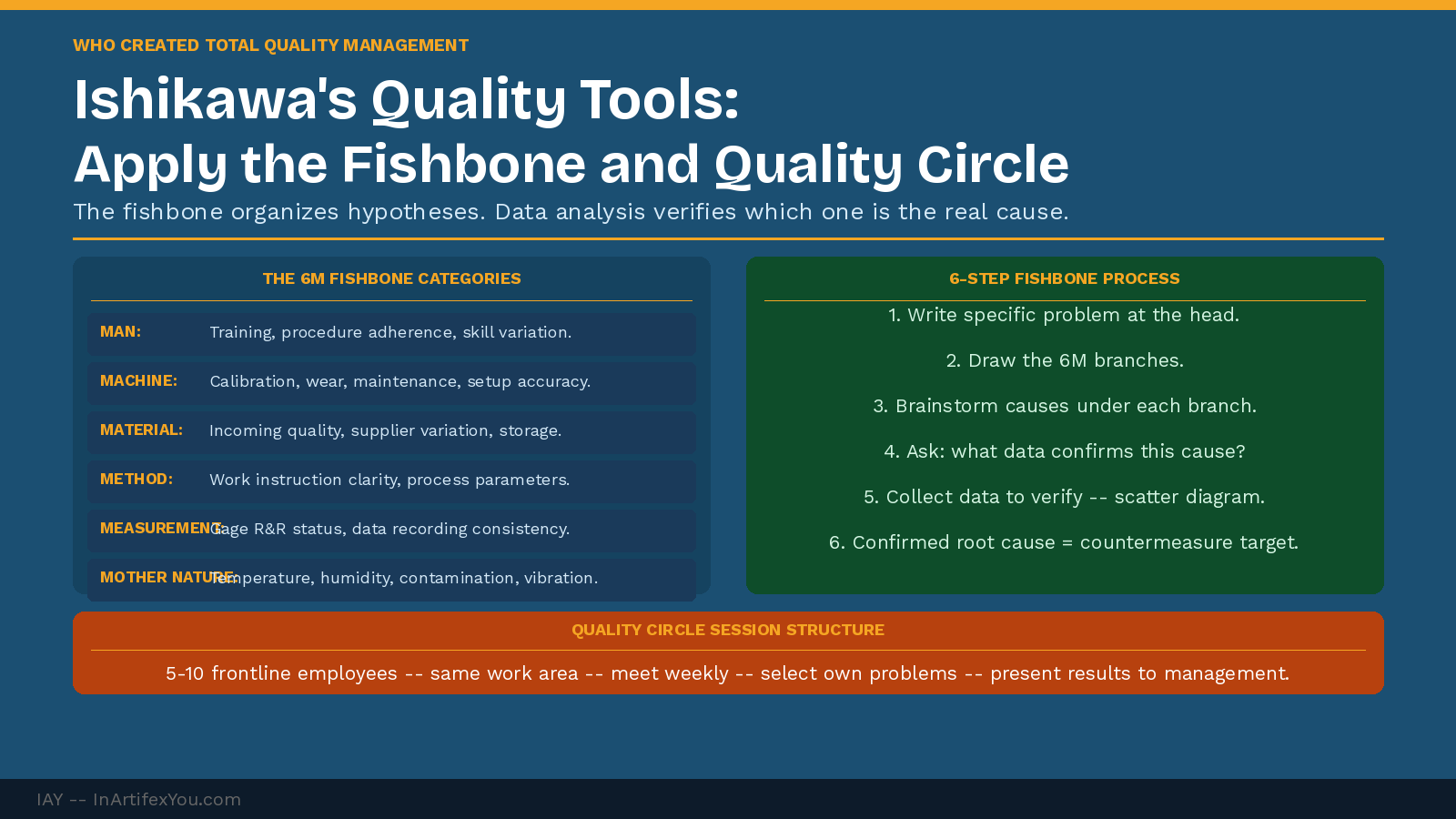
Ishikawa's quality tools are the most widely used in quality management — and the most frequently misused. The fishbone diagram is often used as a brainstorming recording tool rather than a root cause analysis tool, producing a list of possible causes without the data verification step that turns a cause hypothesis into a confirmed root cause. Ishikawa's design intent was clear: the fishbone organizes the hypotheses, and data analysis verifies which hypothesis is the actual cause.
How to Construct a Fishbone Diagram
- Write the problem statement at the head of the fish — be specific: 'Dimension X out of tolerance on 3.2% of parts at Station 4' not 'quality problem.'.
- Draw six M branches from the spine — Man, Machine, Material, Method, Measurement, Mother Nature.
- Brainstorm potential causes under each branch — use '5 Whys' under each branch to go deeper than the surface symptom.
- Identify the most probable causes — not by team vote but by asking 'what data would confirm or deny this cause?'.
- Collect data to verify — scatter diagrams, stratified Pareto charts, or a designed experiment.
- Confirm the root cause — only a cause that data confirms is a root cause. Everything else is a hypothesis.
The Six M Categories — What to Look for in Each
|
Category |
What to Investigate |
Common Causes Found Here |
|
Man (People). |
Training adequacy, procedure adherence, fatigue, skill variation. |
Operator-to-operator variation, untrained substitutes, workarounds. |
|
Machine (Equipment). |
Calibration status, wear, maintenance history, setup accuracy. |
Worn tooling, out-of-calibration gauges, inconsistent setup. |
|
Material (Inputs). |
Incoming material quality, supplier variation, storage conditions. |
Supplier dimension variation, moisture absorption, material substitution. |
|
Method (Process). |
Work instruction clarity, process sequence, parameter settings. |
Undocumented workarounds, parameter drift, incorrect sequence. |
|
Measurement (Data). |
Gage R&R status, measurement procedure consistency, data recording. |
Measurement error larger than process variation, transcription errors. |
|
Mother Nature (Environment). |
Temperature, humidity, vibration, contamination. |
Thermal expansion in uncontrolled environment, airborne contamination. |
Quality Circles: Running an Effective Session
- Problem selection: the team selects a problem within their direct work area — not one assigned by management. Ownership begins with selection.
- Data collection: before the fishbone session, collect baseline data — defect frequency by type, time of occurrence, operator, and machine. The data guides where to focus the fishbone branches.
- Fishbone construction: 45–60 minute session. Facilitator records. Team generates causes — all ideas captured, none evaluated during generation.
- Cause prioritization: team votes on top 3 probable causes — then collects data to verify before any countermeasure is designed.
- Solution implementation: team designs and implements the countermeasure, measures the result, and presents findings to management.
Back to hub: Who Created TQM.
| ||||||||||||||||||||||
The Continuous Improvement Certification at InArtifexYou gives you a complete, practical system to map, baseline, improve, and sustain any process — and the verified credential to prove you can lead it.
inartifexyou.com/continuous-improvement-certification-online.html | ||||||||||||||||||||||
|