Lean Management Expert KPIs: how to measure your
impact as a practitioner
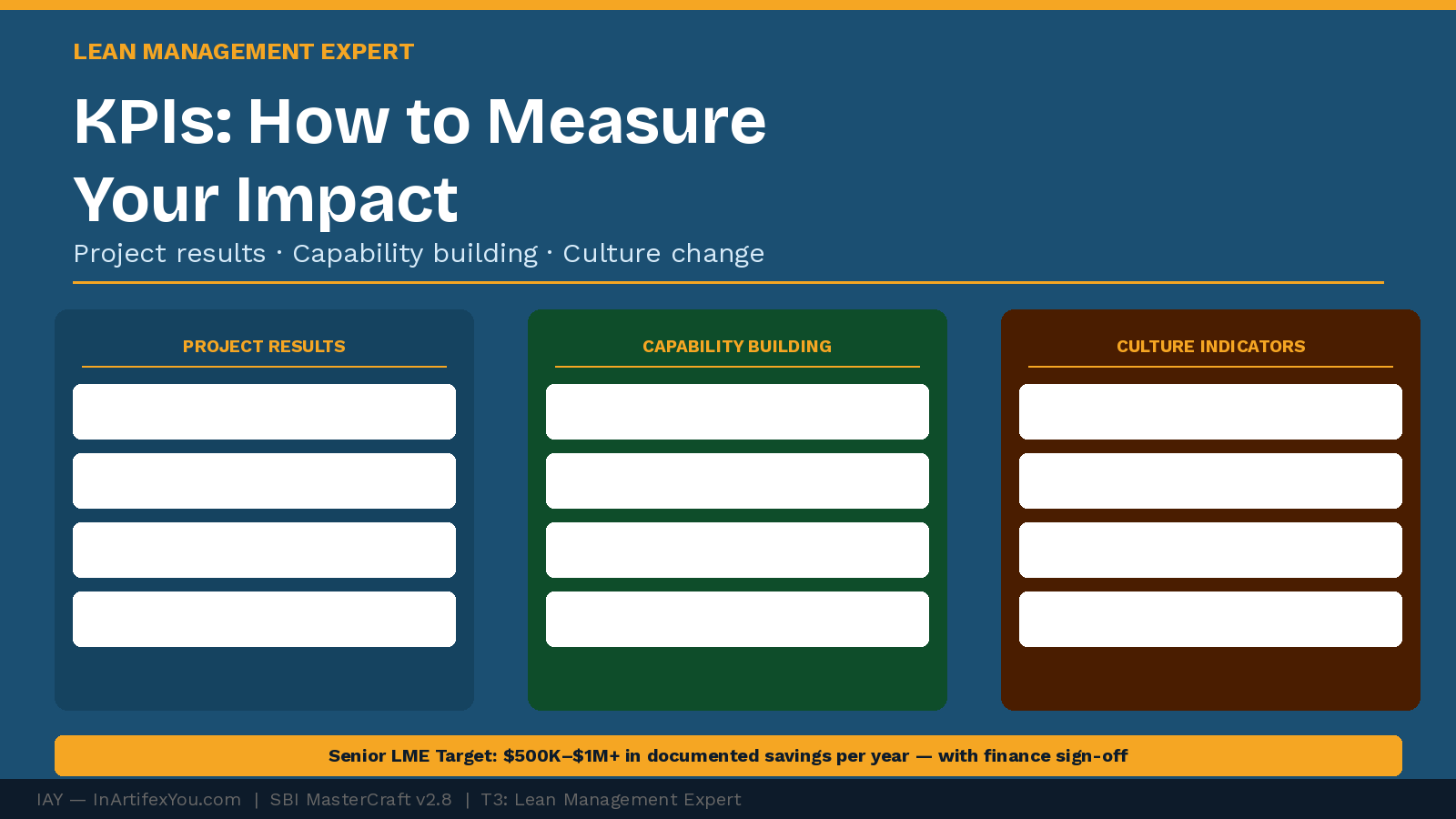
A Lean Management Expert's impact is measured across three dimensions: project results, capability building, and culture change. For project results, track Cost of Poor Quality (COPQ) reduction, OEE improvement, lead time reduction, and first-pass yield gains — always with a baseline for comparison. For capability building, track the number of practitioners trained, projects completed, and teams now running independent Kaizen events. For culture change — the hardest to quantify — track suggestion system participation rates, improvement ideas submitted per employee per year, and the ratio of management-initiated vs. employee-initiated improvements. The most credible Lean Management Expert KPI is documented savings with finance sign-off: a running total of annualized cost reduction attributed to improvement projects led or supported. Target $500K to $1M in documented savings per year for a senior practitioner.
A Lean Management Expert without measurable impact is just a person with a title. The credential opens the door. The numbers keep you in the room.
This page gives you the KPI framework that proves your value — in performance reviews, job interviews, certification portfolios, and executive conversations.
Dimension 1: Project Results
These are your hardest, most defensible numbers. They require a baseline before the project and a documented result after — with finance or operations sign-off.
|
KPI |
What It Measures |
Starting Benchmark |
World-Class Target |
|
OEE (Overall Equipment Effectiveness). |
Availability × Performance × Quality rate. |
45–65% for most plants. 85%+. |
— must be able to facilitate. |
|
First-Pass Yield (FPY). |
% of units completed without defects or rework. |
Varies — establish current state first. |
95%+. . |
|
Cycle Time. |
Average time to complete one production unit. |
Measure current state over 25+ cycles. |
Continuously improving. |
Dimension 2: Capability Building
A Lean Management Expert multiplies impact by building other people's capability. Track these alongside your project numbers:
- Number of Green Belts or Lean practitioners trained and certified.
- Number of Kaizen events facilitated — with documented results per event.
- Number of teams now running independent improvement cycles without your direct involvement.
- Number of projects in the active pipeline — a full pipeline signals organizational embedding.
Dimension 3: Culture Indicators
Culture change is slow, qualitative, and often invisible until it is measured. These proxies make it visible:
- Suggestion system participation rate — target 1+ improvement idea per employee per year.
- Ratio of employee-initiated vs. management-initiated improvements — higher employee ratio = stronger culture.
- Time from problem identification to first countermeasure — decreasing trend signals cultural responsiveness.
- Number of standard work documents actively maintained vs. sitting on a shelf.
Building Your Practitioner Impact Portfolio
The most credible format for a Lean Management Expert's impact record is a one-page project portfolio with five columns:
FPY Formula
FPY = (Units Completed Without Rework ÷ Total Units Started) × 100.
Track at the process level first, not the plant
level. A plant-level FPY of 94% may hide a single process step running at 70% —
which is your highest-priority improvement target.
- Awareness: Can explain the concept and its purpose.
- Working Knowledge: Can apply with guidance or reference material.
- Proficient: Can apply independently in real situations.
- Expert: Can teach, coach, and adapt to novel situations.
Rate yourself on each skill above. For any gap below your minimum LME level: identify one project in your current pipeline where you can close that gap. Skills develop in projects, not classrooms.
A senior Lean Management Expert who cannot produce a one-page impact portfolio is indistinguishable from someone who attended a training and never applied it. The portfolio is the proof.