Lean Management Expert role in manufacturing vs
services: what actually changes
A Lean Management Expert's role changes in three ways when moving from manufacturing to services. First, the waste is invisible: in manufacturing, a Lean Expert can walk the floor and see overproduction, waiting, and motion waste. In services, the waste is buried in email chains, approval queues, and rework loops that no one tracks. Second, the data collection burden shifts: manufacturing processes generate automatic measurement data; the Lean Expert in services often has to design the measurement system from scratch before any improvement work can begin. Third, the change management challenge intensifies: service workers often do not see themselves as part of a 'process' — so the Lean Expert's first job is making invisible work visible. The tools — VSM, 5S, Kaizen, standard work — translate directly. The facilitation approach does not.
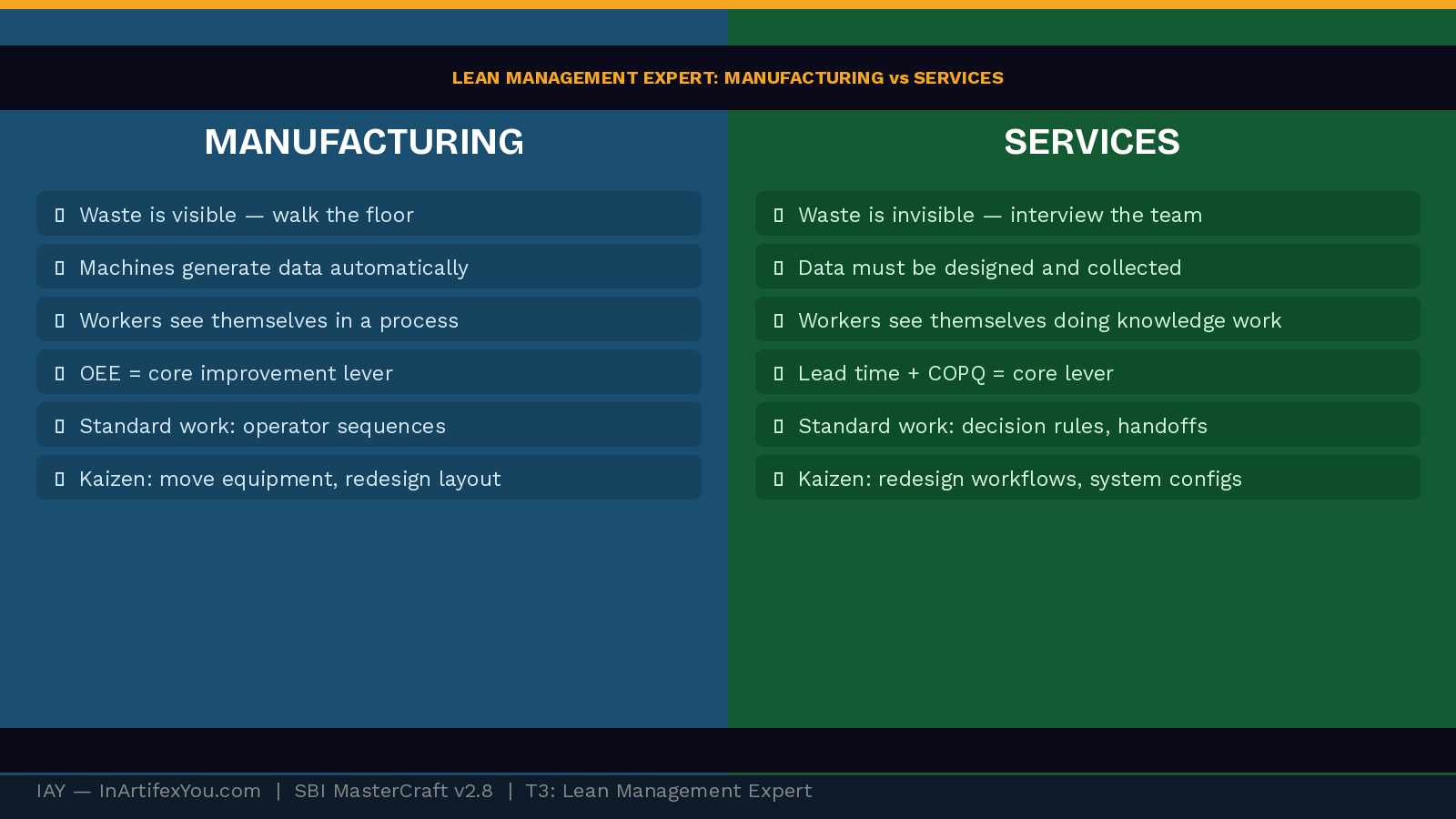
The title Lean Management Expert implies mastery of the methodology. But methodology is context-neutral. Application is not. A practitioner who has only worked on production floors will find the transition to service environments genuinely difficult — not because the tools change, but because the problems are harder to see.
What Changes: The 3 Critical Differences
|
WHAT YOU SAY (Lean language) We improved OEE by 12 points. We completed a DMAIC project on line 3. We ran a Kaizen event in the warehouse. FPY went from 91% to 97%. We reduced DPMO from 15,000 to 3,200. |
WHAT THEY HEAR (Business language) Production capacity increased by 12% — equivalent to adding half a shift without headcount. We eliminated $180K in annual scrap on Line 3 — verified by Finance on March 12. Warehouse picking errors dropped 60% — customer complaints from that area are down to zero. We recovered $240K per year in rework costs on that product line. Defect rate dropped 79% — COPQ on that process went from $95K to $20K annually. |
The Hidden Factory Problem
In manufacturing, every defective part is eventually counted — either as scrap, rework, or a customer return. In services, the equivalent failure often disappears into informal correction loops. A claims processor who fixes 30% of submissions before sending them has built a hidden factory — an unofficial rework operation that never appears on any dashboard.
The Lean Management Expert's first job in a service environment is not running a Kaizen event. It is building the measurement system that makes the hidden factory visible. Without that, every improvement is anecdotal.
Facilitation: The Biggest Real Difference
In manufacturing, Lean tools have visual, physical analogs. A spaghetti diagram of operator motion is immediately understood by anyone who has worked on a production floor. In services, the Lean Expert must translate:
- Value Stream Mapping becomes a swim-lane diagram of information flow — one lane per department, handoffs highlighted.
- 5S becomes digital file organization, email protocol standardization, shared drive structure.
- Kanban becomes a visual queue management system — often digital — for service request handling.
- Standard work becomes documented decision rules: 'If X condition, then Y action' — not operator step sequences.
What Does Not Change
The PDCA cycle is the same. Respect for people is the same. The relentless focus on customer value is the same. The discipline of measuring before improving and controlling after improving is the same.
FPY Formula
FPY = (Units Completed Without Rework ÷ Total Units Started) × 100.
Track at the process level first, not the plant
level. A plant-level FPY of 94% may hide a single process step running at 70% —
which is your highest-priority improvement target.
- Awareness: Can explain the concept and its purpose.
- Working Knowledge: Can apply with guidance or reference material.
- Proficient: Can apply independently in real situations.
- Expert: Can teach, coach, and adapt to novel situations.
Rate yourself on each skill above. For any gap below your minimum LME level: identify one project in your current pipeline where you can close that gap. Skills develop in projects, not classrooms.