Lean office vs shop floor: adapting tools to knowledge
work
Every Lean tool designed for the shop floor has a direct equivalent in knowledge work. Value Stream Mapping becomes swim-lane process mapping, tracing information flow instead of material flow. 5S becomes digital file organization, shared drive structure, and email management protocols. Kanban becomes a visual task queue — often a digital board — that makes work-in-progress visible and limits overload. Standard work becomes documented decision rules and handoff protocols rather than operator task sequences. Kaizen events become structured process improvement workshops where knowledge workers redesign their own workflows. The principles are identical: eliminate waste, create flow, establish pull, pursue perfection. The adaptation requires one key mindset shift — in knowledge work, the product is information, not a physical unit, and information waste is harder to see but equally expensive.
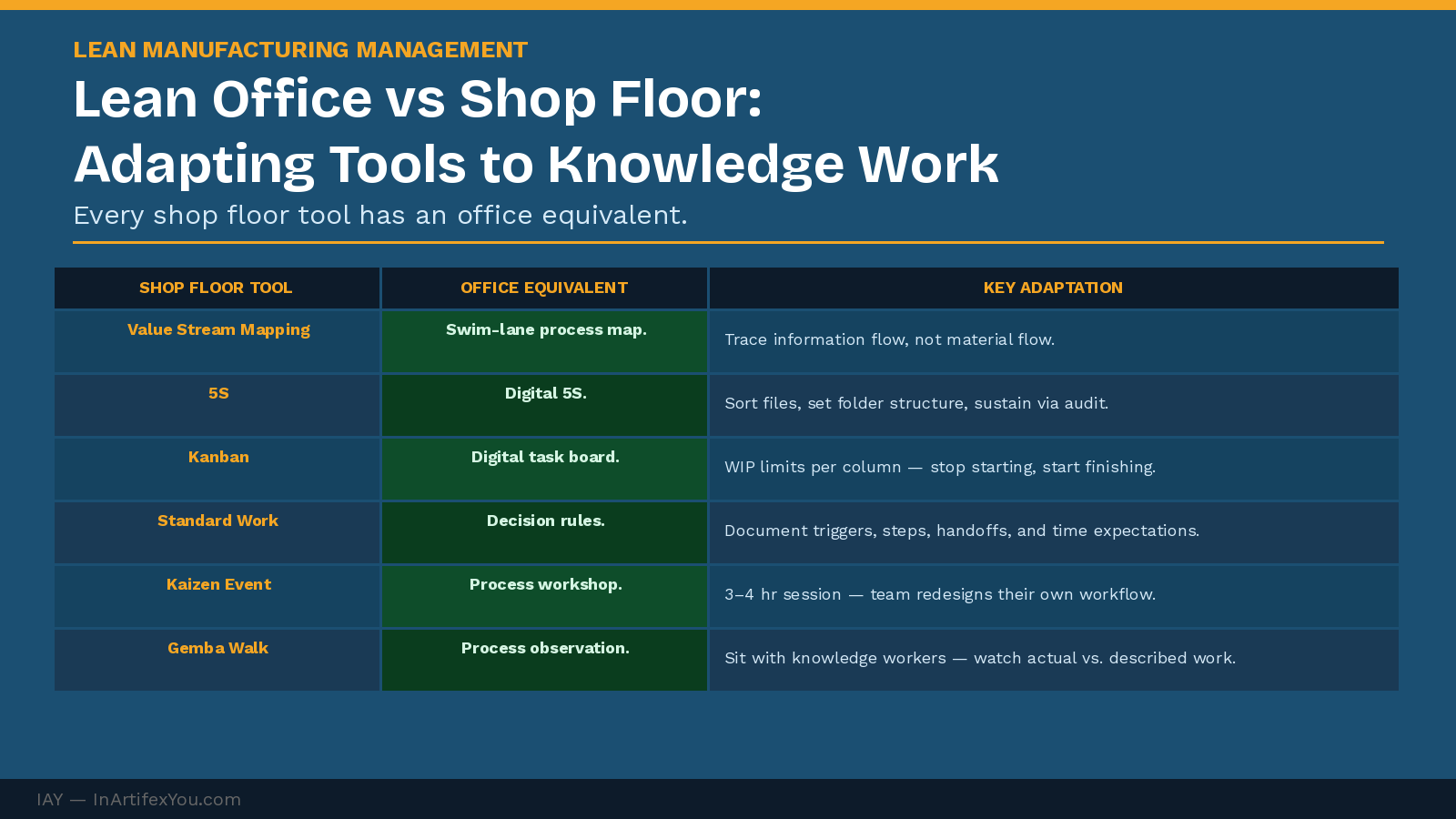
The most common objection to Lean in office and knowledge work environments is: 'We are not a factory.' It is true that knowledge workers do not produce physical units on a production line. But they do produce outputs — documents, decisions, approvals, analyses, responses — and every one of those outputs passes through a process that has waste embedded in it.
The Lean management practitioner's job is to help knowledge workers see their work as a process — and then improve it using the same principles that work on the shop floor.
Tool-by-Tool Adaptation Guide
|
Shop Floor Tool |
Office/Knowledge Work Equivalent |
Key Adaptation |
|
Value Stream Mapping. |
Swim-lane process map. |
Trace information flow instead of material flow — one lane per department, handoffs highlighted. |
|
5S. |
Digital 5S. |
Sort files, set folder structures, shine shared drives, standardize naming conventions, sustain through audit. |
|
Kanban. |
Digital task board. |
Use columns for workflow stages (To Do / In Progress / Review / Done), set WIP limits per column. |
|
Standard Work. |
Decision rules + handoff protocols. |
Document: trigger, steps, decision points, output format, recipient, and time expectation. |
|
Kaizen Event. |
Process improvement workshop. |
3–4 hour structured session where the team maps, analyzes, and redesigns a specific workflow. |
|
Gemba Walk. |
Process observation. |
Sit with knowledge workers for 30 minutes — observe the actual work, not the reported work. |
|
Visual Management. |
Dashboard and status boards. |
Make team workload, project status, and performance visible in a shared digital or physical space. |
Digital 5S: The Most Underused Lean Office Tool
Physical 5S transforms a cluttered workstation into an organized one. Digital 5S does the same for shared drives, inboxes, and project management systems — which are the 'workstations' of knowledge workers.
- Sort: delete or archive files that are no longer active — apply a one-year rule.
- Set in order: establish a logical folder structure that anyone can navigate without a guide.
- Shine: clean up file names, remove duplicates, and update outdated documents.
- Standardize: document the folder structure and naming convention so new team members follow it.
- Sustain: conduct a quarterly digital 5S audit — assign ownership per folder or shared drive.
Kanban for Knowledge Work: Setting WIP Limits
The most powerful aspect of knowledge work Kanban is not the visual board — it is the WIP limit. When a knowledge worker has 12 tasks 'in progress' simultaneously, they have no tasks truly in progress. WIP limits force prioritization and expose the real bottleneck.
Recommended WIP Limits for Knowledge Work
Individual contributor: maximum 3 tasks in progress simultaneously.
Team Kanban board: maximum WIP per column = number of team members + 1.
Project portfolio: maximum active projects per practitioner = 4.
When WIP exceeds the limit: stop starting, start finishing.
The Gemba Walk for Knowledge Work
The shop floor Gemba walk means going to where the work happens and observing it directly. In knowledge work, the equivalent is sitting with the person doing the work — not asking them to describe it in a meeting — and watching what actually happens versus what the process map says should happen.
Thirty minutes of direct observation of a knowledge worker doing their actual job reveals more improvement opportunities than two hours of process mapping from memory.
Back to hub: Lean Manufacturing Management.
- Lean management in office vs shop floor: what actually changes.
- Leader standard work: daily/weekly cadence examples.
- Policy deployment (Hoshin): aligning Lean with strategy.
🔗 INTERNAL LINK SUGGESTIONS
|
||||||||||||||||||||||
The Continuous Improvement Certification at InArtifexYou gives you a complete, practical system to map, baseline, improve, and sustain any process — and the verified credential to prove you can lead it.
inartifexyou.com/continuous-improvement-certification-online.html |
||||||||||||||||||||||
|
||||||||||||||||||||||
|
IAY — InArtifexYou.com | SBI MasterCraft v2.8 | T3: Lean Manufacturing Management |