Portfolio of improvement projects: selecting and
sequencing
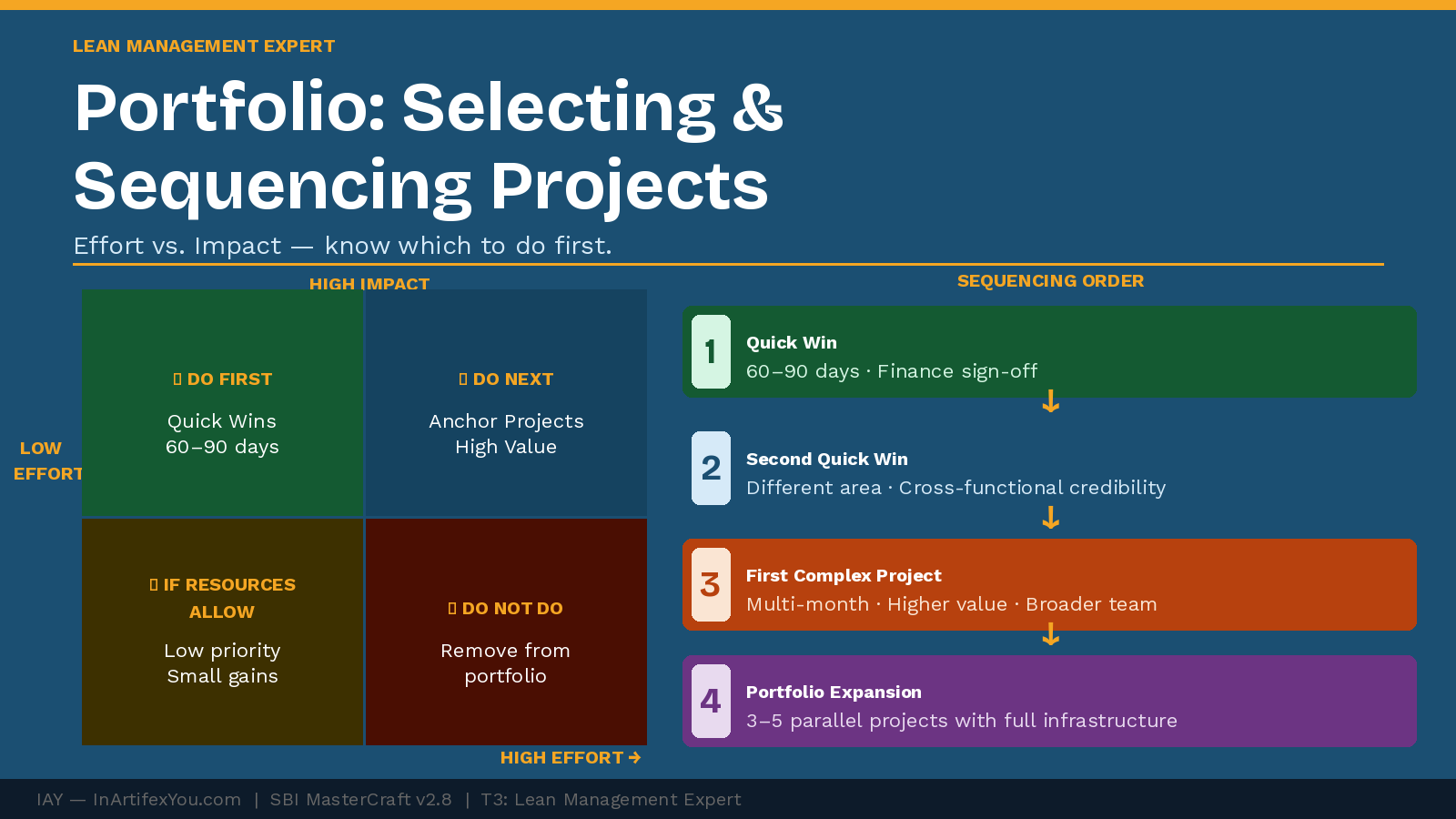
Selecting and sequencing a Lean improvement portfolio requires balancing four factors: strategic alignment (does this project support a company objective?), financial impact (what is the estimated COPQ reduction or capacity gain?), implementation feasibility (does the team have the data, authority, and time to execute?), and speed to first result (how quickly can a visible win be achieved?). The standard sequencing principle for a new Lean program is: quick wins first, complex projects second. A quick win is a project that can be completed in 60–90 days with measurable financial impact — enough to demonstrate momentum and earn continued sponsorship. Complex, high-value projects follow once credibility is established. Never start a Lean program with a multi-month, cross-functional project. The first win is a credibility investment, not just a financial one.
A Lean Management Expert who runs the wrong projects first — regardless of how well they are executed — will struggle to sustain sponsorship. Project selection is a strategic decision, not an administrative one.
The Four Selection Criteria
Every candidate improvement project should be evaluated against four criteria before it enters the active portfolio:
|
KPI |
What It Measures |
Starting Benchmark |
World-Class Target |
|
OEE (Overall Equipment Effectiveness). |
Availability × Performance × Quality rate. |
45–65% for most plants. 85%+. |
— must be able to facilitate. |
|
First-Pass Yield (FPY). |
% of units completed without defects or rework. |
Varies — establish current state first. |
95%+. . |
|
Cycle Time. |
Average time to complete one production unit. |
Measure current state over 25+ cycles. |
Continuously improving. |
The Effort vs. Impact Matrix
Plot every candidate project on a 2x2 matrix: effort on the horizontal axis (low to high), impact on the vertical axis (low to high). The four quadrants tell you where to start:
FPY Formula
FPY = (Units Completed Without Rework ÷ Total Units Started) × 100.
Track at the process level first, not the plant
level. A plant-level FPY of 94% may hide a single process step running at 70% —
which is your highest-priority improvement target.
- Awareness: Can explain the concept and its purpose.
- Working Knowledge: Can apply with guidance or reference material.
- Proficient: Can apply independently in real situations.
- Expert: Can teach, coach, and adapt to novel situations.
Rate yourself on each skill above. For any gap below your minimum LME level: identify one project in your current pipeline where you can close that gap. Skills develop in projects, not classrooms.
The Standard Sequencing Principle
For a new Lean program — or a new Lean Management Expert joining an organization — the sequencing principle is non-negotiable:
1. Quick win first (60–90 days, measurable financial impact, finance sign-off)
2. Second quick win in a different area (builds cross-functional credibility)
3. First complex project (multi-month, higher value, broader team involvement)
4. Portfolio expansion (run 3–5 projects in parallel once infrastructure is established)
The quick win is not chosen for its financial value alone. It is chosen because it can be completed fast enough to demonstrate momentum before anyone questions the investment.
Portfolio Size: How Many Projects at Once?
Portfolio size depends on available resources and organizational readiness. Use these benchmarks:
- Solo Lean practitioner: 3–4 active projects maximum — beyond this, quality of facilitation declines.
- Small Lean team (2–4 people): 6–10 active projects — assign project ownership clearly.
- Embedded Lean department (5+ people): 15–25 active projects — requires a formal project management system.
A portfolio with too many projects and no completed ones is a credibility risk. The Lean Management Expert's job is not to launch projects — it is to close them with documented results.
The Pipeline Discipline
For every project that closes, two candidates should be ready to enter the pipeline. The Lean Management Expert who always has a full pipeline signals to leadership that improvement is systemic — not dependent on their constant project hunting.
Maintain a ranked backlog of 10–15 candidate projects at all times. Review it quarterly with your sponsor. Let the business strategy update the ranking.