Skill matrix for a Lean Management Expert (tools,
facilitation, analytics)
A Lean Management Expert skill matrix covers three domains: technical tools (VSM, SMED, TPM, Kaizen, 5S, kanban, standard work, A3 problem solving), facilitation (Kaizen event design, team coaching, change management, conflict resolution, executive communication), and analytics (SPC, Minitab/Excel-based statistical analysis, COPQ calculation, capability analysis, dashboard design). Proficiency is rated on a four-level scale: Awareness (can explain), Working Knowledge (can apply with guidance), Proficient (can apply independently), Expert (can teach and coach). A Lean Management Expert should be Proficient to Expert across all core tools, Proficient in facilitation, and Working Knowledge to Proficient in analytics. The gap between a Lean Analyst and a Lean Management Expert is almost always in facilitation — not tools knowledge.
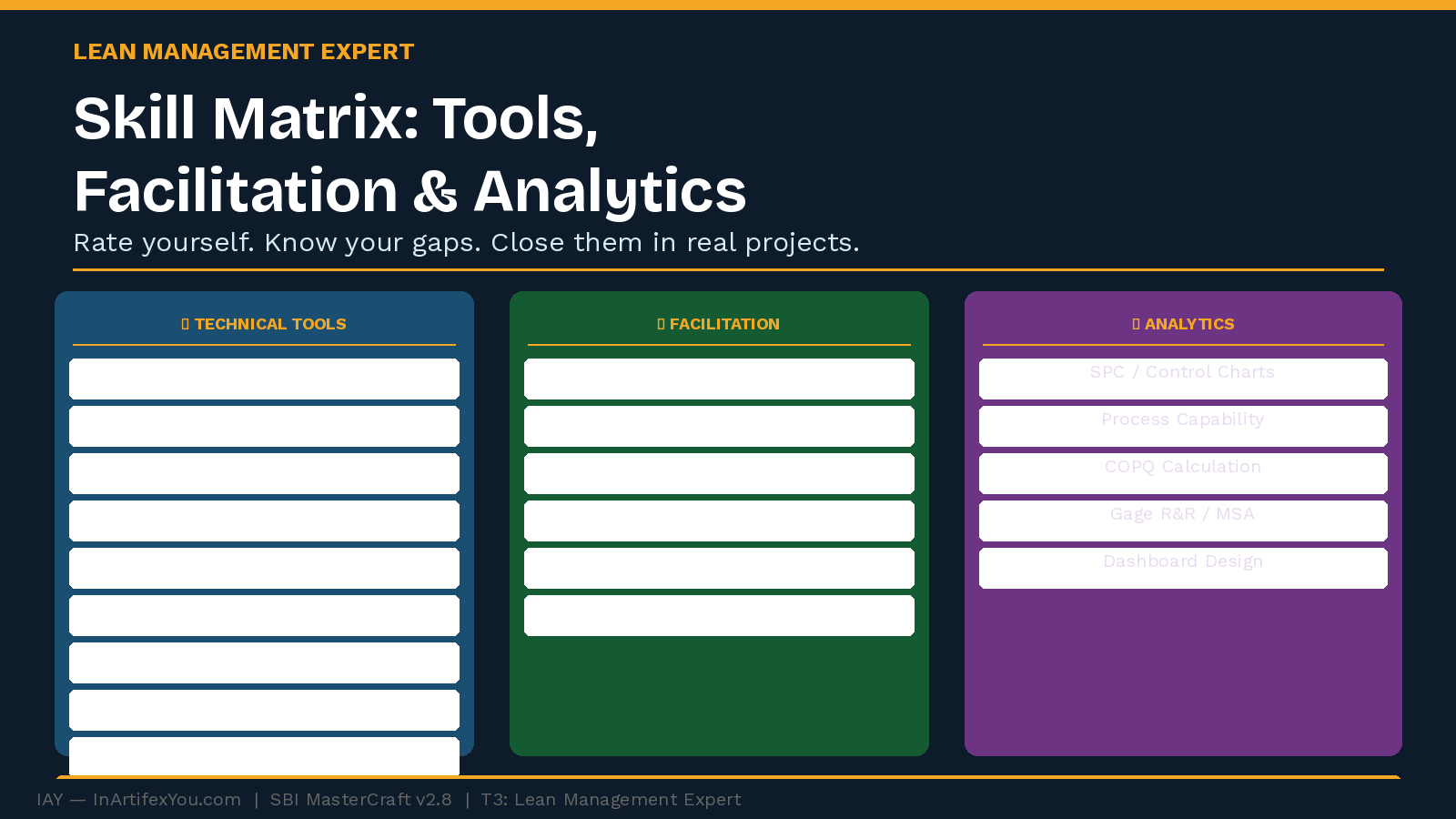
A credential certifies knowledge. A skill matrix reveals capability. The Lean Management Expert who can answer — for every relevant skill — not just 'do I know this?' but 'can I apply this independently, and can I teach it?' is the practitioner who advances.
Domain 1: Technical Lean Tools
|
KPI |
What It Measures |
Starting Benchmark |
World-Class Target |
|
OEE (Overall Equipment Effectiveness). |
Availability × Performance × Quality rate. |
45–65% for most plants. 85%+. |
— must be able to facilitate. |
|
First-Pass Yield (FPY). |
% of units completed without defects or rework. |
Varies — establish current state first. |
95%+. . |
|
Cycle Time. |
Average time to complete one production unit. |
Measure current state over 25+ cycles. |
Continuously improving. |
Domain 2: Facilitation Skills
This is the domain that separates Lean Management Experts from Lean Analysts. Technical knowledge is table stakes. Facilitation is what creates organizational change.
- Kaizen event design — structuring a 3–5 day event with clear objectives, team composition, pre-work, and daily PDCA rhythm.
- Team coaching — helping individuals apply tools independently after the event.
- Change management — addressing resistance, building psychological safety, connecting improvement to personal benefit.
- Conflict resolution — managing disagreement in cross-functional settings without losing momentum.
- Executive communication — translating technical results into financial and strategic language (see: Executive Reporting page).
- Training design — building 1–4 hour training modules that transfer skill, not just awareness.
Domain 3: Analytics
A Lean Management Expert does not need to be a statistician. They need to be a competent data interpreter — able to analyze process performance, identify patterns, and communicate findings without requiring a data analyst to mediate.
- Statistical Process Control — reading control charts, identifying special vs. common cause variation, determining when to act.
- Process Capability Analysis — calculating Cp, Cpk, and interpreting what the numbers mean for the process.
- COPQ Calculation — building the financial case for improvement with credible cost data.
- Measurement System Analysis (Gage R&R) — verifying that the measurement system is reliable before trusting the data.
- Dashboard design — building one-page visual reports that communicate performance to non-technical audiences.
Using the Skill Matrix for Development Planning
FPY Formula
FPY = (Units Completed Without Rework ÷ Total Units Started) × 100.
Track at the process level first, not the plant
level. A plant-level FPY of 94% may hide a single process step running at 70% —
which is your highest-priority improvement target.
- Awareness: Can explain the concept and its purpose.
- Working Knowledge: Can apply with guidance or reference material.
- Proficient: Can apply independently in real situations.
- Expert: Can teach, coach, and adapt to novel situations.
Rate yourself on each skill above. For any gap below your minimum LME level: identify one project in your current pipeline where you can close that gap. Skills develop in projects, not classrooms.