TQM structure and the Deming Cycle: how PDCA drives
continuous improvement
The Deming Cycle, also known as PDCA (Plan-Do-Check-Act), is the operational engine of continuous improvement in TQM — the mechanism that makes improvement a repeating cycle rather than a one-time event. Plan: identify an opportunity for improvement, analyze the current situation, and develop a plan with specific objectives and measurable targets. Do: implement the plan on a small scale — a pilot, a trial run, or a limited deployment — to test the approach before committing to full implementation. Check: measure the results of the pilot against the plan objectives using data — not opinion. Identify what worked, what did not, and why. Act: if the pilot produced the expected results, standardize the improvement and implement it fully. If it did not, revise the plan and run another cycle. The cycle never ends — each Act stage feeds the next Plan stage, producing a continuous upward spiral of improvement.
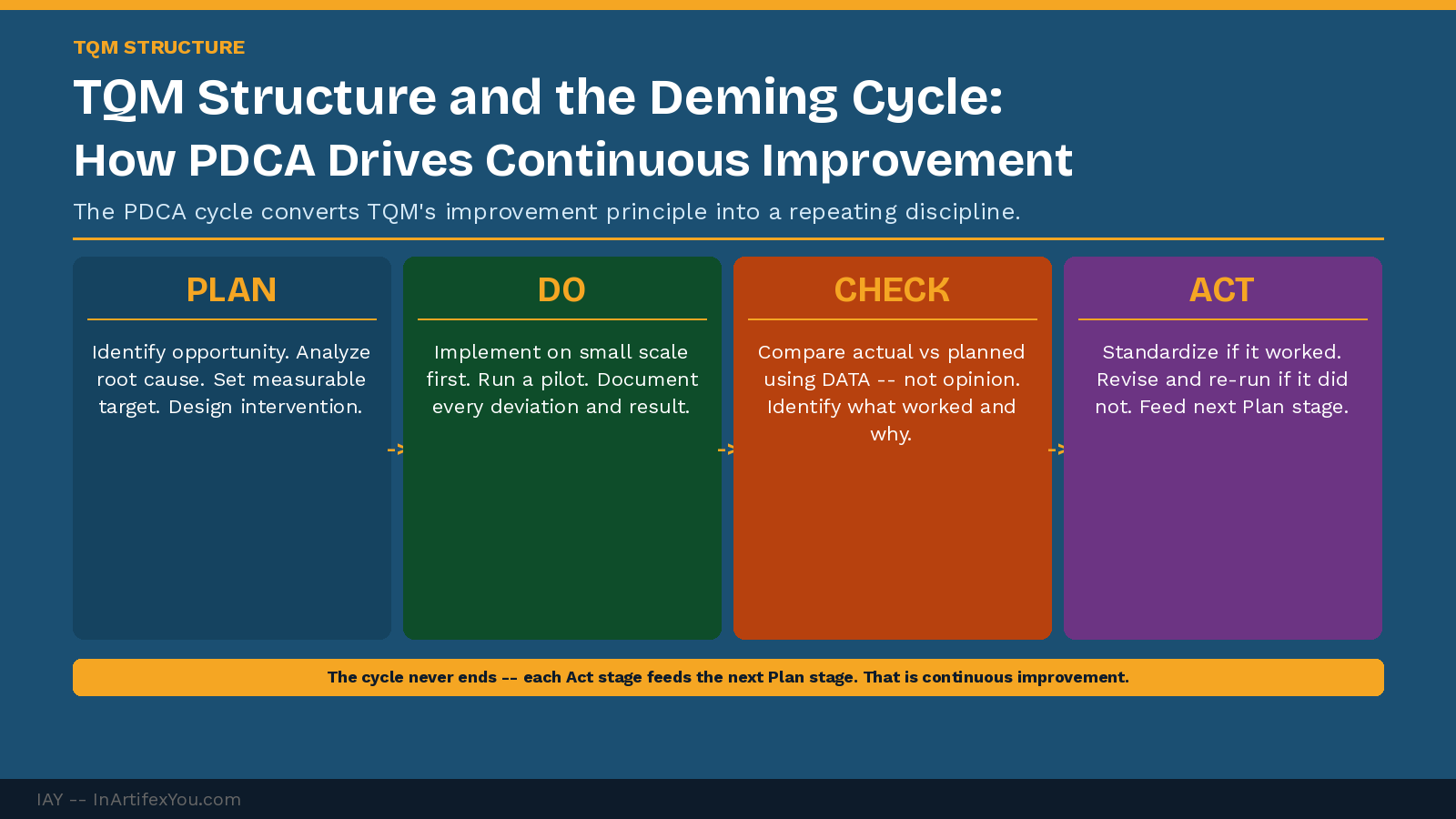
The TQM structure and the Deming Cycle are inseparable — the Deming Cycle is named after Dr. W. Edwards Deming, who introduced PDCA to Japanese manufacturers in the 1950s as the systematic engine that converts TQM's continuous improvement principle into measurable results. Without it, improvement remains an aspiration. With it, improvement becomes a discipline.
Stage 1: Plan
The Plan stage is the most important and most frequently rushed. Organizations that skip rigorous planning produce interventions that address symptoms rather than root causes — and cycle back to the same problems in the next improvement cycle.
- Define the problem specifically: what is happening, at what rate, in which process, and what is the impact on quality, cost, or customer satisfaction?
- Analyze root causes: use 5 Whys, fishbone diagram, or fault tree analysis to identify the true cause — not just the visible symptom.
- Set a measurable objective: 'reduce defect rate from 2.3% to below 1.0% by end of Q3' is a plannable objective. 'Improve quality' is not.
- Design the intervention: what specific change will be made, by whom, in what process, and how will results be measured?
Stage 2: Do
The Do stage implements the plan on a limited scale first. The pilot approach is fundamental to PDCA discipline: it prevents large-scale implementation of an untested solution and provides the data needed for the Check stage.
Pilot Design Principles
Run the pilot long enough to capture meaningful data — at least one full production cycle or 30 days, whichever is longer.
Keep conditions as close to normal as possible — a pilot run under special conditions produces results that cannot be replicated at scale.
Document everything: every deviation from the plan, every unexpected result, every operator observation.
Stage 3: Check
The Check stage compares actual results against planned objectives using data collected during the Do stage. This is where most PDCA cycles fail — the Check stage is replaced by an opinion-based assessment of whether the pilot seemed to work.
- Compare actual performance metrics against the planned targets defined in Stage 1.
- Analyze the gap between planned and actual — whether positive or negative, the gap reveals information about the intervention.
- Identify what worked, what did not work, and what was unexpected — all three are inputs to the Act stage.
Stage 4: Act
The Act stage makes the decision about what to do next based on what the Check stage revealed:
|
IF THE PILOT SUCCEEDED Standardize the improvement: update work instructions and training. |
IF THE PILOT FAILED Revise the plan based on what the Check stage revealed. |
| ||||||||||||||||||||||
The Continuous Improvement Certification at InArtifexYou gives you a complete, practical system to map, baseline, improve, and sustain any process — and the verified credential to prove you can lead it.
inartifexyou.com/continuous-improvement-certification-online.html | ||||||||||||||||||||||
|