What is Total Quality Management? Definition and core
principles
Total Quality Management (TQM) is an organization-wide approach to continuous improvement that focuses every function, process, and person on delivering quality to the customer. It is not a program or a department — it is a management philosophy that makes quality the responsibility of everyone in the organization, not just the quality control team. The eight core principles of TQM are: customer focus, total employee involvement, process-centered thinking, integrated systems, strategic and systematic approach, continual improvement, fact-based decision making, and communications. TQM originated in post-war Japan through the work of W. Edwards Deming and Joseph Juran, and was later adopted by Western manufacturing in the 1980s. Today it underpins ISO 9001, Six Sigma, and Lean — making it the foundational framework behind most modern quality and improvement methodologies
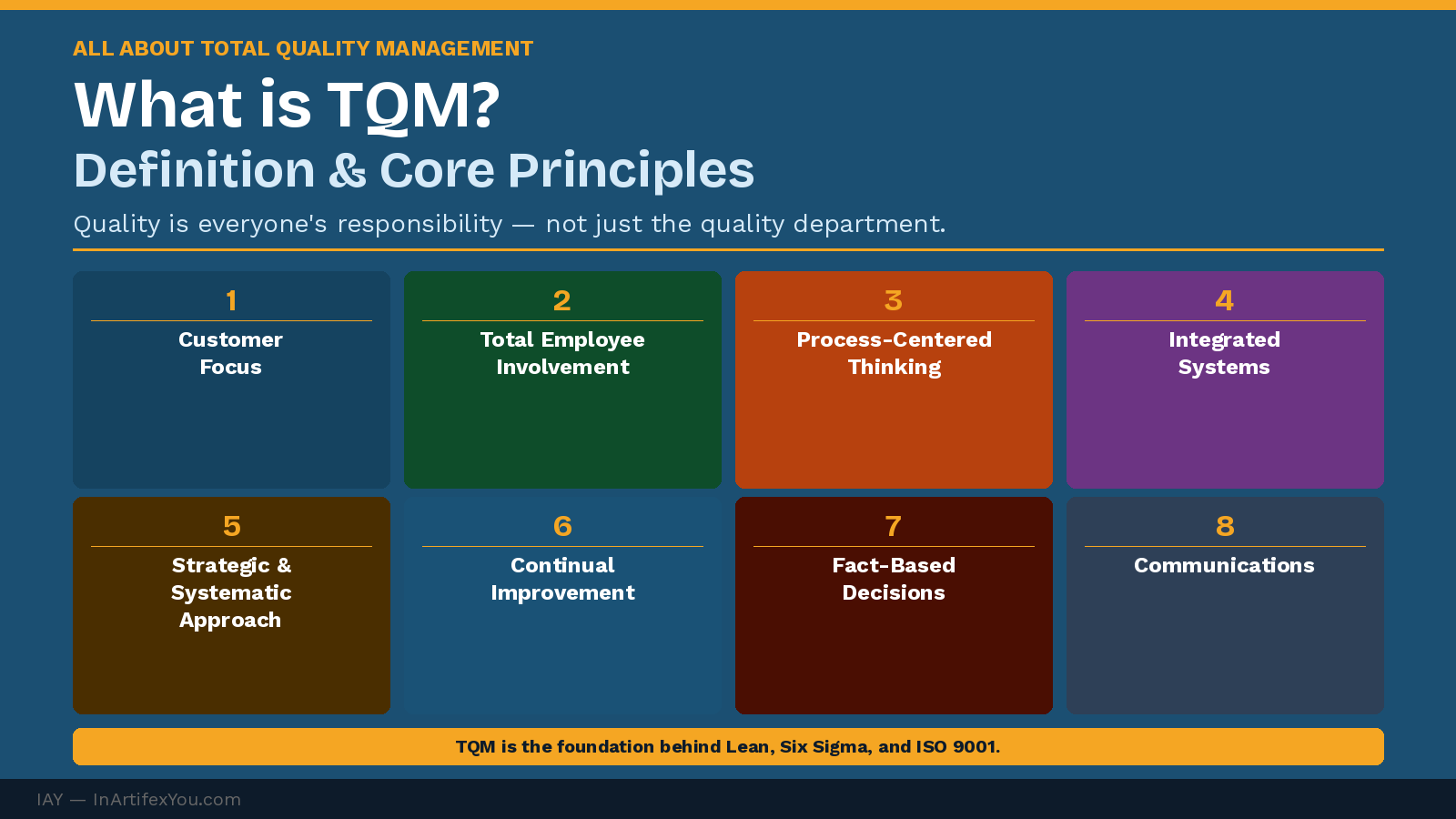
Total Quality Management is one of those terms that appears in nearly every quality and operations curriculum — but is rarely explained with the precision it deserves. Understanding TQM at the principle level is essential for any practitioner because it is the conceptual foundation that makes Lean, Six Sigma, ISO 9001, and continuous improvement coherent as a unified approach rather than a collection of disconnected tools.
The Definition
TQM is a management approach that seeks to optimize all organizational functions — from production to customer service to finance — by focusing them on quality outcomes for the customer. The word 'total' is the key: quality is not the responsibility of the quality department. It is the responsibility of every person, in every process, at every level of the organization.
The Eight Core Principles
|
Principle |
What It Means in Practice |
|
1. Customer Focus. |
Every decision is evaluated against its impact on customer value. |
|
2. Total Employee Involvement. |
Quality improvement is everyone's job — not just quality control. |
|
3. Process-Centered Thinking. |
Results come from processes — improve the process to improve the output. |
|
4. Integrated Systems. |
All departments are connected — a quality problem in one affects all. |
|
5. Strategic & Systematic Approach. |
Quality goals are embedded in organizational strategy and planning. |
|
6. Continual Improvement. |
There is no final state — every process can always be improved. |
|
7. Fact-Based Decision Making. 8. Communications. |
Decisions are driven by data, not opinion or seniority. Clear, consistent communication sustains quality culture at every level. |
TQM vs. Quality Control: The Critical Distinction
|
QUALITY CONTROL Inspects outputs after production. Finds defects — does not prevent them. Responsibility: quality department. Focus: detecting non-conformance. Result: defects are caught and removed. |
TOTAL QUALITY MANAGEMENT Designs quality into the process. Prevents defects before they occur. Responsibility: every person and function. Focus: eliminating root causes. Result: the process cannot produce defects. |
Why TQM Still Matters
TQM is sometimes dismissed as an older framework superseded by Six Sigma or Lean. This misunderstands the relationship. Six Sigma and Lean are TQM methodologies — they operationalize specific TQM principles using structured tools and statistical methods. ISO 9001 is a TQM-based standard. The Baldrige Performance Excellence Program is a TQM framework.
A practitioner who understands TQM at the principle level can apply any quality or improvement methodology more effectively — because they understand why the tools exist, not just how to use them.
The Practitioner's Perspective
TQM is not a checklist. It is a way of thinking about organizations — as systems of interconnected processes, each of which can be improved, measured, and aligned to customer value.
Every Lean or Six Sigma tool you apply is a TQM principle in action.
Back to hub: All About Total Quality Management.
- Does Total Quality Management work? Evidence and results.
- TQM vs Six Sigma: what is the difference?
- How to implement TQM step by step.
🔗 INTERNAL LINK SUGGESTIONS
|
||||||||||||||||||||||
The Continuous Improvement Certification at InArtifexYou gives you a complete, practical system to map, baseline, improve, and sustain any process — and the verified credential to prove you can lead it.
inartifexyou.com/continuous-improvement-certification-online.html |
||||||||||||||||||||||
|