- Home
- Continuous Improvement Certification Online
- Advanced Lean KPI Baselines
Advanced Lean Training KPI Targets and Baselines: What to Track First
If you're doing advanced Lean work, you're past the "track everything" phase - and you're past vanity metrics. The fastest way to earn leadership trust is to:
1. Pick a small set of KPIs that actually move the business,
2. Build a baseline you can defend, and
3. Set targets that are ambitious and credible.
This page gives you a practical sequence for what to track first, what "baseline" really means, and how to set KPI targets without guessing.
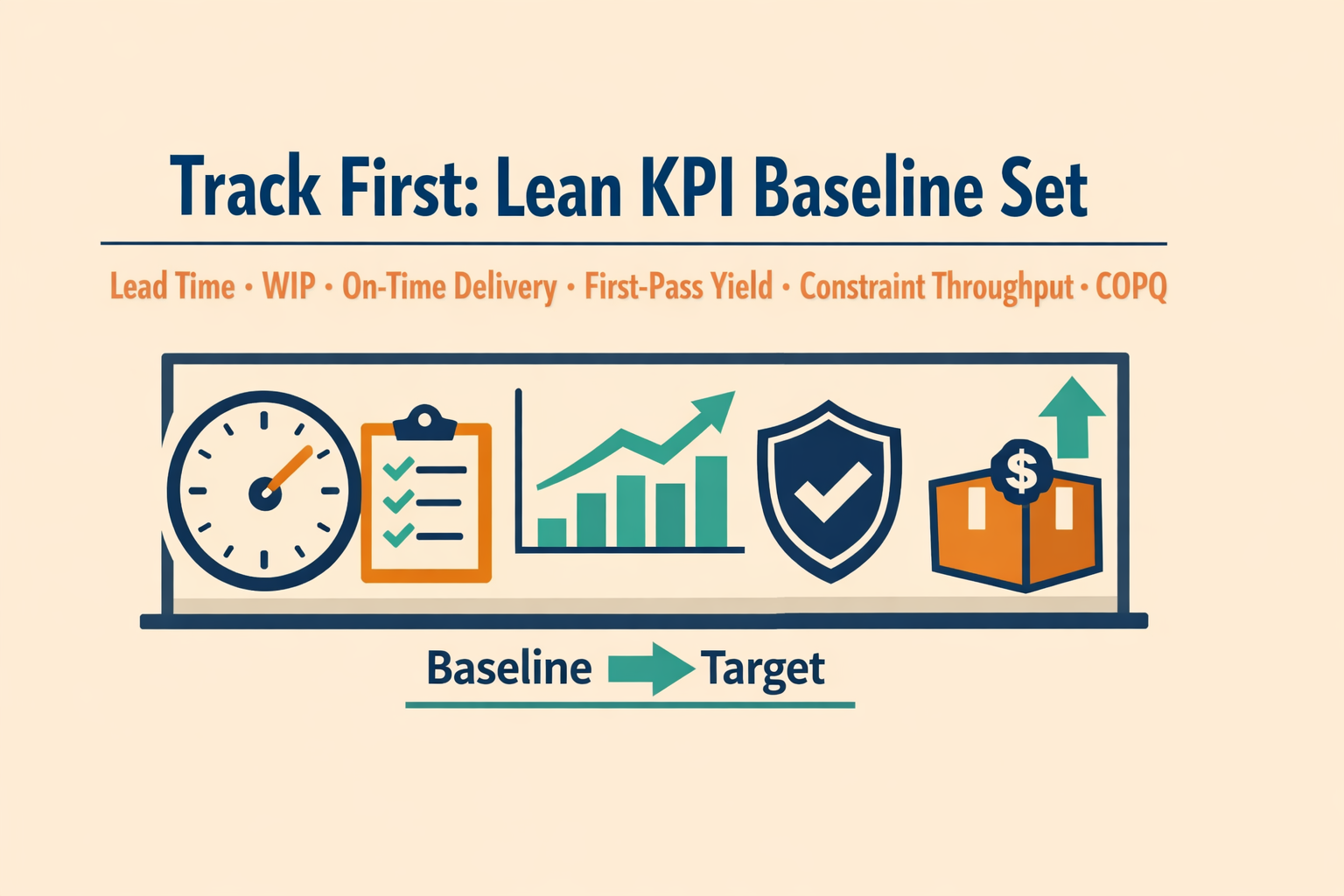
To start advanced Lean work, track a small "starter set" tied to flow and customer impact: end-to-end lead time, on-time delivery (or schedule attainment), first-pass yield/defect rate, and work-in-process (WIP). Build a baseline using 4-8 weeks of stable data (or at least 30-50 observations), with clear operational definitions and stratification by product family, shift, team, or channel. Set targets by linking to business needs (cash, capacity, service level), checking current capability (run charts/capability), and focusing improvements at the constraint step. Use realistic ranges (e.g., 15-30% lead-time reduction in the first wave, then stretch), review weekly, and adjust targets only when scope changes - not when results get uncomfortable.
The KPI logic for advanced Lean (what matters first)
Advanced Lean KPIs should answer four questions in this order:
1. Is value flowing faster? (time + WIP)
2. Is the customer getting what they need, when they need it? (delivery + quality)
3. Is the system stable and capable? (variation + rework)
4. Is the business winning? (cost + cash + capacity)
When teams skip this sequence, they often start with cost ("labor efficiency") and accidentally create local optimization: people look busy while lead time and customer pain stay the same.
What to track first: the "Lean Starter Set" (pick 5-7)
The starter set (recommended)
End-to-end lead time
· Definition: request-to-delivery (or order-to-cash), end to end
· Why first: flow is the point of Lean; lead time exposes waste immediately
WIP (work in process / queue size)
· Definition: items waiting or in progress at key steps
· Why first: WIP drives lead time and hides problems
On-time delivery / service level
· Definition: % delivered by promised date/time (define "promised" carefully)
· Why first: direct customer impact; aligns ops + commercial teams
First-pass yield (FPY) or defect rate
· Definition: % done right first time (or defects per unit/ppm)
· Why first: rework destroys flow and capacity
Rework loops / escalation rate (choose one)
· Definition: % requiring rework, returns, corrections, approvals, escalations
· Why first: tells you where variation is leaking into the system
Constraint throughput (advanced Lean "secret weapon")
· Definition: output rate at the bottleneck step (units/hour, cases/day, tickets/day)
· Why first: improving non-constraints rarely moves system results
COPQ (cost of poor quality) (if finance-ready)
· Definition: scrap + rework labor + warranty/returns + expedited shipping + concessions
· Why first: translates quality and delay into money leadership understandsOptional add-ons (only if they support your first wave)
· Changeover time (if you're fighting batching)
· OEE (only when equipment is truly the constraint and data is clean)
· Inventory turns / days of inventory (for cash + flow)
· Customer complaints / NPS drivers (when service perception is the constraint)
KPI selection rules (so you don't overload the dashboard)
Use these rules to keep KPIs tight and useful:
· One KPI per outcome category: Time, Delivery, Quality, Cost, Capacity
· 1-2 leading indicators max (e.g., WIP, constraint uptime, queue aging)
· A KPI must be actionable weekly: if you can't act on it in 7 days, it's not a steering metric
· Define ownership: every KPI has a single accountable owner (not "the team")
· Avoid composite metrics early: start simple, then mature later
How to build a baseline you can defend (fast + clean)
A baseline isn't "what last month looked like." It's a measured reference point with definitions, scope, and context.Step-by-step baseline method
1. Lock the scope
· Which value stream / product family / service line?
· Start and end points (where the clock starts/ends)
2. Write operational definitions
· Lead time: calendar time or business hours?
· OTD: promised date vs requested date vs scheduled date?
· Defect: what counts and who decides?
3. Choose the baseline window
· Ideal: 4-8 weeks of stable operations
· If operations are volatile: use the most recent stable window and document what "stable" means
4. Get enough observations
· Aim for 30-50+ data points per KPI (more is better)
· If volume is low, use weekly aggregates but keep raw detail stored
5. Stratify early
· Baseline averages can lie. Break results by what actually changes performance:
· product/service type, channel, shift/team, supplier, region, customer segment
6. Use run charts before you use averages
· Plot the KPI over time
· Look for shifts, trends, seasonality, and special causes
· Document known events (downtime, promotions, policy changes)
7. Capture baseline as a "baseline card"
· For each KPI, store:
· definition, formula, source system, data owner, frequency
· baseline window dates
· baseline value + spread (min/max or percentile)
· known exceptions
Deliverable you want: a one-page baseline card per KPI that makes debate unnecessary.
Setting targets (credible, not wishful)
Targets should come from business need + capability + constraint focus, not hope.Target-setting ladder (use in this order)
1. Business need: What must improve for revenue, cash, capacity, or customer promise?
2. Voice of the customer: What service level or defect level is required?
3. Current capability: How capable is the process today (variation, stability, rework)?
4. Constraint leverage: If we improve only one step, which step moves the whole system?
5. Feasibility & timebox: What can the team realistically change in 30/60/90 days?Practical target patterns (typical starting ranges)
These are not guarantees - use them as planning bands for the first improvement wave:
· Lead time: 15-30% reduction in the first wave (often more once batching is attacked)
· WIP: 10-25% reduction (paired with pull limits)
· OTD/service level: +5 to +15 percentage points (if baseline is unstable)
· FPY/defects: 20-50% reduction in defect rate when top rework drivers are known
· Constraint throughput: +5-15% without major capex when waste at the bottleneck is removed
· COPQ: 10-30% reduction when rework and warranty are measurable and attackedDon't set targets without these two guardrails
· Guardrail 1: quality must not decline while chasing speed
· Guardrail 2: safety/compliance must not be traded for output
KPI review cadence (how advanced teams run it)
Weekly (30 minutes): "Flow & stability huddle"
· Lead time trend, WIP trend, OTD trend, FPY/defects trend
· Top 1-3 causes of misses + countermeasures (not explanations)
Monthly (60-90 minutes): "Business impact review"
· COPQ, capacity gained, backlog/aging, customer escalations
· Validate whether the constraint has moved
Quarterly: "Target refresh"
· Reconfirm scope, adjust targets only for scope changes or step-change learning
· Add/remove KPIs only if a KPI is no longer driving decisions
Common mistakes (and what to do instead)
Mistake: Starting with 20 KPIs
Do instead: Starter set + one constraint measure
Mistake: Using only averages
Do instead: Run charts + stratification
Mistake: Targets based on "industry benchmarks" with no context
Do instead: Capability + business need + constraint leverage
Mistake: Measuring OEE everywhere
Do instead: Measure it only where equipment is truly the constraint and data integrity is high
Mistake: Changing definitions mid-project
Do instead: Freeze KPI definitions for the project phase; version them if you must change
Quick-start checklist (copy/paste)
In the next 48 hours:
· Pick 1 value stream (start/end points written)
· Choose 5-7 KPIs from the starter set
· Write operational definitions (one paragraph each)
· Pull 4-8 weeks of data (or stable window)
· Create run charts for Lead Time, WIP, OTD, FPY/Defects
· Identify the constraint step and add constraint throughput
· Set 30/60/90-day targets using business need + capability
· Schedule weekly KPI huddle
Back to hub: Six Sigma
🔗 INTERNAL LINK SUGGESTIONS
Turn Lean training into measurable wins
Advanced Lean Training helps your team set clean baselines, hit KPI targets, and deliver real project outcomes in 30–90 days—faster flow, better quality, and more predictable delivery.
- Start with the right KPIs: lead time, WIP, OTD, FPY/defects, constraint throughput, COPQ
- Baseline → target system: definitions, data plan, cadence, and governance
- Project execution support: prioritize constraints, remove waste, and sustain gains