Green Belt toolkit: tests and graphs you'll actually
use
A Green Belt does not need to master every statistical tool in the Six Sigma library — just the ones that solve real problems in real projects. The core toolkit covers six areas: process mapping (SIPOC, value stream), measurement system analysis (Gage R&R), process capability (Cp, Cpk, histogram), variation analysis (Pareto chart, fishbone, multi-vari), hypothesis testing (t-test, chi-square, ANOVA), and statistical process control (X-bar R chart, I-MR chart). In most Green Belt projects, you will use the Pareto chart to focus, the fishbone to hypothesize, the t-test to confirm, and the control chart to sustain. Master those four and you cover 80% of real project needs.
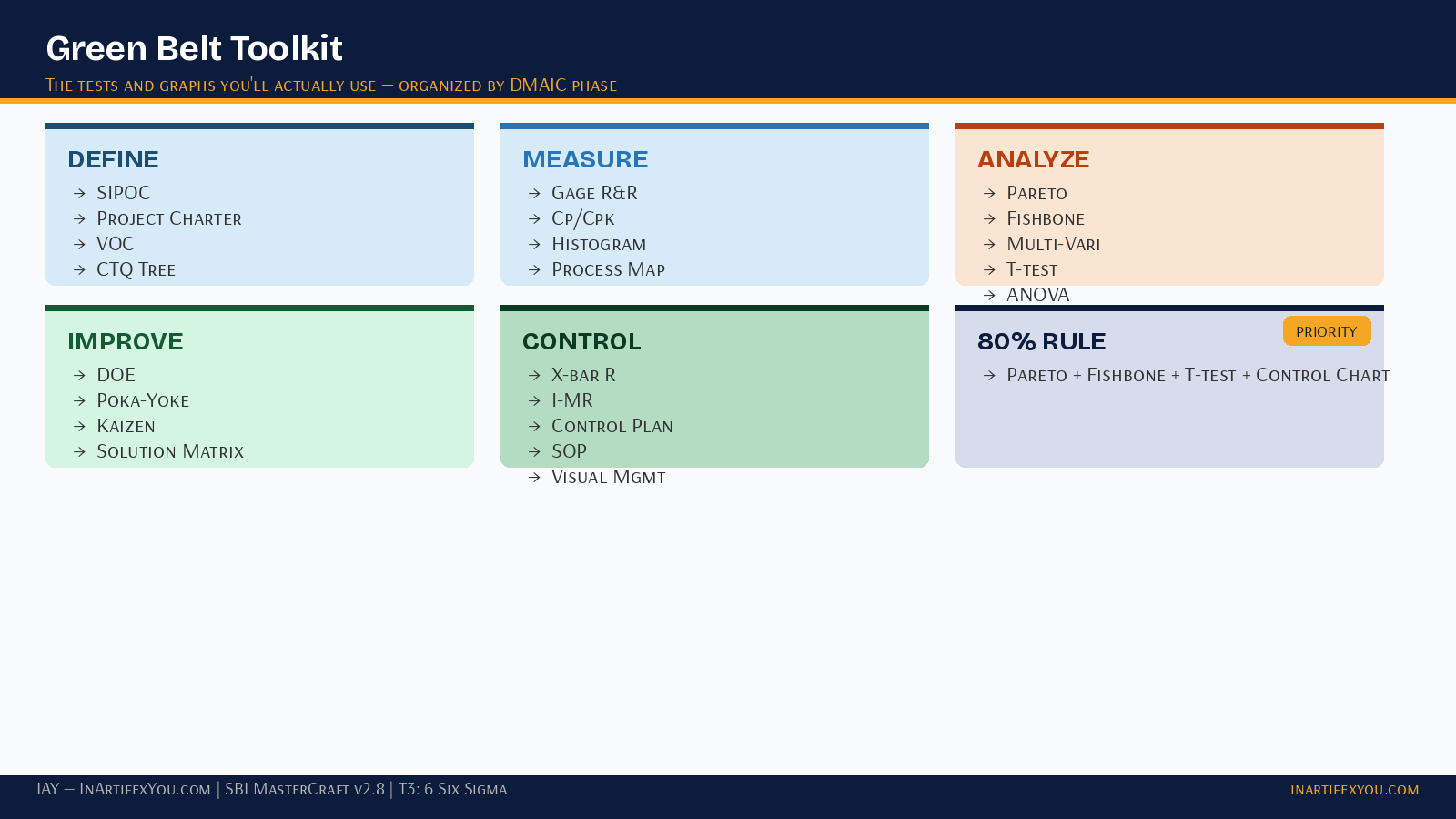
The Green Belt certification exam tests your knowledge of dozens of statistical tools. Your actual Green Belt project will use six to eight of them consistently. This page focuses on the toolkit you will reach for on every real DMAIC project — explained at the level of application, not academic theory.
Phase: Define — Tools You Will Use
• SIPOC Diagram — maps Suppliers, Inputs, Process, Outputs, Customers in one page. Use it in the Define phase to align the team on scope before touching any data.
• Project Charter — not a statistical tool, but the most important document in the project. Defines the problem statement, goal, scope, team, and timeline.
• Voice of Customer (VOC) + CTQ Tree — translates customer language into measurable Critical-to-Quality requirements that guide every subsequent decision.
Phase: Measure — Tools You Will Use
• Gage R&R (Gauge Repeatability and Reproducibility) — tests whether your measurement system is actually measuring the process, not the variation in how people measure. Run this before collecting any baseline data.
• Process Capability (Cp and Cpk) — Cp measures potential capability; Cpk measures actual capability with process centering factored in. Target Cpk ≥ 1.33 for a capable process.
• Histogram — visualizes your data distribution. Tells you if your process is normal, skewed, bimodal, or truncated — all of which affect which statistical tests you can use.
Phase: Analyze — Tools You Will Use
• Pareto Chart — ranks defect categories by frequency. The 80/20 rule in visual form. Always run this first to focus your analysis on what matters most.
• Fishbone Diagram (Ishikawa) — structured brainstorming of potential root causes organized by category: Man, Machine, Material, Method, Measurement, Environment.
• Multi-Vari Chart — identifies the dominant source of variation (positional, cyclical, or temporal) before committing to hypothesis testing.
• T-test / Chi-Square / ANOVA — hypothesis tests that confirm whether a suspected factor is statistically significant. Use t-test for comparing two means, chi-square for categorical data, ANOVA for three or more groups.
Phase: Control — Tools You Will Use
• X-bar and R Chart — the standard SPC chart for continuous data with subgroups. Plots process mean and range over time to detect shifts and trends.
• I-MR Chart (Individuals and Moving Range) — use this when data comes one point at a time (no subgroups). Common in service processes where transactions are individual.
• Control Plan — the document that defines what is measured, by whom, how often, and what to do when the process goes out of control. The bridge between the project and the operation.
The 80% Rule for Real Projects
In a survey of certified Green Belts, four tools appeared in over 80% of reported projects: the Pareto chart, the fishbone diagram, the t-test, and the control chart. Master these four at the application level — know when to use them, how to read them, and what action they imply — and you will handle the vast majority of Green Belt project work without hesitation.
The rest of the toolkit expands your capability for specific situations. Learn them when the project demands them.