Agile organizations in manufacturing vs services: what
actually changes
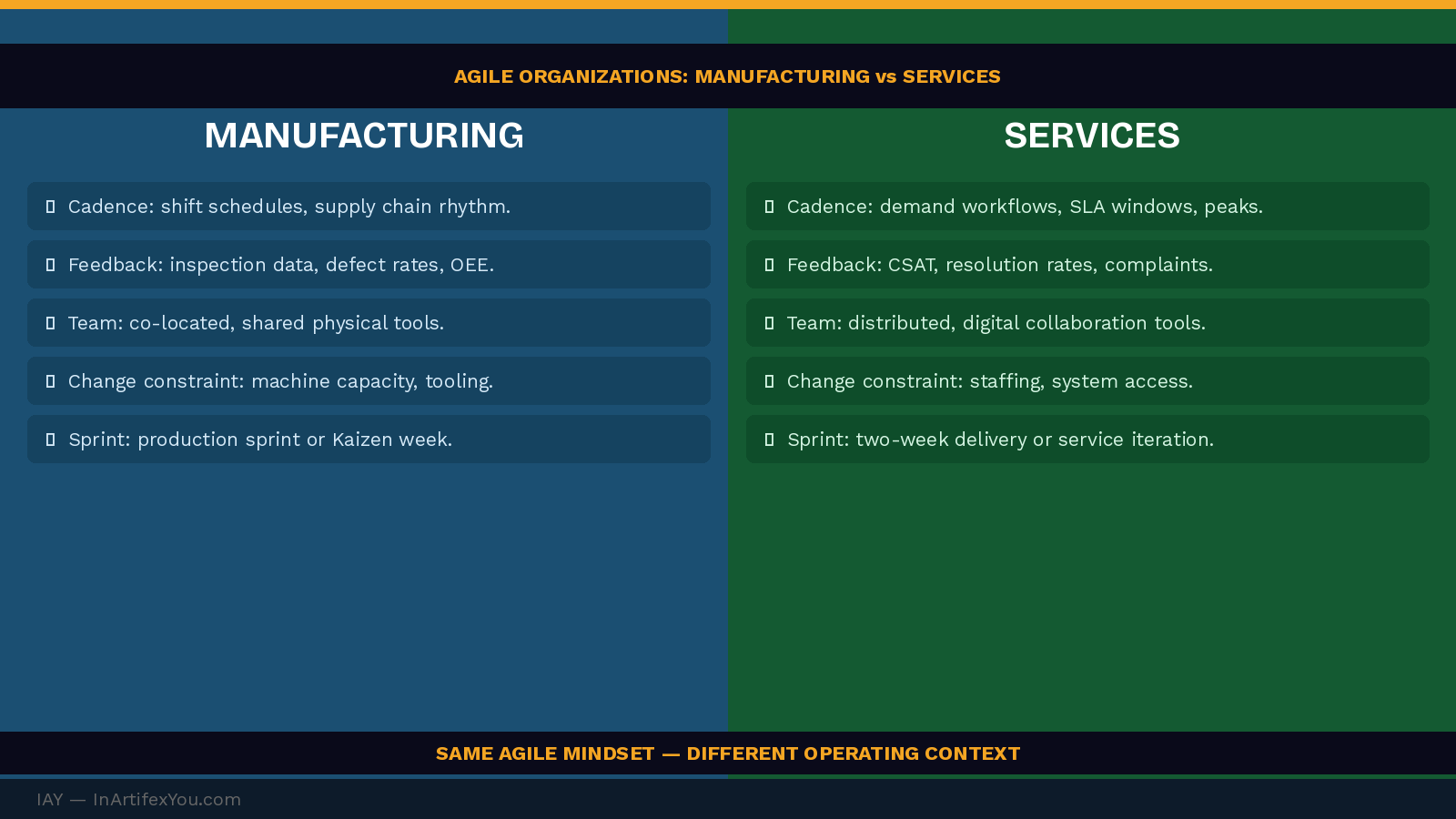
Agile organizations in manufacturing and services share the same foundational principles — iterative delivery, cross-functional teams, and rapid response to change — but differ in three fundamental ways. First, the cadence: manufacturing agility operates around physical production cycles — shift schedules, changeover sequences, and supply chain rhythms. Service agility operates around demand-driven workflows — ticket volumes, seasonal peaks, and customer interaction patterns. Second, the feedback loop: manufacturing gets quality feedback through inspection and defect data. Service organizations get feedback through customer satisfaction scores, resolution rates, and complaint patterns. Third, the team structure: agile manufacturing teams are typically co-located on the production floor with shared physical tools. Agile service teams are often distributed across locations and time zones, requiring digital collaboration infrastructure. The agile mindset is identical — the operating context defines how it is expressed.
Agile as an organizational operating model emerged from software development — a service context. Its adoption in manufacturing has required deliberate translation of principles designed for knowledge work into environments built around physical production. Understanding what changes — and what does not — is essential before launching any agile transformation.
The Three Key Differences
|
MANUFACTURING Cadence: shift schedules, production cycles, supply chain rhythm. Feedback: inspection data, defect rates, FPY, OEE. Team structure: co-located, shared physical tools and processes. Change constraint: machine capacity, tooling, material lead times. Sprint equivalent: production sprint or Kaizen week. Backlog: improvement project list, ranked by strategic value. |
SERVICES Cadence: demand-driven workflows, seasonal peaks, SLA windows. Feedback: CSAT scores, resolution rates, complaint patterns. Team structure: often distributed, digital collaboration tools. Change constraint: staffing, system access, knowledge gaps. Sprint equivalent: two-week delivery cycle or service iteration. Backlog: feature requests, service improvements, process fixes. |
Cadence: Where the Difference Is Most Visible
Manufacturing agility runs on production rhythms — shift changes, preventive maintenance windows, and supplier delivery schedules create natural cadence boundaries that agile ceremonies must work within, not around. Daily standups in a manufacturing context happen at shift start, not at 9am in a conference room.
Service agility runs on demand rhythms — a customer service team's sprint planning must account for predictable volume peaks (Monday morning ticket surge, end-of-month billing inquiries) that do not exist in the same form on a production floor.
Feedback Loops: Speed and Signal Type
Manufacturing feedback is relatively fast and quantitative — a defective part is caught at inspection within the same shift it was produced. A process running out of control generates an SPC signal within hours.
Service feedback is slower and more qualitative — a customer who received poor service may not complain immediately, and when they do, the feedback arrives through channels (reviews, surveys, escalation calls) that require interpretation before they can drive improvement.
THE PRACTICAL IMPLICATION
Manufacturing agile teams can run shorter retrospectives with harder data.
Service agile teams need longer retrospectives and more qualitative synthesis to surface the same quality of insight.
What Does Not Change
The core practices that define agile organizations are environment-agnostic: cross-functional teams with shared accountability, iterative delivery in short cycles, visible work and explicit WIP limits, regular retrospectives that drive genuine process improvement, and leadership that removes obstacles rather than directing tasks.
These practices produce better organizations in both manufacturing and service contexts — because they address the universal causes of slow, unresponsive, and disengaged teams regardless of what those teams produce.
Back to hub: Agile Organizations.
- Agile organization KPI targets: velocity, lead time, and adaptability baselines.
- Change management patterns that avoid initiative fatigue.
- Structuring cross-functional value streams.
🔗 INTERNAL LINK SUGGESTIONS
|
||||||||||||||||||||||
The Continuous Improvement Certification at InArtifexYou gives you a complete, practical system to map, baseline, improve, and sustain any process — and the verified credential to prove you can lead it.
inartifexyou.com/continuous-improvement-certification-online.html |
||||||||||||||||||||||
|