AI in quality management: how artificial intelligence
is changing QM
Artificial intelligence is changing quality management in three primary ways. First, defect detection: machine vision systems using deep learning now detect surface defects, dimensional errors, and assembly failures with accuracy rates exceeding 99% — far above human inspection rates. Second, predictive quality: AI models analyze process parameter data in real time to predict when a process is likely to drift out of specification — enabling correction before defects occur rather than after. Third, automated SPC: AI-powered statistical process control systems monitor hundreds of process variables simultaneously, apply control chart rules automatically, and alert operators only when genuine special cause signals are detected — eliminating the manual monitoring burden while improving signal detection speed. The fundamental principles of quality management — customer focus, process thinking, fact-based decisions — remain unchanged. AI accelerates the data collection, analysis, and response cycle that makes those principles operational.
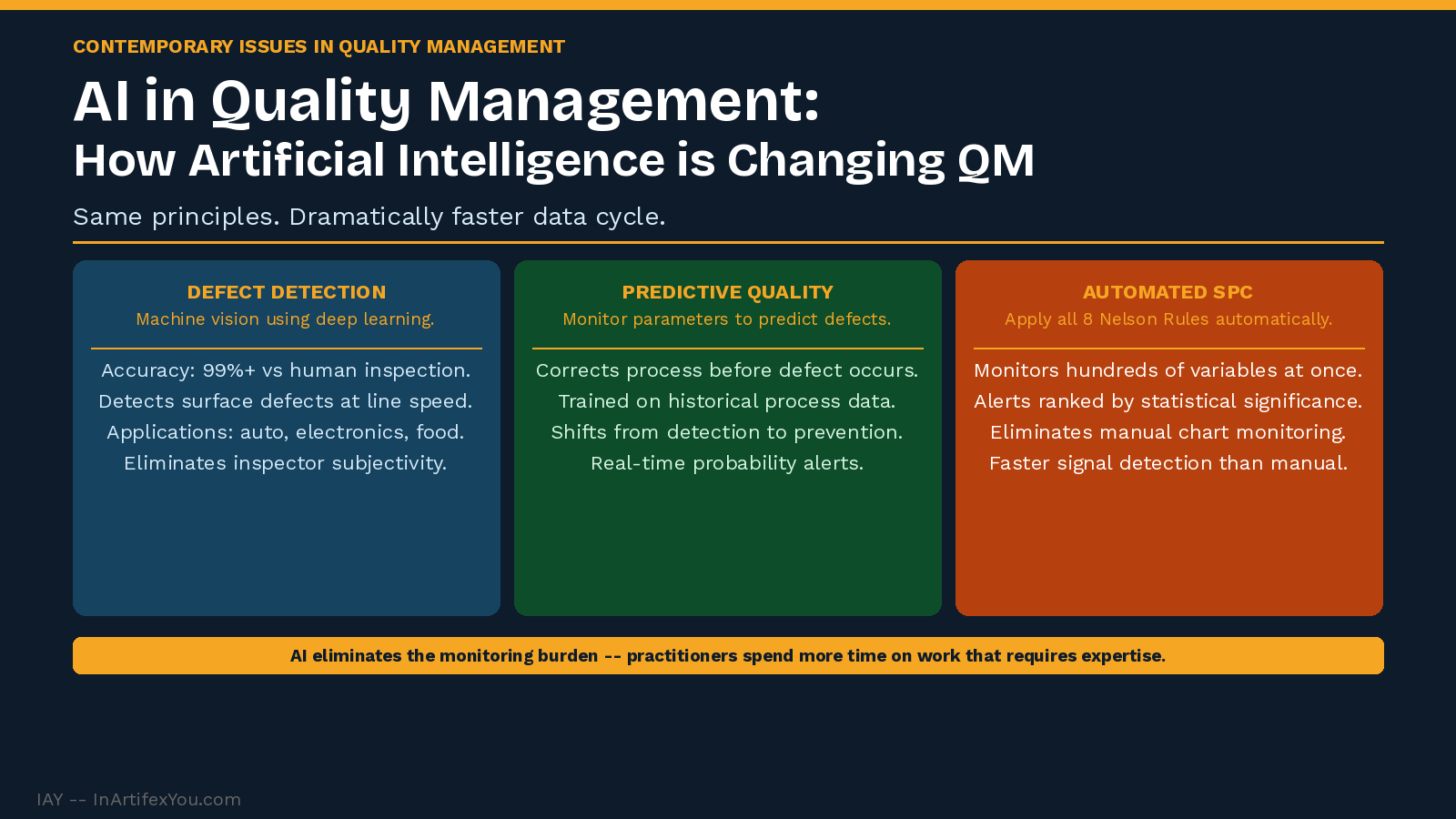
Quality management has always been a data discipline. The principles of TQM, the methods of Six Sigma, and the tools of statistical process control all depend on the ability to collect data, analyze it accurately, and act on the signals it reveals. Artificial intelligence is transforming quality management not by changing these principles but by dramatically accelerating the speed and scale at which they can be applied.
Application 1: AI-Powered Defect Detection
Machine vision systems using convolutional neural networks now inspect products at production line speeds with defect detection accuracy rates that consistently exceed human visual inspection. A system trained on thousands of images of conforming and non-conforming parts learns to identify the visual signatures of defects — scratches, porosity, dimensional deviations, assembly errors — in milliseconds.
- Automotive: AI vision systems inspect painted surfaces for micro-scratches and orange peel texture at line speed.
- Electronics: AI systems inspect solder joints, component placement, and PCB traces at speeds and resolutions impossible for human inspectors.
- Food and beverage: AI vision systems detect foreign objects, fill levels, label placement, and packaging integrity in real time.
Application 2: Predictive Quality
Predictive quality uses machine learning models trained on historical process data to identify the parameter combinations that predict defects before they occur. Instead of detecting a defective output after production, predictive quality systems alert operators when the combination of temperature, pressure, speed, and material properties is trending toward a defect-producing state.
The Predictive Quality Shift
Traditional quality: Inspect outputs → find defects → investigate causes → correct the process.
Predictive quality: Monitor process parameters → predict defect probability → correct the process → prevent the defect.
The shift from detection to prediction is the same shift TQM advocates from quality control to quality improvement — AI makes it continuous and real-time.
Application 3: Automated Statistical Process Control
Traditional SPC requires operators to plot data, apply control chart rules, and decide whether to investigate. AI-powered SPC systems apply all eight Nelson Rules simultaneously across hundreds of process variables, generate alerts ranked by statistical significance, and surface the most actionable signals — without operator manual monitoring.
What AI Does Not Change
AI does not replace the quality practitioner's core competencies — it amplifies them. Root cause analysis still requires human judgment about which hypothesis to test and which countermeasure to apply. Improvement project design still requires practitioner expertise in DMAIC methodology. Customer satisfaction still requires human service design. AI eliminates the data collection and routine monitoring burden so practitioners can spend more time on the work that requires genuine expertise.
|
AI REPLACES Manual visual inspection at scale. |
AI AUGMENTS Root cause analysis and hypothesis testing. |
Back to hub: Contemporary Issues in Quality Management.
- Digital transformation in quality management: tools and approaches.
- Sustainability and quality management: the environmental dimension.
- Quality management in global supply chains.
🔗 INTERNAL LINK SUGGESTIONS
| ||||||||||||||||||||||
The Continuous Improvement Certification at InArtifexYou gives you a complete, practical system to map, baseline, improve, and sustain any process — and the verified credential to prove you can lead it.
inartifexyou.com/continuous-improvement-certification-online.html | ||||||||||||||||||||||
|