Change management patterns that avoid initiative
fatigue
Initiative fatigue occurs when an organization launches more improvement programs than its people can absorb, resulting in surface-level compliance rather than genuine adoption. The four change management patterns that consistently avoid it are: sequencing over stacking (completing one initiative before launching the next), anchoring change to felt pain (connecting improvement to problems people are already experiencing), celebrating visible wins early (demonstrating results within 60 days to sustain belief), and protecting the improvement team's capacity (reserving at least 20% of team time for improvement work separate from daily operations). The single biggest predictor of initiative fatigue is launching a new program before the previous one has produced a visible, documented result. Credibility is built one completed change at a time — not one launched initiative at a time.
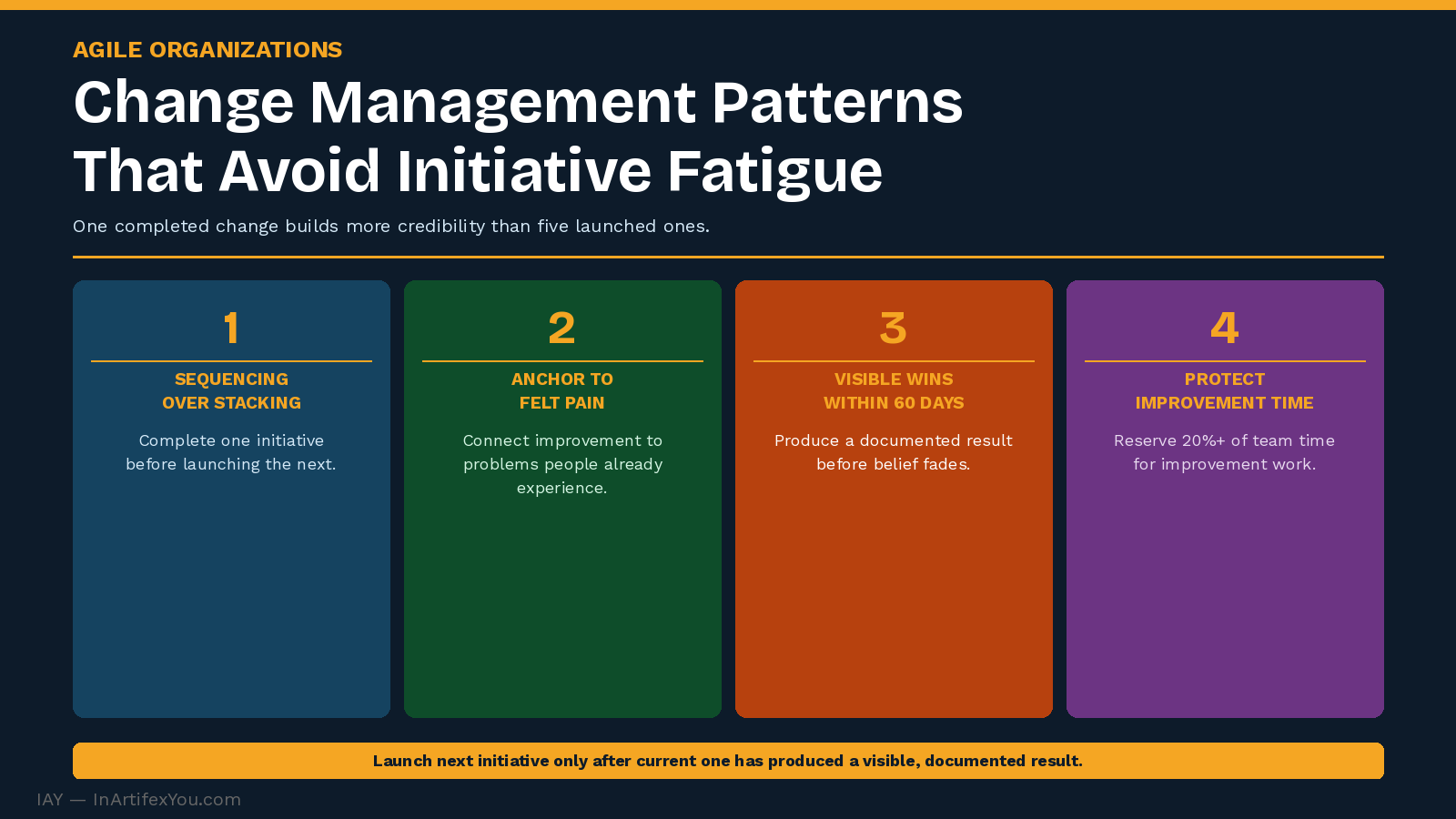
Initiative fatigue is the organizational immune response to too much change introduced too fast with too little visible result. It manifests as polite compliance during workshops, unchanged behavior afterward, and a growing cynicism among the most experienced employees — who have seen previous improvement programs arrive with fanfare and depart without consequence.
The antidote is not less change. It is better-sequenced, better-anchored, better-celebrated change.
Pattern 1: Sequencing Over Stacking
The most common cause of initiative fatigue is launching multiple improvement programs simultaneously. Lean, agile, a new ERP, and a cultural transformation — all at once — produce a workforce that is technically enrolled in everything and genuinely committed to nothing.
The Sequencing Rule
Launch the next initiative only after the current one has produced a documented, visible result — not just a completed training program.
If your organization is currently running more than three active improvement initiatives, pause new launches until at least one closes with a verified outcome.
Pattern 2: Anchoring Change to Felt Pain
People adopt change when it solves a problem they are already experiencing — not when it addresses a problem leadership has identified in a strategy document. The change management failure mode is leading with the methodology ('we are implementing Lean Six Sigma') rather than the pain ('we know the current approval process is costing you six days of waiting on every project').
Anchor every improvement initiative to a specific, named pain point that the target team will immediately recognize as real. The methodology is the solution — the pain is the reason to care about it.
Pattern 3: Visible Wins Within 60 Days
Belief in an improvement program is sustained by evidence, not by promises. Every agile or continuous improvement initiative must produce a visible, documentable result within 60 days of launch — something that team members can point to and say: 'That is different now, and it is better.'
- A 60-day win does not have to be large — it has to be real and attributable to the initiative.
- Document it with before-and-after data, not just testimonials.
- Communicate it visibly: post it on the team board, share it in the all-hands, reference it in the next project proposal.
Pattern 4: Protecting Improvement Capacity
The most reliable predictor of initiative fatigue is launching improvement programs on top of full operational workloads. When people have zero protected time for improvement work, improvement becomes a weekend activity — which means it does not happen.
|
Team Role |
Recommended Protected |
Time What It Covers |
|
Frontline operators / knowledge workers. |
10% of work time. |
Kaizen suggestions, standard work updates, 5S maintenance. |
|
Team leaders / supervisors. |
20% of work time. |
Improvement event participation, coaching, audit activities. |
|
Lean / Agile practitioners. |
50–80% of work time. |
Project facilitation, training, portfolio management. |
Protected time is not idle time. It is the organizational investment in continuous improvement — and without it, the ROI of any change initiative is permanently limited by the unavailability of the people who are supposed to execute it.
Back to hub: Agile Organizations.
- Agile organization KPI targets: velocity, lead time, and adaptability baselines.
- OKR examples that reinforce quality and flow.
- Structuring cross-functional value streams.
🔗 INTERNAL LINK SUGGESTIONS
|
||||||||||||||||||||||
The Continuous Improvement Certification at InArtifexYou gives you a complete, practical system to map, baseline, improve, and sustain any process — and the verified credential to prove you can lead it.
inartifexyou.com/continuous-improvement-certification-online.html |
||||||||||||||||||||||
|