Cost of Poor Quality in TQM: how to calculate and
reduce it
Cost of Poor Quality (COPQ) is the total financial cost of not doing things right the first time. It is organized into four categories: internal failure costs (defects caught before the product reaches the customer — scrap, rework, downtime), external failure costs (defects that reach the customer — returns, warranty claims, complaint handling, lost customers), appraisal costs (the cost of finding defects — inspection, testing, audits), and prevention costs (the cost of preventing defects — training, process design, quality planning). The COPQ formula: Internal Failures + External Failures + Appraisal Costs + Prevention Costs = Total COPQ. In most organizations that have not implemented TQM, internal and external failures represent 70–80% of total COPQ — meaning they are spending most of their quality budget finding and fixing defects rather than preventing them. A shift to prevention-focused TQM reduces total COPQ by 30–60% within three years.
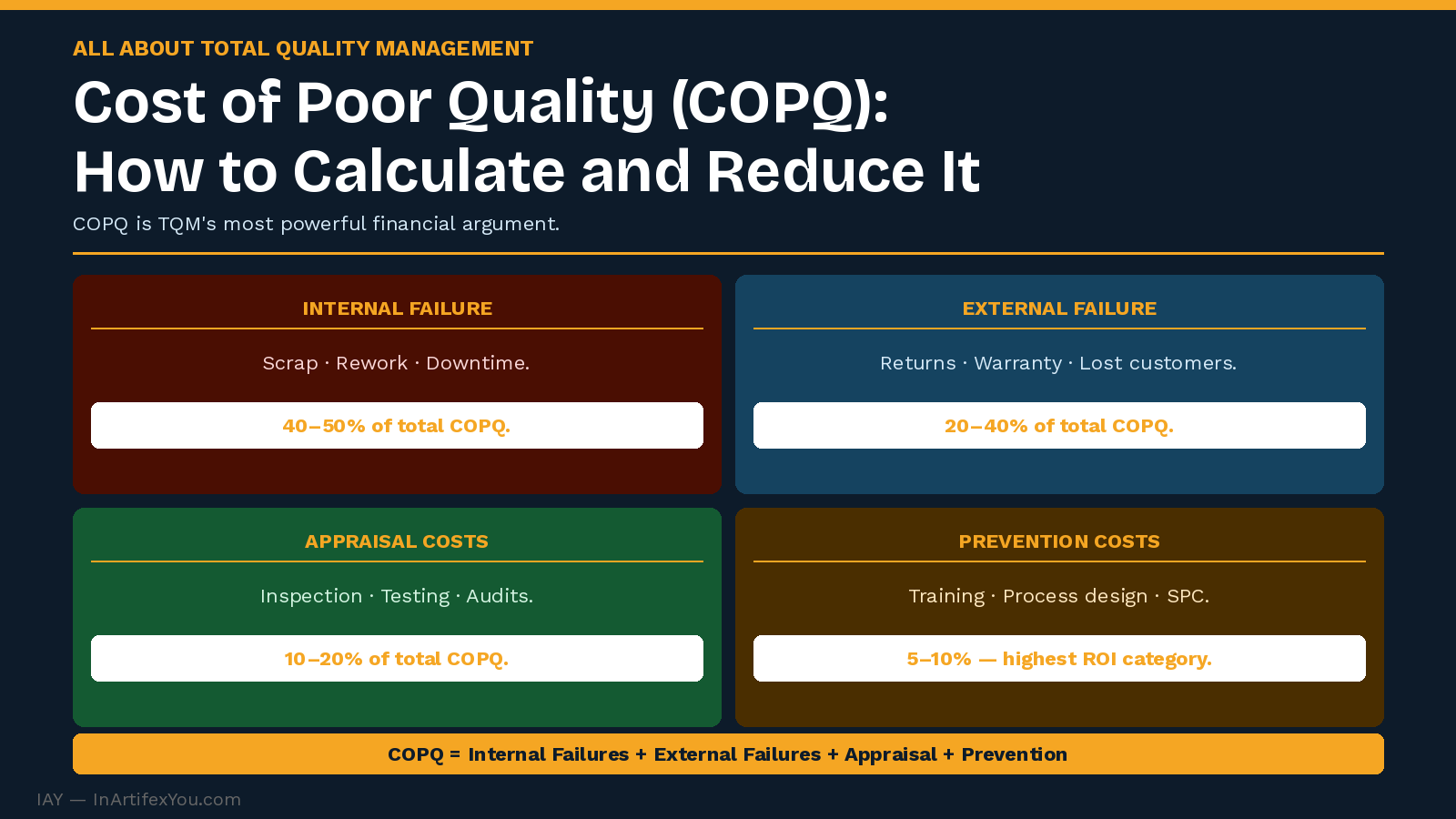
COPQ is the financial argument that makes TQM impossible to ignore. When a quality practitioner can show leadership that the organization is spending $400,000 per year on rework, $180,000 on warranty returns, and $95,000 on inspection — and that a prevention-focused improvement program can reduce that total by 40% — the conversation about quality investment changes completely.
COPQ is not a quality metric. It is a business metric that happens to measure the financial consequence of quality failures.
The Four Categories of COPQ
|
Category |
What It Includes |
Typical % of Total COPQ |
|
Internal Failure Costs. |
Scrap, rework, re-inspection, downtime caused by defects found before delivery. |
40–50%. |
|
External Failure Costs. |
Returns, warranty claims, complaint handling, field repairs, lost customer revenue. |
20–40%. |
|
Appraisal Costs. |
Incoming inspection, in-process testing, final inspection, quality audits, calibration. |
10–20%. |
|
Prevention Costs. |
Quality training, process design, supplier qualification, quality planning, SPC systems. |
5–10%. |
How to Calculate COPQ
COPQ Calculation Steps
Step 1: Identify all internal failure events in the period — count scrap units, rework hours, and downtime incidents.
Step 2: Assign a cost to each — material cost for scrap, labor rate × hours for rework, lost capacity value for downtime.
Step 3: Identify all external failure events — warranty claims, returns, complaint resolution hours.
Step 4: Assign costs — warranty parts + labor, return freight, complaint handling time × labor rate.
Step 5: Add appraisal costs — inspector labor, testing equipment depreciation, audit costs.
Step 6: Add prevention costs — training hours × labor rate, quality system maintenance costs.
Total COPQ = Sum of all four categories.
The Hidden Factory: Why COPQ Is Always Higher Than It Looks
Most organizations that calculate COPQ for the first time discover that actual COPQ is two to four times higher than their initial estimate. This is because informal rework — corrections made by individuals before passing work to the next step — is rarely tracked in any system. It exists as a hidden factory: an unofficial quality recovery operation that consumes capacity without appearing in any official metric.
To surface the hidden factory: ask every team member 'What do you fix before passing your work on?' and assign a labor cost to the time spent. This single exercise typically reveals 15–30% additional COPQ that was previously invisible.
Using COPQ to Justify Improvement Projects
The standard COPQ-to-improvement ROI calculation:
- Calculate annual COPQ for the target process.
- Estimate improvement project cost: practitioner time + team time + any tooling or system changes.
- Apply a conservative 30% COPQ reduction target for a well-executed project.
- ROI = (Annual COPQ × 30%) ÷ Project Cost.
A process with $500,000 annual COPQ and a $40,000 project cost produces a projected ROI of 3.75:1 — before accounting for the compounding benefit of the sustained improvement in subsequent years.
The Prevention Paradox
Organizations that spend 5–10% of their COPQ on prevention consistently report total COPQ reductions of 30–60%.
Every dollar invested in prevention returns $3–$10 in reduced failure and appraisal costs — making prevention the highest-ROI quality investment available.
Back to hub: All About Total Quality Management.
- What is Total Quality Management? Definition and core principles.
- TQM vs Six Sigma: what is the difference?
- How to implement TQM step by step.
🔗 INTERNAL LINK SUGGESTIONS
|
||||||||||||||||||||||
The Continuous Improvement Certification at InArtifexYou gives you a complete, practical system to map, baseline, improve, and sustain any process — and the verified credential to prove you can lead it.
inartifexyou.com/continuous-improvement-certification-online.html |
||||||||||||||||||||||
|