Digital transformation in quality management: tools
and approaches
Digital transformation in quality management replaces paper-based, manual, and siloed quality processes with connected digital systems that collect data automatically, analyze it in real time, and make it accessible across the organization. The four key digital transformation tools in quality management are: Manufacturing Execution Systems (MES) — which capture process and quality data at the point of production; Quality Management Systems (QMS) — which digitize document control, non-conformance management, and corrective action workflows; Statistical Process Control software — which automates control chart creation and special cause detection; and Enterprise Quality Platforms — which integrate all quality data sources into a single analytics environment. The most important principle in digital quality transformation is data connectivity: a digital tool that operates in isolation produces reports rather than improvement. Connected digital quality systems produce decisions.
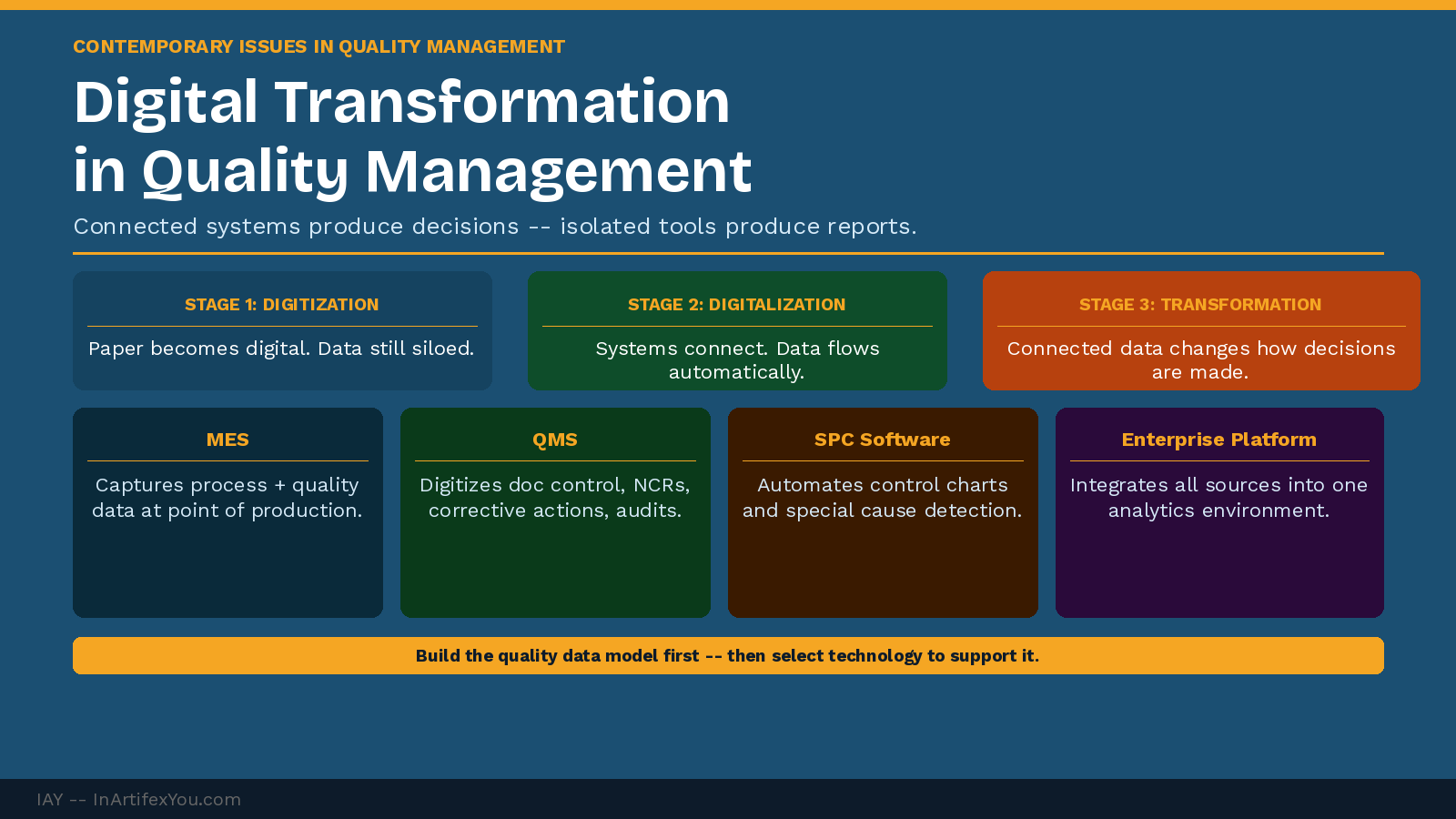
Most quality management systems in operation today are partially digital at best — some data is captured electronically, some is still on paper, and the connections between systems are manual exports and spreadsheet consolidations. Digital transformation in quality management means replacing this patchwork with connected systems where quality data flows automatically from collection to analysis to action.
The Four Core Digital Quality Tools
|
Tool |
What It Digitizes |
Quality Impact |
|
Manufacturing Execution System (MES). |
Process parameters, production records, quality inspection results at point of production. |
Real-time quality data capture — eliminates manual logging delays and transcription errors. |
|
Quality Management System (QMS). |
Document control, non-conformance reports, corrective actions, audit management. |
Standardizes quality workflows and creates auditable records — replaces paper-based quality systems. |
|
SPC Software. |
Control chart creation, rule application, special cause detection across multiple process variables. |
Automates routine monitoring — alerts operators to genuine signals without manual chart review. |
|
Enterprise Quality Platform. |
Integrates MES, QMS, SPC, supplier quality, and customer feedback into a single analytics environment. |
Enables organization-wide quality visibility and data-driven decision making at the leadership level. |
The Three Stages of Digital Quality Maturity
- Digitization: converting paper-based records to digital format — forms become digital forms, paper SPC becomes software SPC. Data is digital but still siloed.
- Digitalization: connecting digital systems so data flows between them automatically — MES data feeds SPC software, non-conformances trigger corrective action workflows automatically.
- Digital transformation: using connected data to fundamentally change how quality decisions are made — predictive quality, real-time dashboards, AI-assisted root cause analysis.
Most organizations are currently at Stage 1 or transitioning to Stage 2. Full digital transformation (Stage 3) requires not just technology investment but a fundamental change in how quality data is used for decision making.
Implementation Principles
- Start with the data: before selecting technology, map which quality data exists, where it is generated, and what decisions it should inform.
- Connect before you analyze: isolated digital tools produce data. Connected digital tools produce insight.
- Build the quality data model first: define what will be measured, at what frequency, with what precision, and for what purpose — before implementing any system.
- Train practitioners in data interpretation, not just data collection: digital transformation fails when it produces dashboards that nobody acts on.
The Connectivity Principle
A QMS that does not connect to your SPC system is a document management tool.
An SPC system that does not connect to your corrective action workflow is a charting tool.
Digital quality transformation produces value only when systems are connected and data flows automatically to the decision makers who need it.
Back to hub: Contemporary Issues in Quality Management.
- AI in quality management: how artificial intelligence is changing QM.
- Quality management in global supply chains.
- Agile quality management: applying agile principles to quality systems.
🔗 INTERNAL LINK SUGGESTIONS
| ||||||||||||||||||||||
The Continuous Improvement Certification at InArtifexYou gives you a complete, practical system to map, baseline, improve, and sustain any process — and the verified credential to prove you can lead it.
inartifexyou.com/continuous-improvement-certification-online.html | ||||||||||||||||||||||
|