DPMO → Sigma level calculator explained
DPMO (Defects Per Million Opportunities) measures how many defects your process would produce if it ran one million times. To calculate it: count total defects, divide by total opportunities, multiply by 1,000,000. A result of 6,210 DPMO corresponds to 4 Sigma — where most competent organizations operate. To convert DPMO to Sigma level, use the standard lookup table (or a Z-table with a 1.5σ long-term shift applied). A Six Sigma process produces just 3.4 DPMO — meaning near-perfect quality. Most organizations begin at 3σ to 4σ and use DMAIC projects to close the gap. The goal is not perfection from day one; it is knowing exactly where you are and moving the number deliberately.
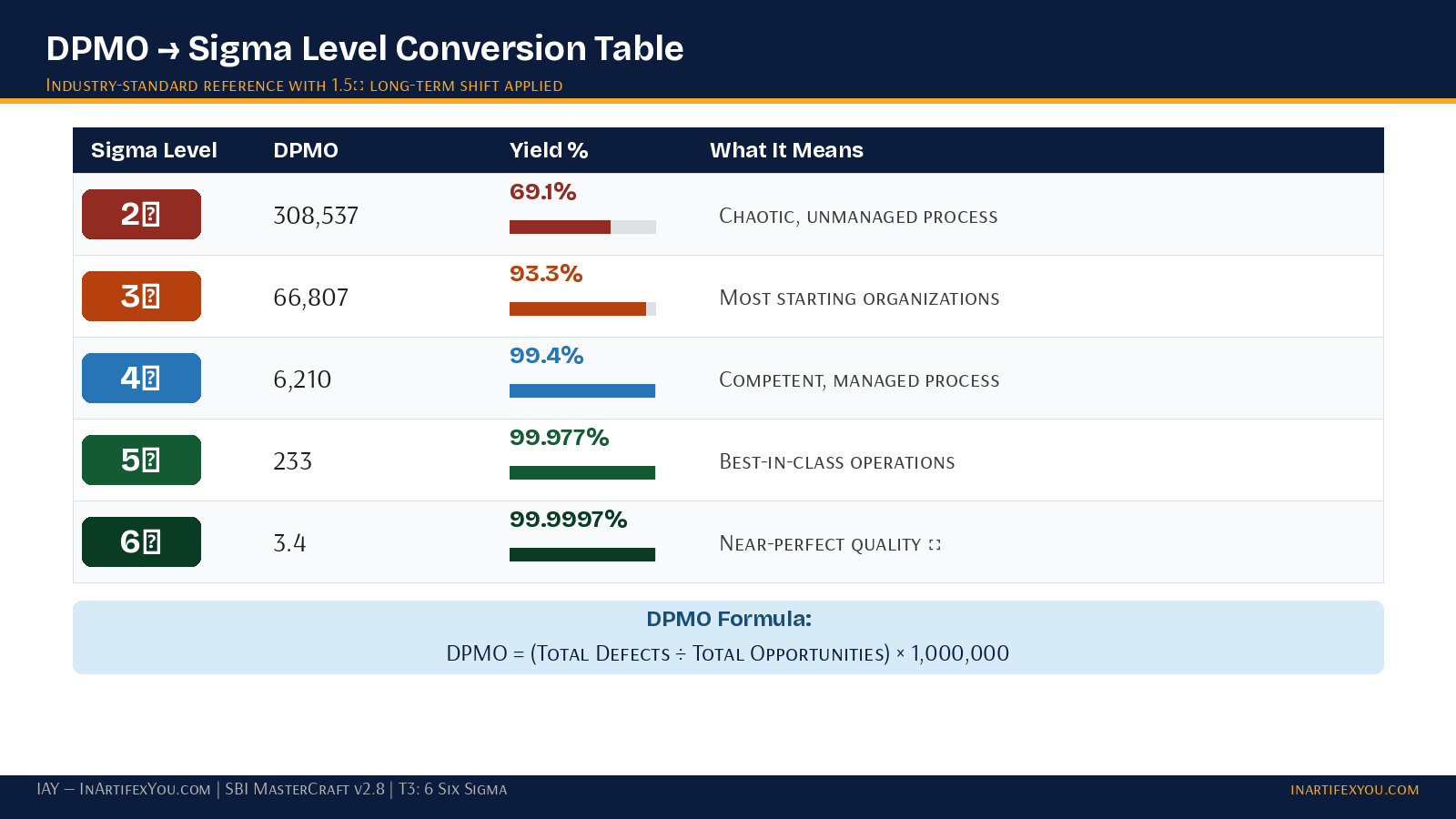
DPMO is the universal language of Six Sigma quality measurement. It translates your defect rate into a single number that can be compared across processes, plants, business units, and industries — regardless of process size or complexity.
The DPMO Calculation
Step-by-Step DPMO Calculation
1. Count all defects observed in your sample
2. Count all opportunities for a defect (units × defect opportunities per unit)
3. Divide defects by total opportunities
4. Multiply by 1,000,000
Formula: DPMO = (Defects ÷ Opportunities) × 1,000,000
Example: 47 defects found in 500 invoices, each with 10 fields = 5,000 opportunities
DPMO = (47 ÷ 5,000) × 1,000,000 = 9,400 DPMO → approximately 3.8 Sigma
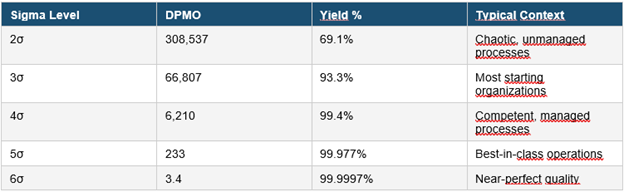
The DPMO to Sigma Level Conversion Table
This table uses the industry-standard 1.5σ long-term shift built into the Six Sigma model:
What Your DPMO Number Actually Means
A DPMO of 9,400 does not mean your process is bad. It means your process is average — and average is a starting point, not a verdict. The number gives you something far more valuable than a grade: a precise measurement gap between where you are and where you want to be.
If you move from 3σ to 4σ, you reduce your defect rate by 91%. For a call center handling 10,000 transactions per month, that means cutting monthly defects from 670 to 62. That is not a quality statistic. That is a cost reduction, a customer satisfaction gain, and a competitive advantage.
Common DPMO Calculation Mistakes
• Counting defective units instead of individual defects — these are not the same thing
• Defining opportunities inconsistently — standardize before you start measuring
• Using too small a sample — fewer than 50 units makes DPMO unreliable
• Forgetting the 1.5σ shift — published Six Sigma tables already include it; do not apply it again
Calculate your DPMO. Find your Sigma level. Then use that number to prioritize your first DMAIC project.