The five focusing steps of TOC: how to apply them
The five focusing steps of the Theory of Constraints are a continuous improvement cycle applied to any system with a performance-limiting constraint. Step 1 — Identify: find the constraint by mapping where work piles up, where throughput is lost, and where the team is always waiting. Step 2 — Exploit: maximize the constraint's output using only existing resources — eliminate idle time, reduce setup, stop starving the constraint with upstream delays. Step 3 — Subordinate: slow down or buffer all non-constraint processes to keep the constraint fed and busy at all times. Step 4 — Elevate: if the constraint persists after steps 1–3, invest in additional capacity — more people, equipment, or process redesign. Step 5 — Repeat: once the constraint is resolved, a new constraint will emerge — return to step 1 immediately. The cycle never ends because every system always has exactly one constraint limiting its throughput at any given time.
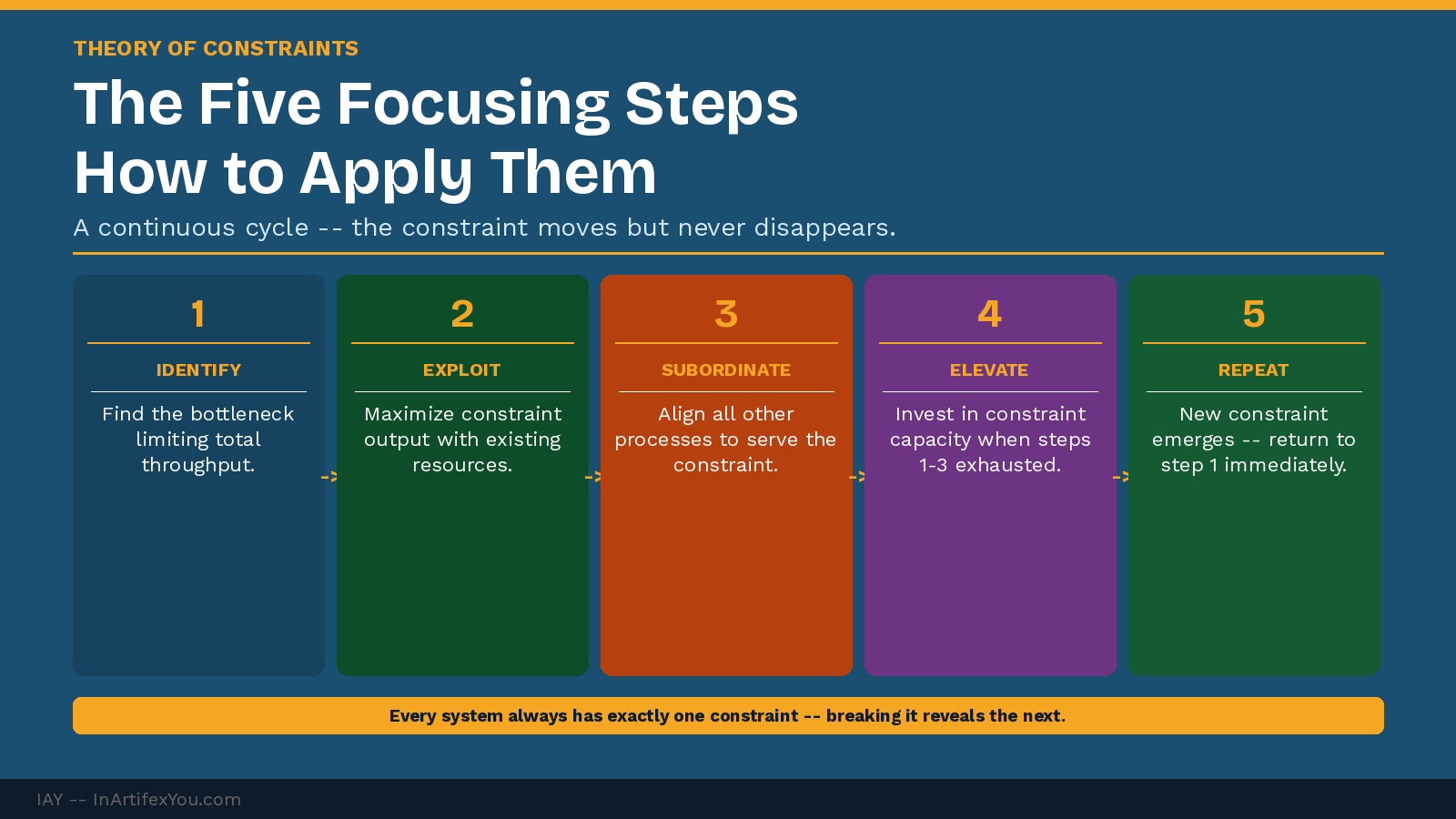
The five focusing steps are the operational engine of TOC. Understanding them conceptually is straightforward. Applying them in a real organization — where political pressure to improve everything simultaneously is constant — requires discipline and a clear decision framework.
Step 1: Identify the Constraint
The constraint is the process, resource, or policy that limits the system's throughput. In manufacturing it is typically a machine or work center with a queue that never empties. In services it is typically an approval step, a skilled specialist, or an information bottleneck that everything else waits on.
- Walk the process — physically or digitally — and observe where work accumulates.
- Map cycle times at each step — the step with the longest cycle time relative to demand is a candidate constraint.
- Track queue lengths over time — a queue that grows consistently identifies the constraint upstream of it.
Step 2: Exploit the Constraint
Exploitation means maximizing the output of the constraint using resources you already have — before spending a dollar on additional capacity. This step is frequently skipped, which leads organizations to invest in capacity they did not need.
Exploitation Tactics
Eliminate
constraint downtime: every minute the constraint is idle is throughput lost
forever.
Reduce
constraint setup time: faster changeovers mean more productive time at the
constraint.
Prioritize
constraint work: the constraint should never be waiting for upstream work —
buffer it with input inventory.
Fix quality before the constraint: defects that
reach the constraint waste its capacity on rework.
Step 3: Subordinate Everything Else
Subordination is the most counterintuitive step in TOC. It requires that all non-constraint processes deliberately limit their own efficiency in order to serve the constraint — even if that means allowing upstream resources to sit idle or run below capacity.
The reason: if upstream processes run at full speed regardless of constraint capacity, they create large work-in-process queues that increase lead time, complexity, and cost — without increasing throughput. The goal is to keep the constraint busy, not to keep every resource busy.
Step 4: Elevate the Constraint
Elevation means investing in additional constraint capacity — after exploitation and subordination have been fully implemented. Common elevation actions:
- Adding a second shift or overtime at the constraint.
- Purchasing additional equipment or tooling for the constraint.
- Offloading constraint work to a subcontractor or parallel resource.
- Redesigning the constraint process to eliminate steps that do not add value.
Step 5: Repeat
Breaking a constraint does not end the improvement work — it moves it. When the current constraint is resolved, system throughput increases until it hits the next constraint somewhere else in the system. Return to Step 1 immediately and begin the cycle again.
The Constraint Is Never Gone.
By definition, every system has exactly one constraint at any point in time.
When you break the current constraint, you do not eliminate constraints — you move the constraint to the next weakest link. The system always has a throughput ceiling. The five focusing steps are the tool for raising that ceiling, one constraint at a time.
Back to hub: Theory of Constraints.
- TOC Drum-Buffer-Rope: how to schedule around your constraint.
- TOC vs Lean vs Six Sigma: which to use first.
- Identifying bottlenecks using TOC: a step-by-step guide.
🔗 INTERNAL LINK SUGGESTIONS
| ||||||||||||||||||||||
The Continuous Improvement Certification at InArtifexYou gives you a complete, practical system to map, baseline, improve, and sustain any process — and the verified credential to prove you can lead it.
inartifexyou.com/continuous-improvement-certification-online.html | ||||||||||||||||||||||
|