TOC Drum-Buffer-Rope: how to schedule around your
constraint
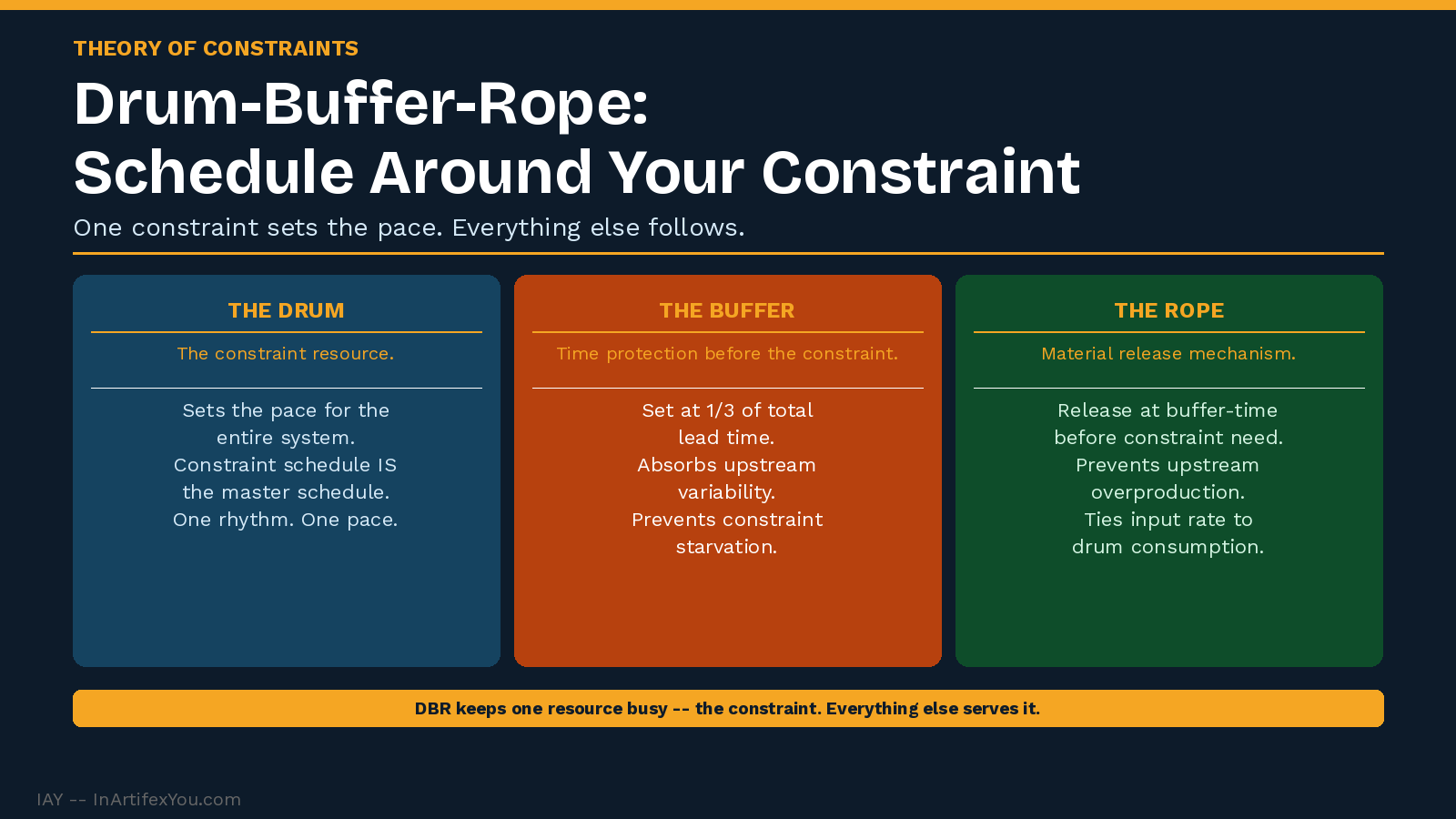
Drum-Buffer-Rope (DBR) is the Theory of Constraints scheduling system designed to protect constraint throughput while preventing the buildup of excess work-in-process inventory. The Drum is the constraint — the pace-setter for the entire system. The Buffer is a time-based protection mechanism placed in front of the constraint — typically one-third of the total lead time — that ensures the constraint always has work to process even when upstream processes experience disruptions. The Rope is the release mechanism: materials are released into the system at the same rate the constraint can process them — no faster. The combined effect of DBR is that the constraint runs at full capacity continuously, upstream processes do not overproduce, and WIP stays controlled throughout the system. DBR is the operational implementation of the TOC principle that the constraint sets the pace for the entire system.
The five focusing steps tell you what to do — identify the constraint, exploit it, subordinate everything else. Drum-Buffer-Rope tells you how to operationalize Step 3 in a production or service environment. It is the scheduling system that makes TOC's theoretical principles executable on the shop floor or in the service workflow.
The Three Components
|
THE DRUM The Drum is the constraint — the resource that limits total system throughput. It sets the production rhythm for the entire system. Every other resource schedules its work around the drum's capacity and sequence. The drum's schedule IS the master production schedule — not a department-level schedule, not a resource-level schedule. One schedule. One pace. The constraint's pace. | |
|
THE BUFFER The Buffer is a time-based protection in front of the constraint. It is typically set at one-third of the total system lead time. If average lead time is 15 days, the buffer is 5 days of work sitting in front of the constraint at all times. The buffer's purpose is to absorb upstream variability — machine breakdowns, material delays, quality problems — without starving the constraint. A starved constraint loses throughput that can never be recovered. THE ROPE The Rope is the material release signal. Materials are released into the system exactly one buffer-length before the constraint needs them — no earlier. The rope prevents upstream processes from running ahead of the constraint's pace, which would create excess WIP and long lead times without any increase in throughput. The rope ties the input release rate to the drum's consumption rate. |
Setting Up DBR in Practice
|
Step |
Action |
Output |
|
1. Identify the drum. |
Confirm the constraint through queue analysis and utilization measurement. |
The constraint resource and its daily capacity in hours or units. |
|
2. Build the drum schedule. |
Schedule the constraint first — sequence work at the constraint to maximize throughput. |
A constraint-level production sequence for the planning period. |
|
3. Set the buffer size. |
Calculate buffer = one-third of average total lead time. |
Start conservative and adjust. A time-based buffer quantity in hours or days of work. |
|
4. Set the rope. |
Release materials at buffer time before constraint need — not at job start date. |
A material release schedule tied to constraint consumption. |
|
5. Monitor buffer status. |
Track what fraction of the buffer is consumed at any point — high consumption signals upstream disruption. |
Buffer management alerts that trigger expediting before the constraint is starved. |
Buffer Management: Reading the Signal
Buffer management is the ongoing monitoring practice that keeps DBR working after setup. The buffer is divided into three zones:
- Green zone (first third): buffer is healthy — no action needed.
- Yellow zone (second third): buffer is being consumed faster than expected — investigate upstream disruption.
- Red zone (final third): constraint is at risk of starvation — expedite immediately.
Buffer management converts the buffer from a passive time cushion into an active signal system. When orders enter the red zone frequently, it reveals either that the buffer is too small or that upstream reliability is lower than assumed — both of which require a management response.
DBR in Service Environments
DBR translates directly into service environments with one substitution: instead of managing physical material flow, DBR manages information and work item flow. The constraint is the bottleneck step in the service process — the approval, the specialist, the system. The buffer is a queue of ready-to-process items maintained in front of that step. The rope is the intake rate — new work is accepted into the system only at the pace the constraint can process it.
The DBR Insight
Most scheduling systems try to keep every resource busy. DBR keeps only one resource busy — the constraint.
Keeping non-constraints busy at the expense of
constraint starvation destroys throughput. DBR
is the scheduling discipline that prevents exactly that.
Back to hub: Theory of Constraints.
| ||||||||||||||||||||||
The Continuous Improvement Certification at InArtifexYou gives you a complete, practical system to map, baseline, improve, and sustain any process — and the verified credential to prove you can lead it.
inartifexyou.com/continuous-improvement-certification-online.html | ||||||||||||||||||||||
|