TOC vs Lean vs Six Sigma: which to use first
TOC, Lean, and Six Sigma are complementary methodologies that address different improvement problems. TOC focuses exclusively on the system's constraint — the one bottleneck limiting total throughput. Lean focuses on eliminating waste across all processes to improve flow. Six Sigma focuses on reducing variation and defects in specific processes using statistical methods. The recommended sequence: use TOC first to identify and break the primary throughput constraint — this produces the fastest system-level improvement. Then use Lean to eliminate waste and improve flow in the processes that feed and follow the constraint. Then use Six Sigma to address variation and defect problems that persist after the constraint is broken and waste is eliminated. This sequence — TOC then Lean then Six Sigma — maximizes the speed of system-level improvement by ensuring that improvement energy is applied where it produces the most throughput impact first.
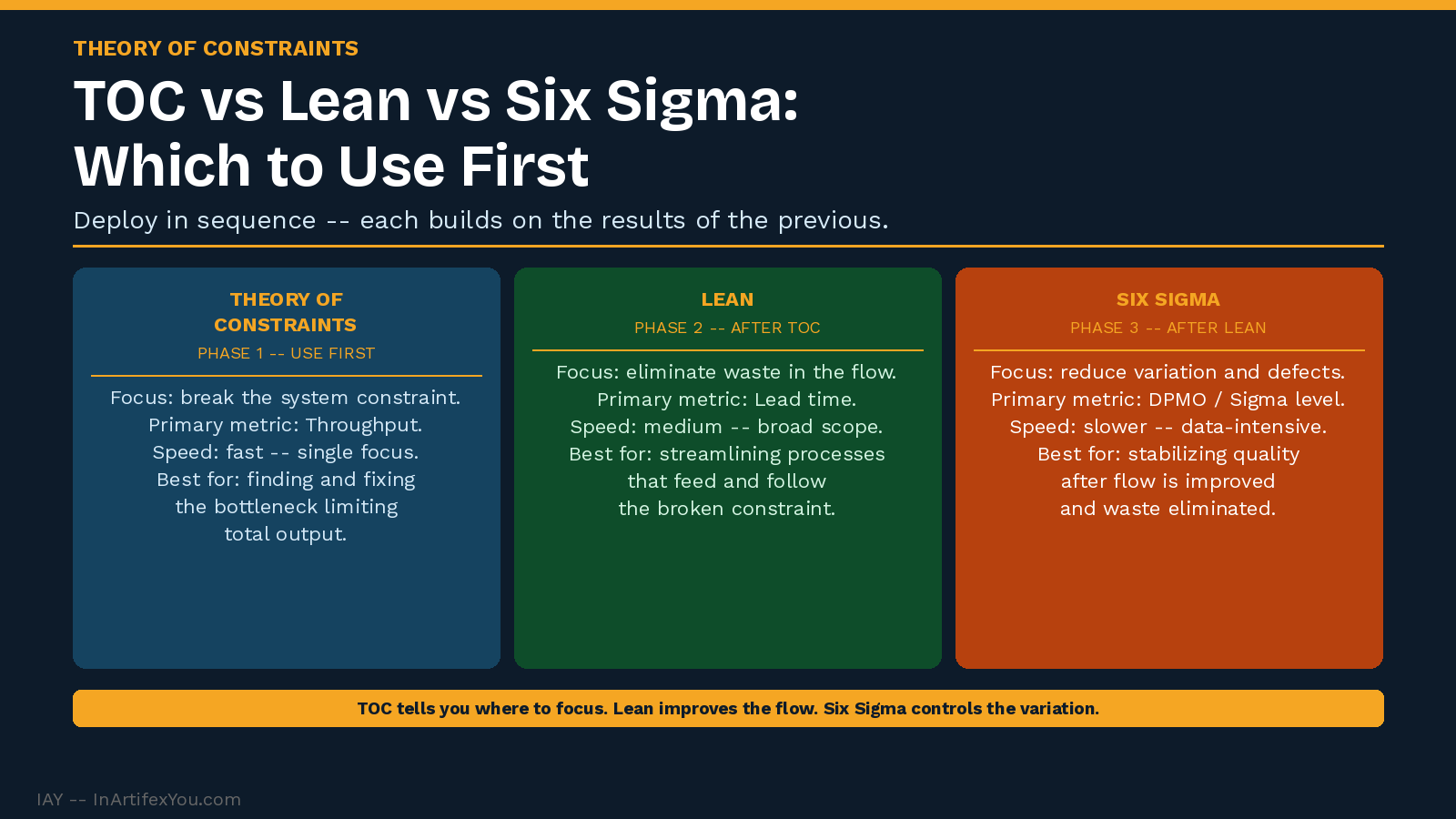
Organizations that try to deploy TOC, Lean, and Six Sigma simultaneously typically make slow progress in all three and significant progress in none. The methodologies are most powerful when deployed in sequence — each building on the results of the previous one.
How Each Methodology Thinks About Improvement
|
Methodology |
Primary Focus |
Primary Metric |
Speed |
Best For |
|
Theory of Constraints. |
Break the system's throughput constraint. |
Throughput (revenue generated through sales). |
Fast — single focus, rapid results. |
Finding and fixing the bottleneck limiting total output. |
|
Lean. |
Eliminate waste across all processes. |
Flow efficiency and lead time reduction. |
Medium — broad scope, many tools. |
Streamlining flow after the constraint is identified. |
|
Six Sigma. |
Reduce variation and defects. |
DPMO, Sigma level, process capability. |
Slower — data-intensive DMAIC projects. |
Stabilizing quality after flow is improved. |
The Deployment Sequence:
Phase 1: TOC — Find and Break the Constraint
TOC first because it produces the fastest impact on total system output. Before improving anything else, identify what is limiting throughput. Improving non-constraint processes produces no throughput improvement — it only creates better-run processes that feed a bottleneck faster. Apply the five focusing steps until the constraint is broken and throughput increases visibly.
Phase 2: Lean — Eliminate Waste in the Flow
Once the constraint is broken, Lean tools become immediately more impactful because the system now has more capacity to absorb improvement. Use Value Stream Mapping to identify the next generation of waste — overproduction, waiting, transportation, motion, inventory, over-processing, and defects. Kaizen events are the primary execution vehicle at this phase.
Phase 3: Six Sigma — Stabilize with Statistical Rigor
Once flow is improved and waste is reduced, Six Sigma addresses the remaining variation and defect problems that Lean and TOC cannot solve without statistical root cause analysis. DMAIC projects at this phase operate on already-improved processes — which means the baselines are better, the gains are more significant, and the improvements are more durable.
The Integration Principle
TOC tells you where to focus. Lean tells you how to improve the flow. Six Sigma tells you how to control the variation.
Each methodology is most powerful when it builds on the results of the previous one — not when it competes for organizational attention simultaneously.
Back to hub: Theory of Constraints.
| ||||||||||||||||||||||
The Continuous Improvement Certification at InArtifexYou gives you a complete, practical system to map, baseline, improve, and sustain any process — and the verified credential to prove you can lead it.
inartifexyou.com/continuous-improvement-certification-online.html | ||||||||||||||||||||||
|