Throughput accounting: the TOC financial framework
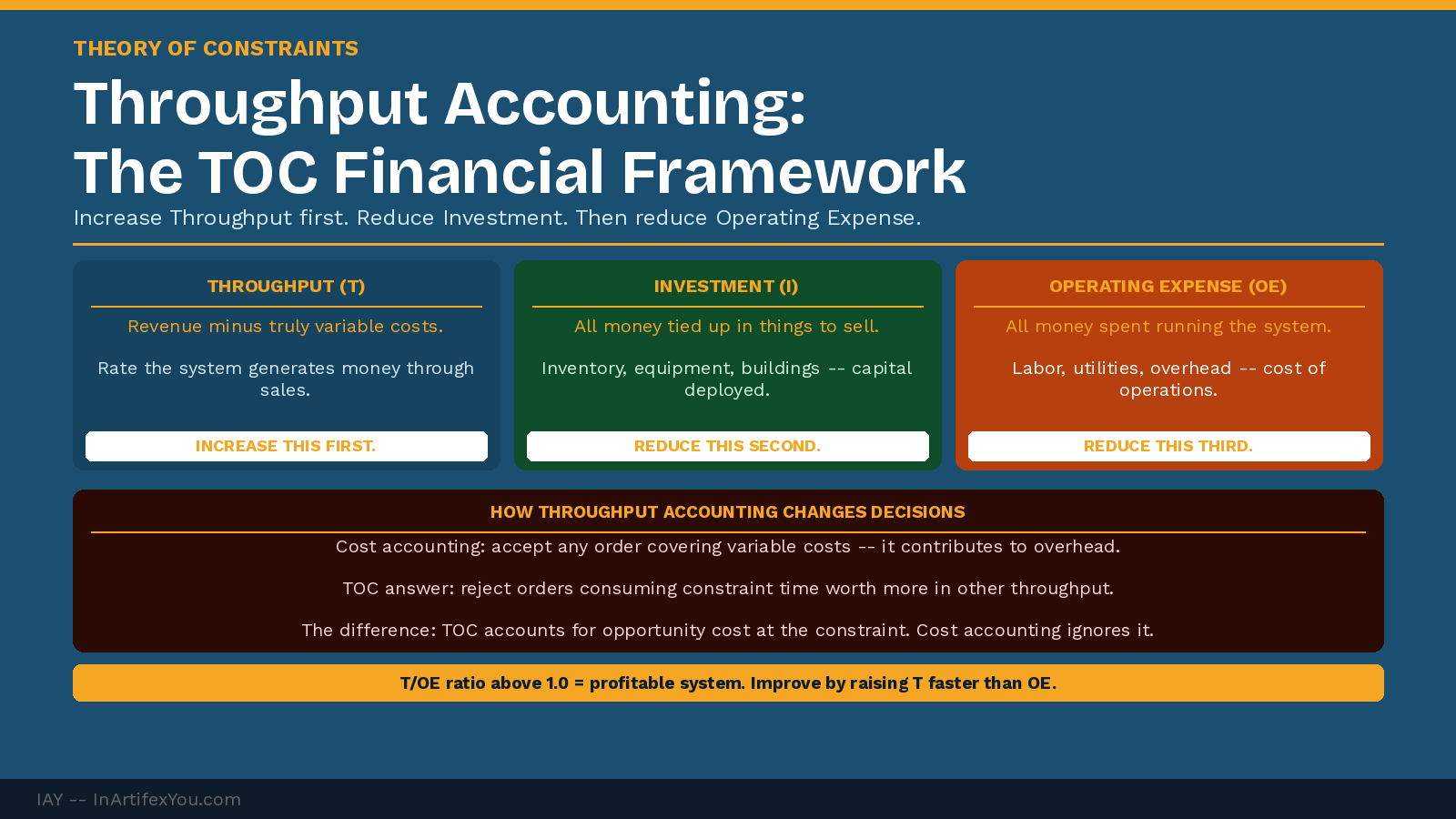
Throughput accounting is the financial framework developed by Goldratt as an alternative to traditional cost accounting for organizations using the Theory of Constraints. It measures performance through three variables: Throughput (T) — the rate at which the system generates money through sales (revenue minus truly variable costs), Investment (I) — all money the system invests in things it intends to sell, and Operating Expense (OE) — all money the system spends turning Investment into Throughput. The three financial goals in TOC are: increase Throughput, reduce Investment, and reduce Operating Expense — in that priority order. Traditional cost accounting drives local optimization by measuring cost per unit, which can lead to decisions that improve departmental efficiency while reducing total system throughput. Throughput accounting evaluates every decision by its impact on Throughput, Investment, and Operating Expense at the system level.
Traditional cost accounting was designed for a world where direct labor was the primary variable cost and overhead allocation was the primary management challenge. In most modern organizations — where direct labor is a small fraction of total cost and throughput is determined by constraint capacity — traditional cost accounting produces misleading signals that drive exactly the wrong improvement decisions.
The Three TOC Financial Metrics
|
Metric |
Definition |
What It Measures |
|
Throughput (T). |
Revenue minus truly variable costs (materials, commissions). |
The rate at which the system generates money through sales. |
|
Investment (I). |
All money tied up in things intended for sale: inventory, equipment, buildings. |
Capital deployed in the system — previously called 'Inventory' in early TOC. |
|
Operating Expense (OE). |
All money spent turning Investment into Throughput: labor, utilities, overhead. |
The cost of running the system — regardless of how much it produces. |
The Three TOC Financial Goals
Goldratt's three financial goals — ranked in priority order:
- Increase Throughput — generate more revenue through sales without proportionally increasing costs.
- Reduce Investment — free up capital tied up in inventory and fixed assets.
- Reduce Operating Expense — decrease the cost of running the system.
The priority order matters. Traditional cost accounting typically inverts it — focusing first on cost reduction (OE) and last on throughput growth (T). TOC argues that a dollar of increased throughput is worth more than a dollar of cost reduction because throughput improvement has no ceiling, while cost reduction is bounded by zero.
How Throughput Accounting Changes Decisions
Cost Accounting Decision vs. TOC Decision.
Scenario: Should we accept an order for $10,000 that uses constraint time worth $8,000 in lost throughput on other orders?
Cost accounting answer: yes — the order covers its variable costs and contributes to overhead absorption.
TOC answer: no — the order consumes $8,000 of constraint capacity that could produce $8,000 in other throughput. Net impact is negative.
The TOC decision correctly accounts for opportunity cost at the constraint — which cost accounting ignores entirely.
Applying Throughput Accounting in Practice
- Calculate T for every product line: revenue minus truly variable costs only — not allocated overhead.
- Rank products by T per unit of constraint time — the product that generates the most throughput per constraint minute is the highest-priority product.
- Evaluate every investment decision by its impact on T, I, and OE — not just its cost.
- Use T/OE ratio as a key performance indicator: a ratio above 1.0 means the system is profitable; improvements should increase this ratio.
Back to hub: Theory of Constraints.
| ||||||||||||||||||||||
The Continuous Improvement Certification at InArtifexYou gives you a complete, practical system to map, baseline, improve, and sustain any process — and the verified credential to prove you can lead it.
inartifexyou.com/continuous-improvement-certification-online.html | ||||||||||||||||||||||
|