Identifying bottlenecks using TOC: a step-by-step
guide
Identifying the bottleneck in a system using the Theory of Constraints requires four steps. Step 1 — Queue analysis: observe where work accumulates and forms a persistent queue that never fully clears — the process immediately downstream of that queue is the constraint candidate. Step 2 — Cycle time mapping: measure the actual cycle time at each process step and compare it to the takt time (available time divided by customer demand). The step with the highest utilization rate relative to demand is the constraint. Step 3 — Utilization measurement: track what percentage of available time each resource is actively processing work — the resource consistently at or near 100% utilization is the constraint. Step 4 — Constraint verification: starve the suspected constraint deliberately — if overall throughput drops immediately, the constraint is confirmed. If throughput holds, look upstream.
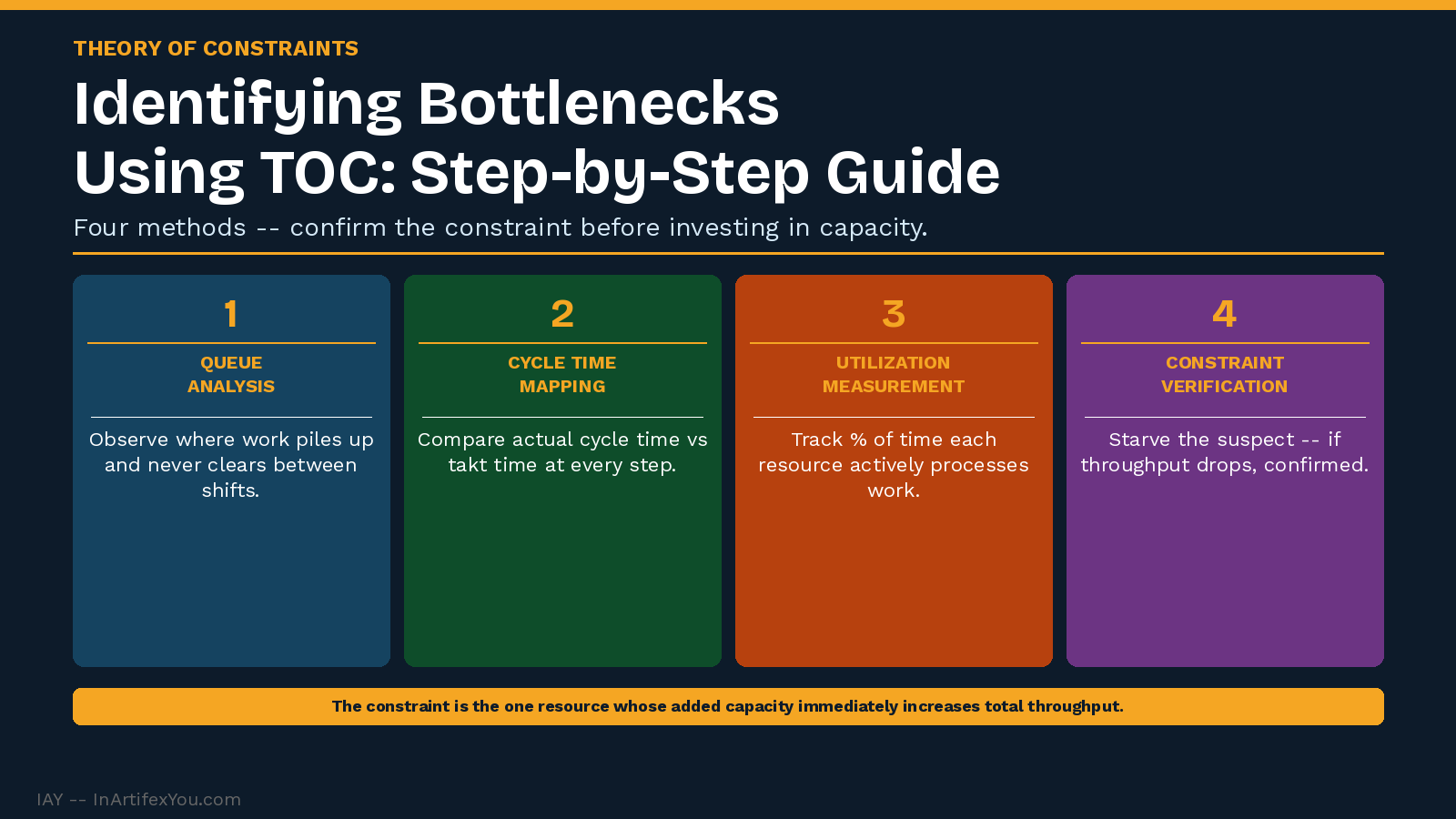
Finding the bottleneck sounds straightforward — but in complex systems with multiple interdependent processes, the constraint is not always where it appears to be. A process that looks overloaded may be fed by an upstream process that is actually the root cause. A resource that appears idle may be the constraint during peak demand periods that are not visible during observation. The four-method approach ensures the constraint is correctly identified before any improvement investment is made.
Method 1: Queue Analysis
Walk the process — physically for manufacturing, digitally for service workflows — and observe where work piles up. A queue that grows over time, never fully clears between shifts or periods, and causes downstream processes to wait is the clearest signal of a constraint upstream.
- In manufacturing: look for piles of WIP between workstations — the workstation where WIP accumulates on the input side is the constraint.
- In services: look for the step where requests sit the longest before being processed — check ticket aging reports, approval queue depths, and email response time data.
- Document queue sizes at the same time each day for one week — a growing trend confirms the constraint location.
Method 2: Cycle Time Mapping
Map the actual cycle time at every process step and compare each step's cycle time to the system's takt time — the available production time divided by customer demand rate. Any step with a cycle time at or above takt time is operating at or beyond capacity and is a constraint candidate.
|
Process Step |
Actual Cycle |
Time Takt |
Time Utilization |
Constraint? |
|
Assembly A. |
45 seconds. |
60 seconds. |
75%. |
No. |
|
Machining B. |
58 seconds. |
60 seconds. |
97%. |
Constraint candidate. |
|
Inspection C. |
30 seconds. |
60 seconds. |
50%. |
No. |
|
Packaging D. |
40 seconds. |
60 seconds. |
67%. |
No. |
Method 3: Utilization Measurement
Measure what percentage of available time each resource is actively processing work — as opposed to waiting, setting up, or being idle. The resource that is consistently at or near 100% utilization across all observation periods is the constraint.
- Track utilization at 30-minute intervals across at least three full production days.
- Distinguish between productive utilization (processing value-adding work) and non-productive utilization (setup, repair, waiting for materials).
- A resource at 95%+ productive utilization with a growing input queue is almost certainly the constraint.
Method 4: Constraint Verification
Once the suspected constraint is identified, verify it by deliberately starving it — temporarily reducing the input it receives — and observing the effect on overall system throughput. If throughput drops immediately, the constraint is confirmed. If throughput holds at the same level, the true constraint is somewhere else in the system.
The Verification Rule
The constraint is the one resource whose increased capacity immediately increases total system throughput.
If you could add one more unit of capacity anywhere in the system, and only one location would produce an immediate increase in output — that location is the constraint.
Back to hub: Theory of Constraints.
| ||||||||||||||||||||||
The Continuous Improvement Certification at InArtifexYou gives you a complete, practical system to map, baseline, improve, and sustain any process — and the verified credential to prove you can lead it.
inartifexyou.com/continuous-improvement-certification-online.html | ||||||||||||||||||||||
|