Juran's Quality Trilogy: how to use planning, control,
and improvement together
Juran's Quality Trilogy organizes all quality management activity into three interdependent processes: Quality Planning, Quality Control, and Quality Improvement. Quality Planning establishes the conditions for meeting quality goals — it identifies customers, determines their needs, translates needs into product or service requirements, develops the processes capable of meeting those requirements, and transfers the plans to operations. Quality Control monitors and adjusts processes during operation to ensure they remain capable of meeting requirements — it is the ongoing management of process performance. Quality Improvement addresses the chronic waste that Quality Control accepts as normal — it systematically reduces the gap between current performance and quality objectives through structured improvement projects. The Trilogy's key insight: Quality Control stabilizes performance at its current level, but it does not improve it. Only Quality Improvement reduces chronic waste. Organizations that only manage quality — without improving it — are permanently plateaued at their current defect rate.
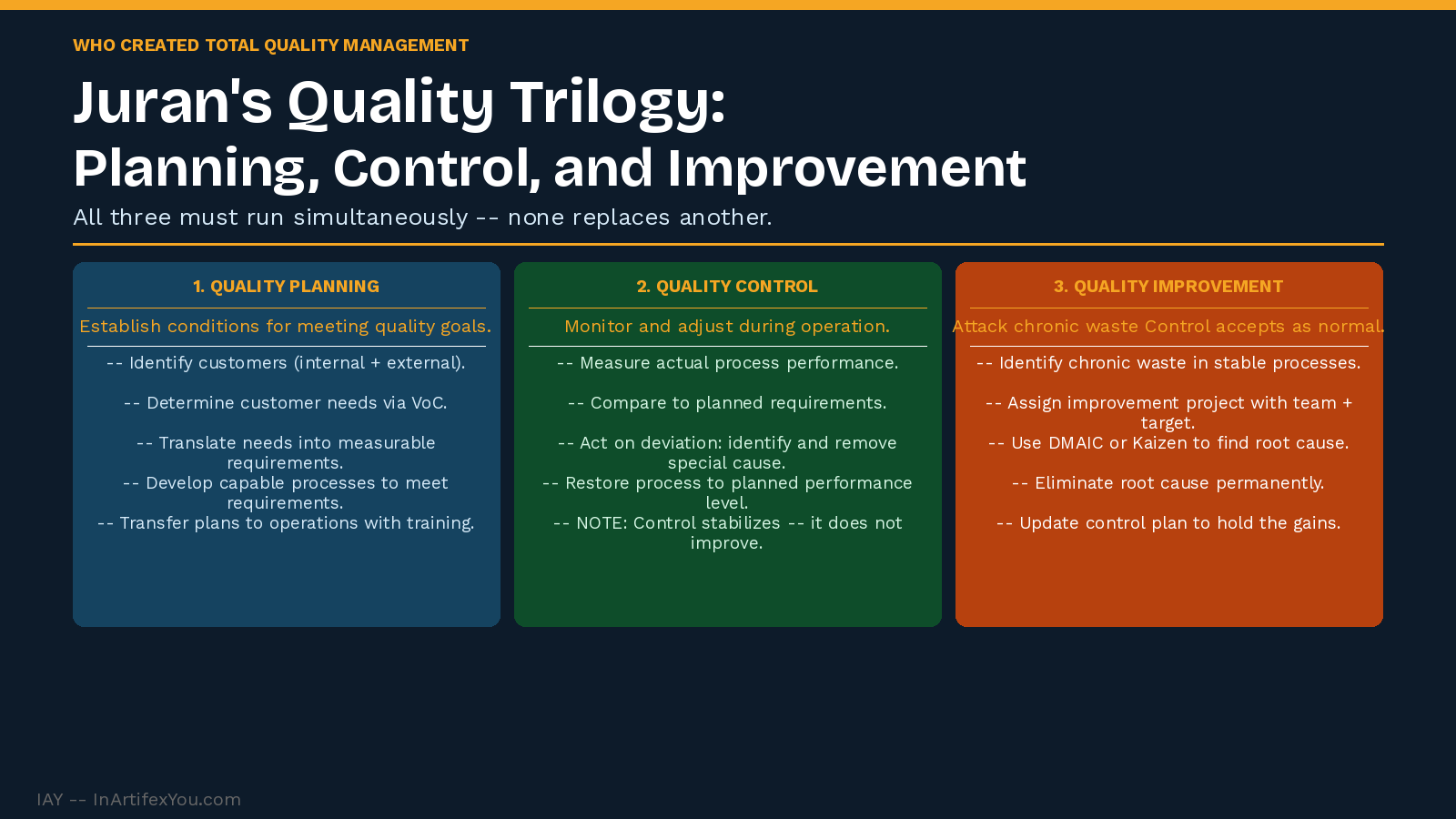
Juran's Quality Trilogy provides the clearest organizational framework for understanding why quality management and quality improvement must be separate, concurrent activities. Most organizations either manage quality without improving it — running control systems that keep defect rates stable at an unacceptable level — or launch improvement projects without adequate control systems that allow gains to erode when attention shifts. The Trilogy connects both disciplines into a coherent system.
Phase 1: Quality Planning
Quality Planning establishes what needs to be produced and how to produce it consistently:
- Identify customers — both external (end users) and internal (next process in the sequence).
- Determine customer needs — using VoC methods: surveys, interviews, complaint analysis, and observational research.
- Translate needs into measurable requirements — convert 'fast delivery' into 'order-to-ship within 48 hours for 98% of orders.'.
- Develop processes capable of meeting requirements — design or redesign processes so that meeting the requirement is the natural output of a capable process.
- Transfer plans to operations — document work instructions, train operators, and establish the control plan before handoff.
The Planning Failure
Most quality problems begin in planning — not in production.
Processes that are not designed to meet customer requirements cannot be controlled into meeting them. Control can only maintain what planning built in — it cannot compensate for a process that was never capable of meeting the requirement.
Phase 2: Quality Control
Quality Control monitors process performance during operation and responds to deviations:
- Measure actual performance: collect process output data at defined intervals using validated measurement systems.
- Compare to standards: evaluate actual performance against the planned requirements established in Quality Planning.
- Act on the difference: when actual performance deviates from standard, identify and eliminate the special cause — then restore the process to its planned performance level.
Quality Control's objective is to maintain performance at its current level. It does not improve it — it stabilizes it. The chronic waste that remains after special causes are eliminated is the starting point for Quality Improvement.
Phase 3: Quality Improvement
Quality Improvement attacks chronic waste — the defect rate that Quality Control accepts as normal because it has always been that way:
- Identify the chronic waste: the portion of defects, rework, and scrap that has been present for so long that it is treated as an acceptable cost of doing business.
- Establish an improvement project: assign a team, define the problem, set a measurable improvement target, and use DMAIC or Kaizen to find and eliminate the root cause.
- Hold the gains: update the control plan, work instructions, and monitoring system to ensure the improvement is sustained.
|
QUALITY CONTROL MANAGES Special cause variation. |
QUALITY IMPROVEMENT ATTACKS Common cause variation. |
Back to hub: Who Created TQM.
| ||||||||||||||||||||||
The Continuous Improvement Certification at InArtifexYou gives you a complete, practical system to map, baseline, improve, and sustain any process — and the verified credential to prove you can lead it.
inartifexyou.com/continuous-improvement-certification-online.html | ||||||||||||||||||||||
|