Lean manufacturing management KPI targets: OEE, FPY,
and cycle time baselines
Lean manufacturing management depends on three primary KPIs established before improvement begins: Overall Equipment Effectiveness (OEE), First-Pass Yield (FPY), and cycle time. World-class OEE is 85% — most plants start between 45% and 65%, making it the highest-leverage improvement target. FPY measures the percentage of units completed without defects or rework; target 95% or higher. Cycle time measures the average time to complete one unit from start to finish — establish the current-state average over at least 25 production cycles before making changes. Secondary KPIs — lead time, inventory turns, and Cost of Poor Quality (COPQ) — should be added after the primary three are stable and understood by the team. Track weekly, not monthly, to catch variation before it becomes a trend.
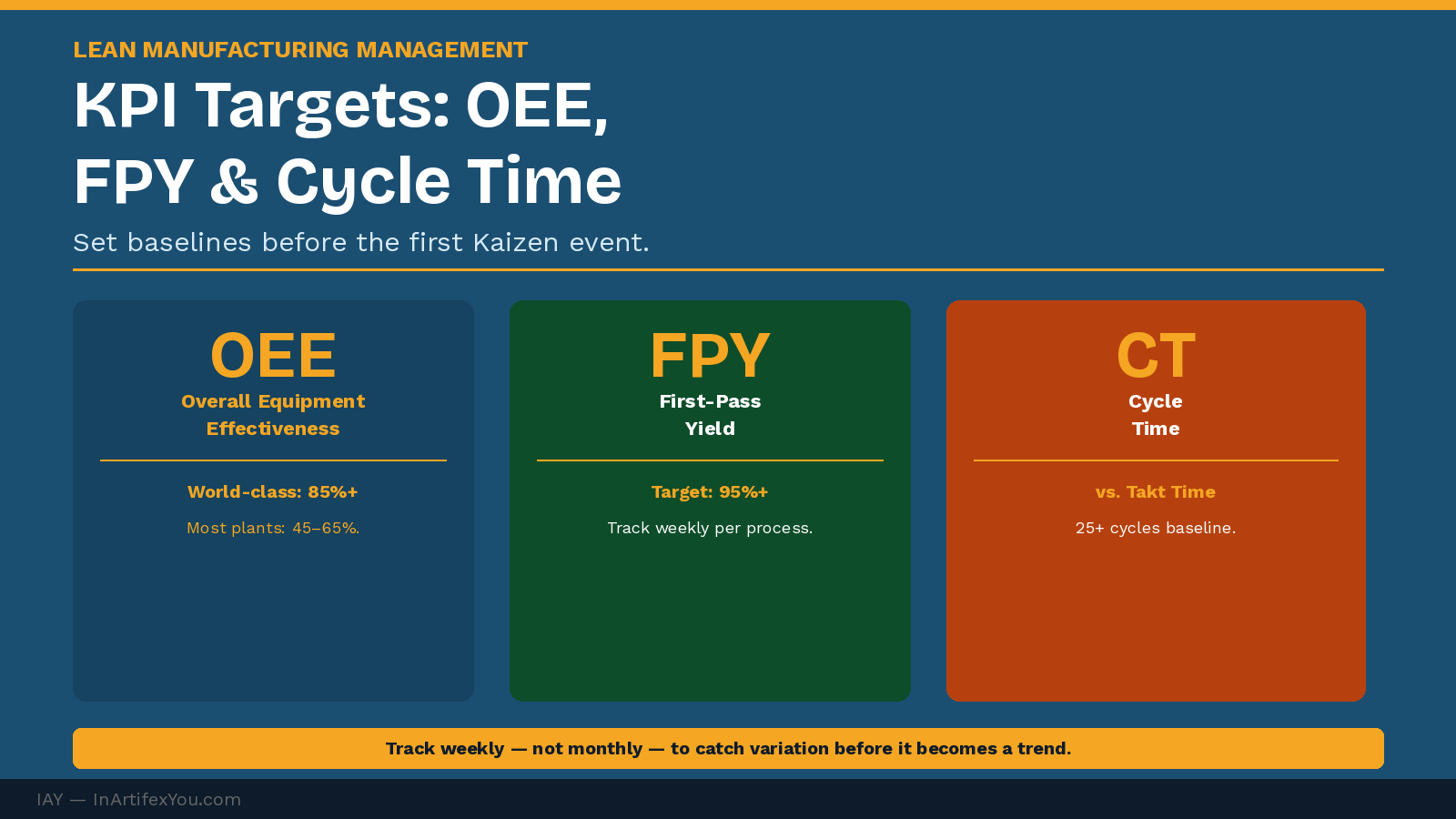
Lean manufacturing management without measurement is opinion. The practitioner who cannot show a before-and-after comparison for every improvement project will always struggle to sustain leadership support. The solution starts before the first Kaizen event — with a valid baseline.
The Three Primary Lean Manufacturing KPIs
These three KPIs form the measurement foundation for any Lean manufacturing program. Establish all three before beginning improvement work.
|
KPI |
What It Measures |
Starting Benchmark |
World-Class Target |
|
OEE (Overall Equipment Effectiveness). |
Availability × Performance × Quality rate. |
45–65% for most plants. 85%+. |
— must be able to facilitate. |
|
First-Pass Yield (FPY). |
% of units completed without defects or rework. |
Varies — establish current state first. |
95%+. . |
|
Cycle Time. |
Average time to complete one production unit. |
Measure current state over 25+ cycles. |
Continuously improving. |
OEE: The Single Best Lean Manufacturing Metric
OEE captures three types of loss in one number: availability loss (unplanned downtime, changeovers), performance loss (slow running, minor stops), and quality loss (defects, rework, scrap). A plant running at 60% OEE has 40% of its theoretical capacity consumed by waste — which means 40% of potential output is being lost before a single Lean tool is applied.
Break OEE into its three components from the start. A plant with good availability but poor quality needs a different set of tools than one with good quality but chronic downtime. The component breakdown tells you where to focus first.
FPY: The Quality Signal That Leaders Trust
First-Pass Yield is the metric that connects Lean manufacturing to financial results most directly. Every unit that fails the first pass generates rework cost, cycle time extension, and potential delivery delay. Calculate FPY weekly using this formula:
FPY Formula
FPY = (Units Completed Without Rework ÷ Total Units Started) × 100.
Track at the process level first, not the plant
level. A plant-level FPY of 94% may hide a single process step running at 70% —
which is your highest-priority improvement target.
- Awareness: Can explain the concept and its purpose.
- Working Knowledge: Can apply with guidance or reference material.
- Proficient: Can apply independently in real situations.
- Expert: Can teach, coach, and adapt to novel situations.
Rate yourself on each skill above. For any gap below your minimum LME level: identify one project in your current pipeline where you can close that gap. Skills develop in projects, not classrooms.
Cycle Time: The Pace of Your Process
Cycle time is the heartbeat of lean manufacturing. It tells you whether your process is running at, above, or below customer demand — which is the definition of flow. Compare cycle time against takt time (available production time ÷ customer demand) to identify whether you are overproducing or underdelivering.
- If cycle time < takt time: the process is running faster than demand — a pull system opportunity.
- If cycle time > takt time: the process cannot meet demand — a capacity or efficiency problem.
- If cycle time = takt time: perfect flow — the goal of lean manufacturing management.
When to Add Secondary KPIs
After 60 days of consistent primary KPI tracking, introduce:
- Lead time: total time from raw material receipt to finished goods delivery.
- Inventory turns: how many times total inventory cycles in a period — target 12+ turns per year for lean operations.
- sugCOPQ: Cost of Poor Quality — the financial total of internal and external failures.
Adding secondary KPIs too early creates measurement complexity without improvement clarity. Stabilize the primary three first.
Back to hub: Lean Manufacturing Management.
|
||||||||||||||||||||||
The Continuous Improvement Certification at InArtifexYou gives you a complete, practical system to map, baseline, improve, and sustain any process — and the verified credential to prove you can lead it.
inartifexyou.com/continuous-improvement-certification-online.html |
||||||||||||||||||||||
|
||||||||||||||||||||||
|
IAY — InArtifexYou.com | SBI MasterCraft v2.8 | T3: Lean Manufacturing Management |