Policy deployment (Hoshin): aligning Lean with
strategy
Policy deployment, or Hoshin Kanri, is the process of connecting company strategy to daily improvement work. It answers the question every Lean practitioner faces: 'How does this project support what the business is trying to achieve?' Hoshin works through a four-level cascade: the organization sets 3–5 breakthrough objectives for the year; each objective is translated into annual improvement targets; each target is supported by specific Lean projects with owners and deadlines; each project is tracked on a monthly basis through a structured review cadence. The primary planning tool is the X-matrix, which maps the relationships between objectives, targets, projects, and owners on a single page. The primary review tool is the catchball process — a two-way negotiation between levels of the organization to align resources with priorities.
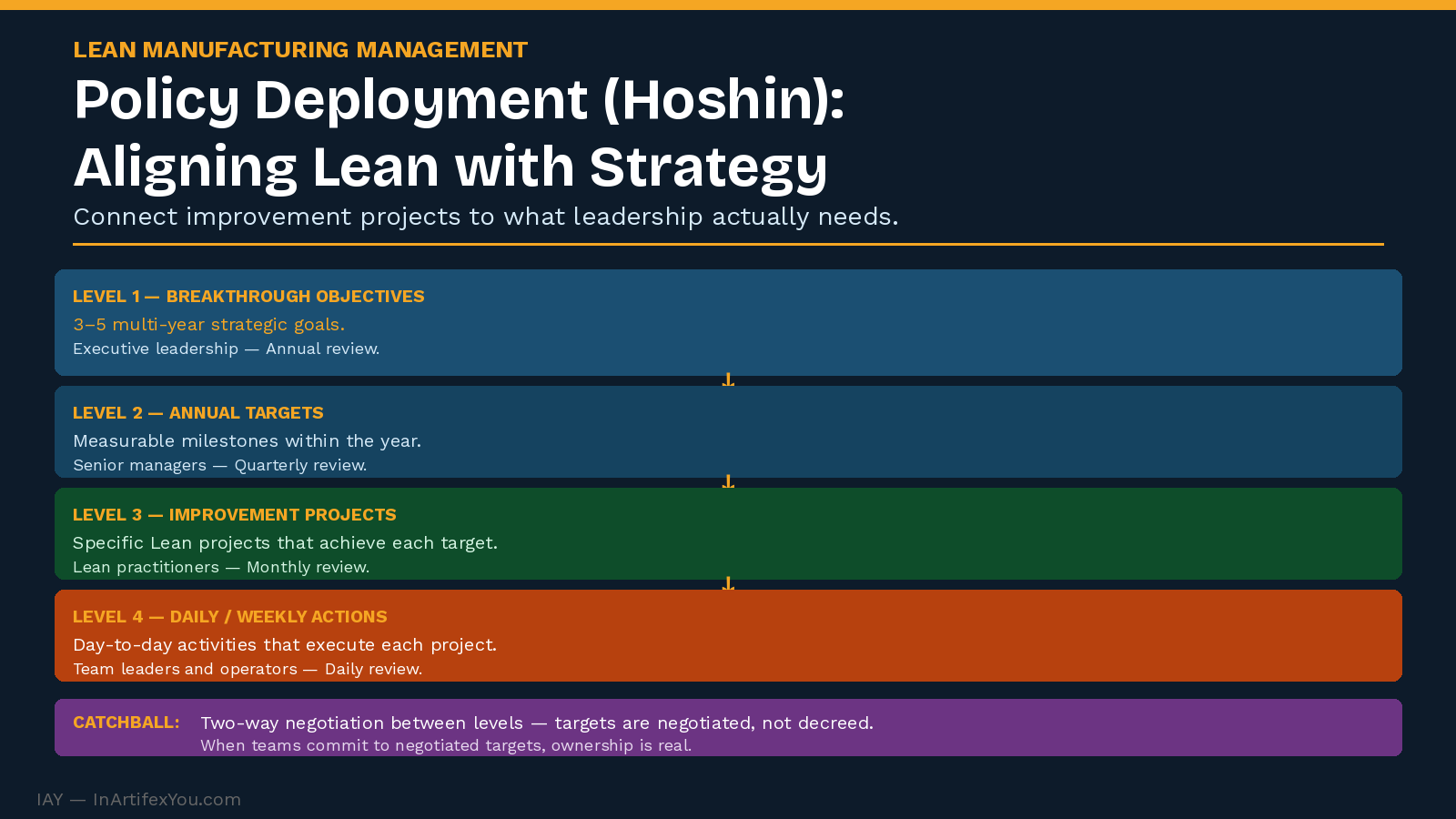
The most common failure mode in Lean manufacturing management is not poor tool execution — it is poor project selection. A team that runs excellent Kaizen events on the wrong processes will produce excellent results that nobody in leadership cares about. Policy deployment solves that problem by connecting improvement work to strategic intent before a single project begins.
The Four-Level Hoshin Cascade
Hoshin Kanri works through a structured cascade that translates organizational strategy into specific, actionable improvement projects
|
Level |
Content |
Owner |
Review Cadence |
|
1 — Breakthrough Objectives. |
3–5 multi-year strategic goals. |
Executive leadership. |
Annual. |
|
2 — Annual Targets. |
Measurable milestones that advance each objective within the year. |
Senior managers. |
Quarterly. |
|
3 — Improvement Projects. |
Specific Lean projects that achieve the annual targets. |
Lean practitioners and team leaders. |
Monthly. |
|
4 — Daily/Weekly Actions. |
The day-to-day improvement activities that execute each project. |
Team leaders and operators. |
Daily/weekly. |
The X-Matrix: One Page, Full Alignment
The X-matrix is the core planning tool of Hoshin Kanri. It maps four elements on a single page in a cross pattern:
- North: breakthrough objectives for the planning horizon.
- East: annual improvement targets that advance each objective.
- South: specific improvement projects tied to each target.
- West: owners responsible for each project.
The intersections between elements show the relationships — which projects support which targets, which targets advance which objectives, and who owns each project. The X-matrix makes misalignment immediately visible: a project with no intersection to any strategic objective should not be in the portfolio.
The Catchball Process: Alignment Through Dialogue
Hoshin planning is not a top-down decree. It is a two-way negotiation — called catchball — between each level of the organization. Leadership proposes targets. Teams respond with what is achievable given current resources. Leadership adjusts. Teams commit.
This dialogue serves two purposes: it ensures targets are realistic, and it creates genuine ownership at every level. When a team leader has negotiated their improvement target rather than received it, they are far more likely to treat it as a real commitment.
Connecting Your Lean Projects to Hoshin
If your organization does not yet have a formal Hoshin process, you can still apply the alignment discipline informally. For each improvement project in your portfolio, answer these three questions before committing resources:
- Which company objective does this project directly support?
- What is the measurable target this project is designed to achieve?
- Who in leadership will recognize this result as strategically meaningful?
If you cannot answer all three questions, reconsider the project.
A Lean project that cannot be connected to a strategic objective is a hobby, not a priority.
A Lean project connected to a strategic objective with a named executive sponsor is a funded commitment
Hoshin Review Cadence
Policy deployment requires a structured review rhythm to stay alive. Without reviews, the plan becomes a document rather than a management system.
- Monthly: project owner reviews actual vs. planned progress — red/yellow/green status with root cause for any gap.
- Quarterly: senior management reviews annual target progress — adjusts project priorities if external conditions have changed.
- Annual: full Hoshin planning cycle — assess prior year results, set new breakthrough objectives and targets.
Back to hub: Lean Manufacturing Management.
|
||||||||||||||||||||||
The Continuous Improvement Certification at InArtifexYou gives you a complete, practical system to map, baseline, improve, and sustain any process — and the verified credential to prove you can lead it.
inartifexyou.com/continuous-improvement-certification-online.html |
||||||||||||||||||||||
|
||||||||||||||||||||||
|
IAY — InArtifexYou.com | SBI MasterCraft v2.8 | T3: Lean Manufacturing Management |