Which SPC chart to use: a quick decision table
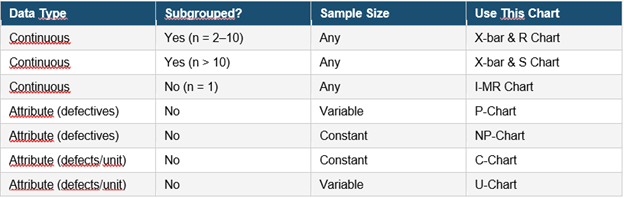
Choosing the right SPC chart depends on two questions: Is your data continuous or attribute? And do you have subgroups or individual measurements? For continuous data with subgroups (n ≥ 2): use the X-bar and R chart (subgroups of 2–10) or X-bar and S chart (subgroups > 10). For continuous data without subgroups: use the I-MR chart (Individuals and Moving Range). For attribute data counting defectives: use the P-chart (variable sample size) or NP-chart (constant sample size). For attribute data counting defects per unit: use the C-chart (constant sample size) or U-chart (variable sample size). When in doubt: if your data is a proportion or percentage, start with a P-chart. If it is a count of events, start with a U-chart.
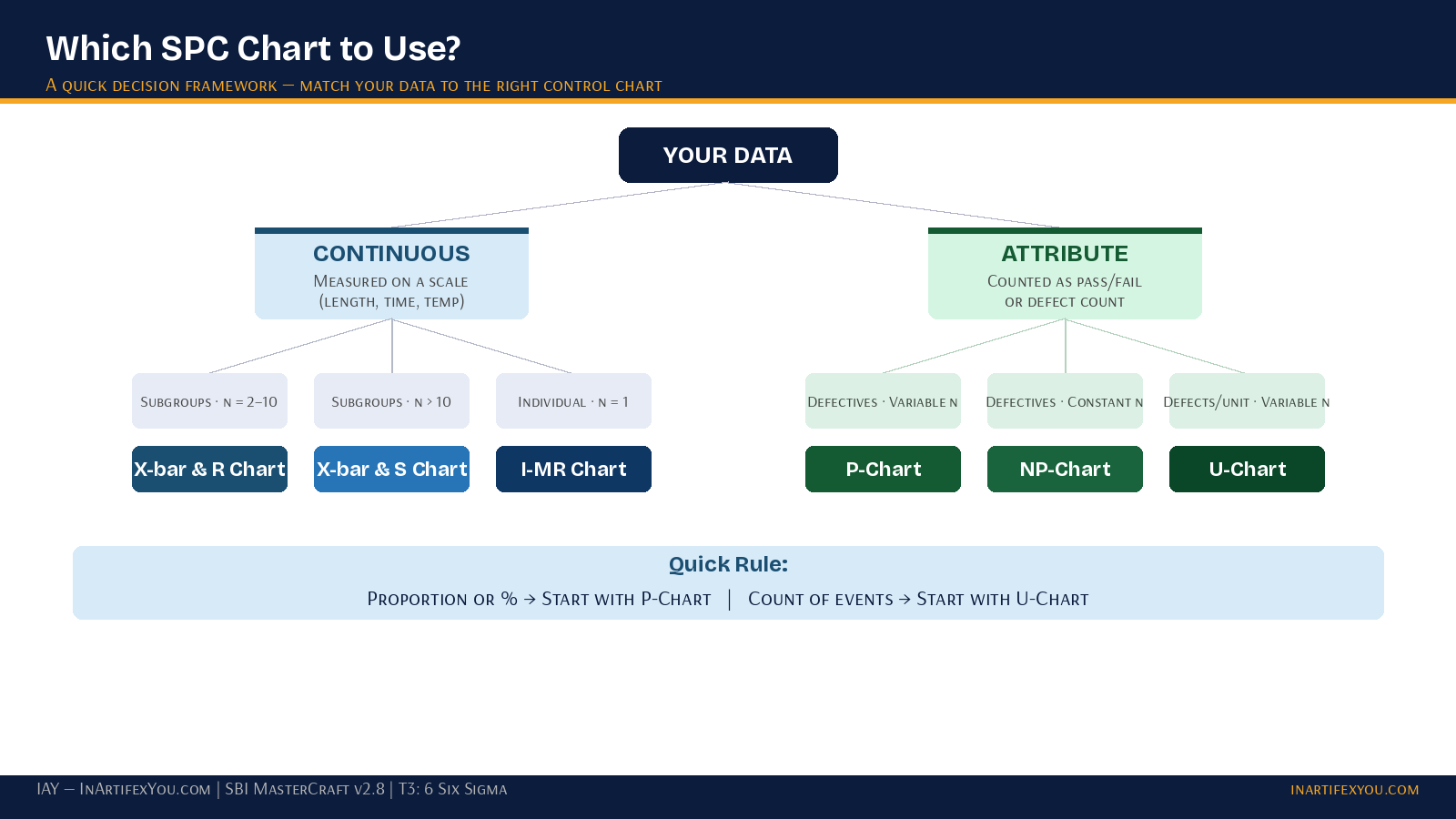
Statistical Process Control charts are only useful when you choose the right one for your data type. Using an X-bar chart on attribute data, or a P-chart on continuous data, produces meaningless control limits that will mislead every decision downstream.
The Decision Table: Match Data to Chart
Understanding the Two Key Decisions
Decision 1 — Continuous or Attribute? Continuous data is measured on a scale (length, weight, temperature, time). Attribute data is counted — either something is defective or it is not, or you count the number of defects on a unit.
Decision 2 — Subgroups or Individual Measurements? A subgroup is a set of items produced under the same conditions at the same time. If you measure 5 parts every hour, you have subgroups of 5. If you measure one transaction per hour, you have individual data points (n = 1).
When to Use Each Chart: Practical Examples
- X-bar & R Chart: Diameter of machined parts measured in subgroups of 5, every 30 minutes on a production line
- I-MR Chart: Daily call abandonment rate — one data point per day, no subgroups possible
- P-Chart: Percentage of invoices with errors per week, where the number of invoices varies week to week
- NP-Chart: Number of rejected units per shift, where you always inspect exactly 100 units per shift
- C-Chart: Number of defects found on each circuit board when every board has the same area
- U-Chart: Number of defects per square meter of fabric when roll lengths vary
The Most Common Mistake
Practitioners most often misapply the P-chart — using it for continuous data expressed as a percentage (like efficiency rate or utilization). A utilization percentage calculated from continuous measurements is not attribute data. Use an I-MR chart instead, or transform the data.
The rule: if the underlying data point is measured on a scale, it is continuous — regardless of how it is reported.
Get the chart selection right, and your control limits will be statistically valid. Get it wrong, and your entire SPC program produces noise instead of signals.