Customer satisfaction measurement: metrics and
improvement strategies
Customer satisfaction measurement in a TQ Marketing context uses three primary metrics: CSAT (Customer Satisfaction Score) — the percentage of customers who rate their experience as satisfied or very satisfied on a post-interaction survey, typically used to measure transactional quality at individual service touchpoints; NPS (Net Promoter Score) — the percentage of promoters minus the percentage of detractors on a 0–10 recommendation scale, used to measure overall relationship quality and predict customer loyalty; and CES (Customer Effort Score) — the ease of resolving a customer issue or completing a transaction, measured on a 1–7 scale, strongly correlated with customer retention in service environments. The three metrics measure different things: CSAT measures the quality of a specific interaction, NPS measures the cumulative quality of the entire relationship, and CES measures the friction in the customer experience — reducing effort is often the highest-ROI service quality improvement.
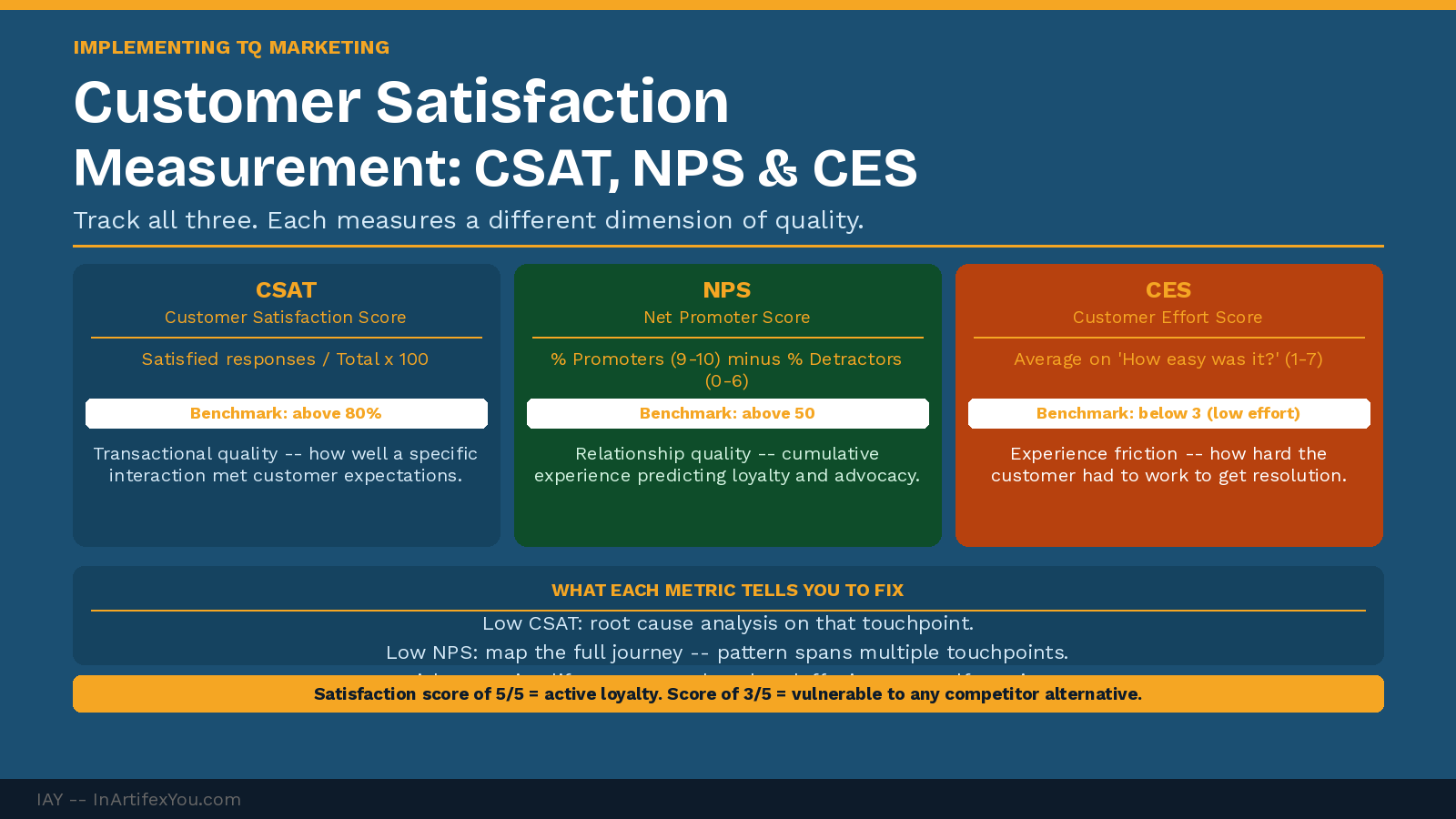
Customer satisfaction is not a feeling — it is a measurable quality metric. Like any quality metric, it should be tracked systematically, connected to process performance, and used to drive improvement priorities. The three metrics below form a complete satisfaction measurement system when used together.
The Three Satisfaction Metrics
|
Metric |
Formula |
Benchmark |
What It Measures |
|
CSAT. |
(Satisfied + Very Satisfied responses) / Total responses x 100. |
Above 80%. |
Transactional quality — how well a specific interaction met expectations. |
|
NPS. |
% Promoters (9-10) minus % Detractors (0-6). |
Above 50 (excellent). |
Relationship quality — cumulative experience predicting loyalty and advocacy. |
|
CES. |
Average score on 'How easy was it?' question (1-7 scale). |
Below 3 (low effort). |
Experience friction — how much effort the customer had to expend to get resolution. |
Connecting Satisfaction Metrics to Improvement Priorities
Each metric points to a different improvement lever:
- Low CSAT on a specific touchpoint: investigate that interaction for process failures — what goes wrong at this point, and how often? Apply root cause analysis and targeted improvement.
- Low NPS: the overall relationship has quality problems that span multiple touchpoints — map the full customer journey and identify the pattern of dissatisfaction across all interactions.
- High CES (high effort): the customer is working too hard to get what they need — simplify the process, reduce handoffs, improve self-service options, and remove approval steps that add no value.
The Satisfaction-Loyalty Connection
Customer satisfaction research consistently shows a non-linear relationship between satisfaction and loyalty: customers who rate satisfaction as 4 or 5 (on a 5-point scale) are significantly more likely to repurchase and refer than customers who rate satisfaction as 3 — even though a 3 might appear to be a passing grade. This is the zone of indifference versus the zone of loyalty.
The Loyalty Zone
Satisfaction score of 3 out of 5: the customer is not dissatisfied enough to complain but is not loyal enough to stay when a competitor offers an alternative.
Satisfaction score of 5 out of 5: the customer is actively loyal — they repurchase, refer others, and forgive occasional service failures.
TQ Marketing targets the zone above 4 — not just absence of dissatisfaction but presence of loyalty-driving quality.
Tracking and Reporting Satisfaction Metrics
- Measure CSAT after every significant customer interaction — not just quarterly or annually.
- Track NPS monthly at the relationship level — correlate movements with recent improvement initiatives and service changes.
- Report satisfaction metrics alongside process metrics at management review — CSAT next to FPY, NPS next to complaint rate, CES next to resolution time.
- Set improvement targets for satisfaction metrics in the same way targets are set for process metrics — 'NPS above 60 by Q4' is as valid a quality target as 'defect rate below 0.5%.
Back to hub: Implementing TQ Marketing.
| ||||||||||||||||||||||
The Continuous Improvement Certification at InArtifexYou gives you a complete, practical system to map, baseline, improve, and sustain any process — and the verified credential to prove you can lead it.
inartifexyou.com/continuous-improvement-certification-online.html | ||||||||||||||||||||||
|