TQ marketing metrics: how to measure marketing quality
performance
TQ Marketing performance is measured through six metrics that span the full customer quality cycle. Customer Satisfaction Score (CSAT): percentage of customers rating their experience as satisfied or very satisfied — target above 80%. Net Promoter Score (NPS): percentage of promoters minus detractors on a 0–10 recommendation scale — target above 50. Customer Effort Score (CES): ease of resolving a customer issue — target below 3 (low effort). Customer Retention Rate: percentage of customers retained over a defined period — target above 90% annually. Referral Rate: percentage of new customers acquired through existing customer recommendations — a direct measure of raving fan density. Market Quality Index: composite score tracking how the market perceives the organization's quality relative to competitors — measured through periodic competitive benchmarking surveys. Together these six metrics cover the complete TQ Marketing performance picture: interaction quality, relationship quality, experience friction, loyalty, advocacy, and competitive quality position.
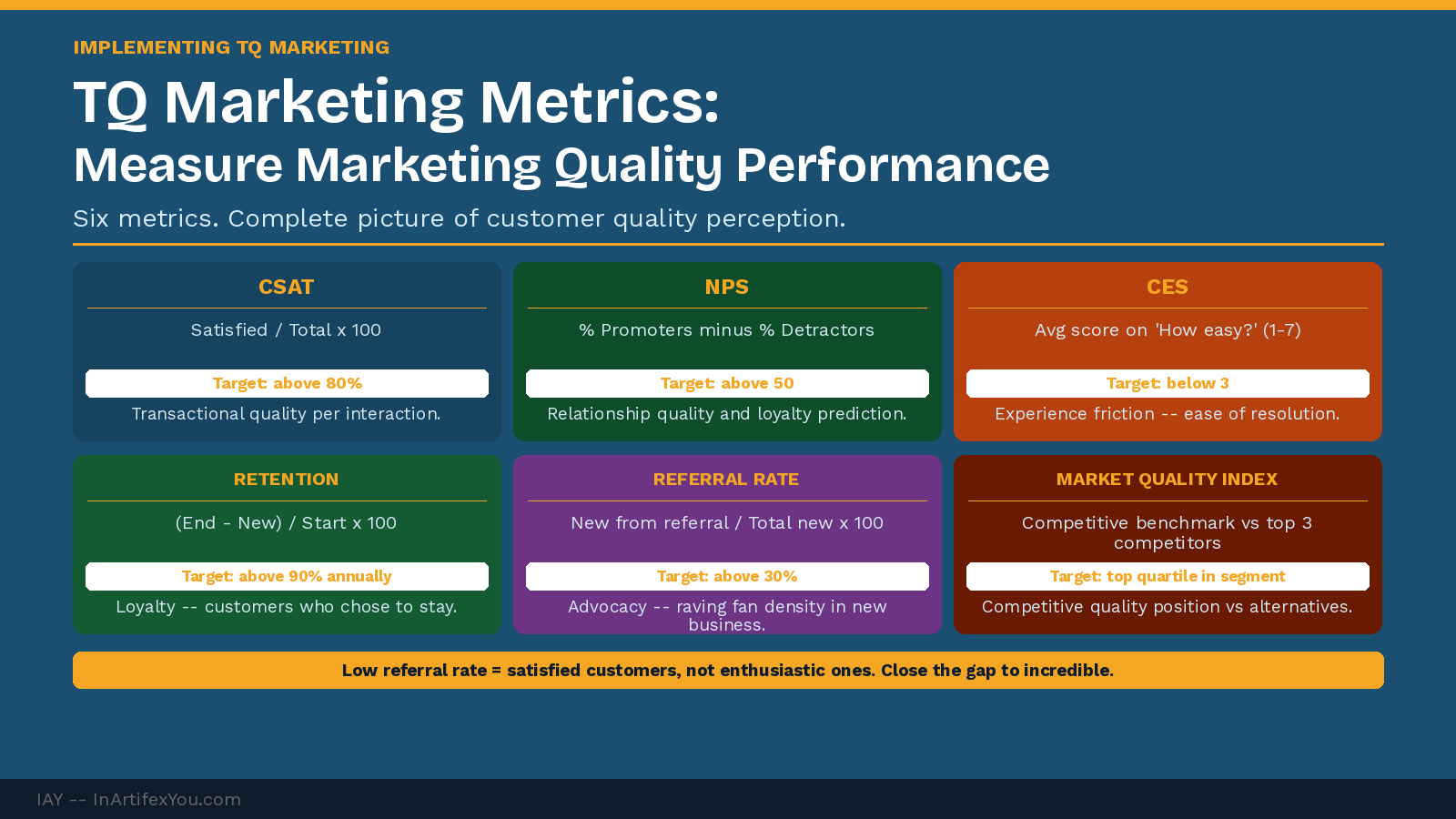
Most marketing measurement systems track outputs — leads generated, campaigns deployed, conversion rates achieved. TQ Marketing measurement tracks outcomes — how the market perceives and responds to the quality of what the organization delivers. The six metrics below form a complete TQ Marketing measurement system that connects customer experience data to improvement priorities.
The Six TQ Marketing Metrics
|
Metric |
Formula |
World-Class Target |
What It Reveals |
|
CSAT. |
Satisfied responses / Total responses x 100. |
Above 80%. |
Transactional quality — how well specific interactions met customer expectations. |
|
NPS. |
% Promoters (9-10) minus % Detractors (0-6). |
Above 50. |
Relationship quality — cumulative experience predicting loyalty and advocacy. |
|
CES. |
Average score on 'How easy was it?' (1-7 scale). |
Below 3. |
Experience friction — how hard the customer had to work to get what they needed. |
|
Retention Rate. |
(Customers at end - new customers) / Customers at start x 100. |
Above 90% annually. |
Loyalty — the percentage of customers who chose to stay over a defined period. |
|
Referral Rate. |
New customers from referral / Total new customers x 100. |
Above 30%. |
Advocacy density — the proportion of new business generated by raving fans. |
|
Market Quality Index. |
Composite competitive benchmarking score vs top 3 competitors. |
Top quartile in segment. |
Competitive quality position — how the market ranks the organization's quality vs alternatives. |
How to Set TQ Marketing Metric Targets
TQ Marketing targets should be set at three levels — not just one aspirational number:
- Minimum acceptable: the floor below which action is mandatory — a CSAT below 70% or NPS below 20 triggers immediate improvement response.
- Current target: the improvement goal for the current planning period — set based on current performance plus a realistic improvement increment.
- World-class benchmark: the standard achieved by the best organizations in the industry — used to calibrate long-term ambition and avoid setting targets too low.
Connecting Metrics to Improvement Priorities
Each TQ Marketing metric points to a different improvement lever — the discipline is knowing which lever to pull when a metric underperforms:
METRIC-TO-IMPROVEMENT MAPPING
Low CSAT: root cause analysis on the specific interaction that is underperforming — apply DMAIC or Kaizen.
Low NPS: the overall customer relationship has quality problems across multiple touchpoints — map the full journey and identify the pattern.
High CES (high effort): the customer is working too hard to get resolution — eliminate handoffs, simplify the process, improve self-service.
Low Retention Rate: customers are not staying — segment by reason for churn and address the highest-frequency departure reason first.
Low Referral Rate: customers are satisfied but not enthusiastic enough to recommend — the service is at 'expected' level but not at 'incredible' level.
Low Market Quality Index: competitors are winning on perceived quality — benchmark their practices and identify which quality dimensions they are winning on.
Reporting TQ Marketing Metrics
TQ Marketing metrics should be reported alongside operational quality metrics at every management review — not in a separate marketing report. The juxtaposition that matters:
- CSAT next to First Pass Yield: if FPY is high but CSAT is low, the product is meeting specification but not meeting customer expectations — the specification is wrong.
- NPS next to complaint rate: if complaint rate is low but NPS is also low, customers are not complaining — they are leaving silently.
- Referral Rate next to customer acquisition cost: as referral rate increases, acquisition cost decreases — quantify this relationship and present it as the ROI of quality improvement investment.
The TQ Marketing Dashboard Cadence
- Weekly: CSAT and CES at touchpoint level — operational signals requiring fast response.
- Monthly: NPS trend and retention rate — relationship quality signals requiring strategic response.
- Quarterly: referral rate and Market Quality Index — competitive quality position requiring long-term improvement investment.
The Measurement Principle
What gets measured gets improved. What gets reported at management review gets resourced.
TQ Marketing metrics belong in the same management review as process quality metrics — because they measure the same thing from the customer's side of the system.
Back to hub: Implementing TQ Marketing.
| ||||||||||||||||||||||
The Continuous Improvement Certification at InArtifexYou gives you a complete, practical system to map, baseline, improve, and sustain any process — and the verified credential to prove you can lead it.
inartifexyou.com/continuous-improvement-certification-online.html | ||||||||||||||||||||||
|