Voice of the customer: methods and tools for capturing
requirements
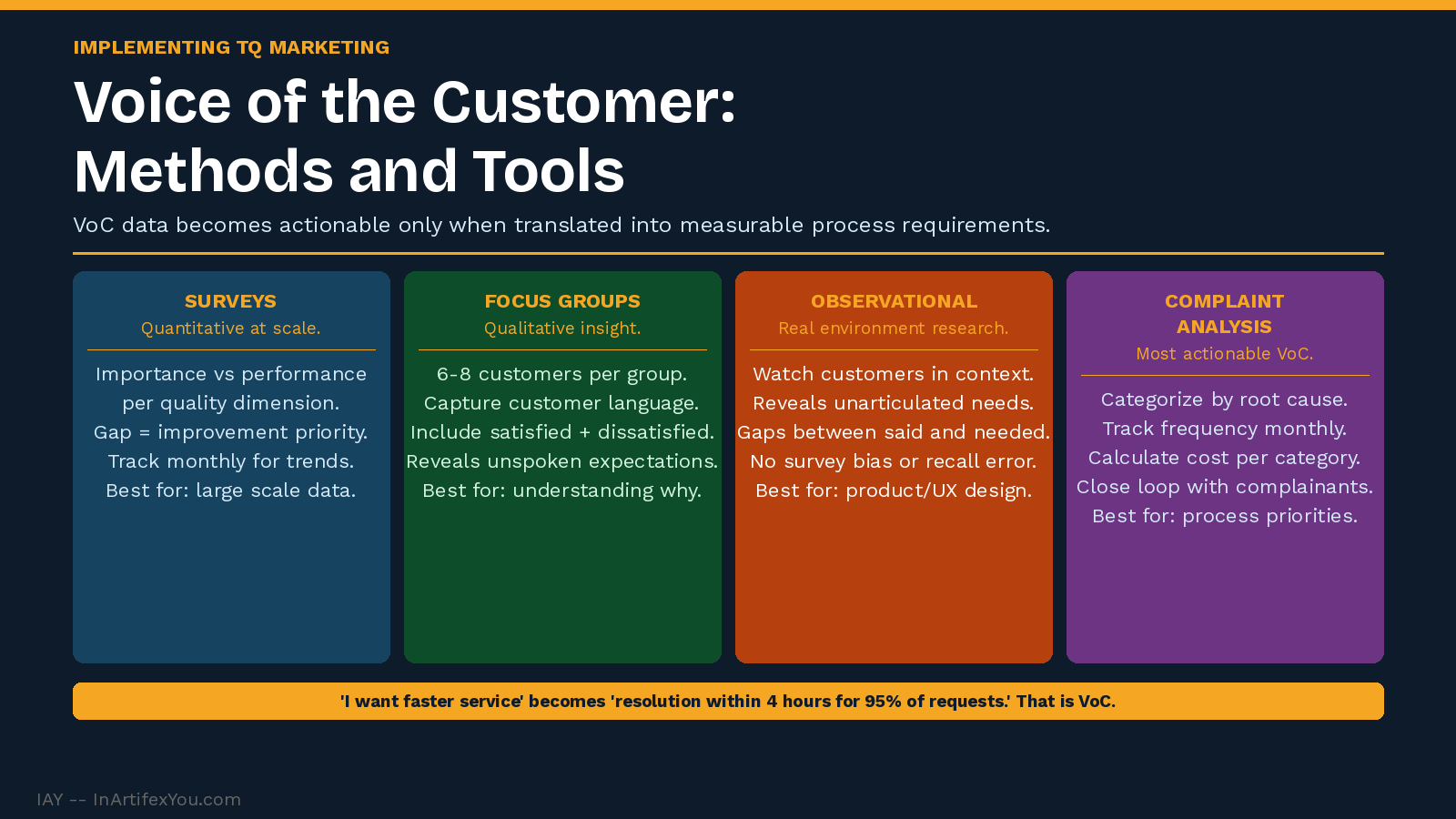
The Voice of the Customer (VoC) is the process of capturing customer requirements, expectations, preferences, and perceptions of quality through systematic research methods. The four primary VoC methods are: surveys (structured questionnaires measuring satisfaction, importance, and performance across quality dimensions — best for quantitative data at scale), focus groups (facilitated group discussions that reveal the language customers use to describe quality and the emotional dimensions of their experience — best for qualitative insight), observational research (watching customers use products or services in real environments — reveals requirements that customers cannot articulate in surveys), and complaint and feedback analysis (systematic analysis of complaints, reviews, and service escalations to identify the most common quality failures). VoC data is only valuable when it is translated into specific, measurable requirements that operations can act on — the translation step is where most VoC programs fail.
Most organizations collect some form of customer feedback. Very few have a system that consistently translates that feedback into improvement actions. The VoC program described below is designed to close that gap — not just to collect data but to produce actionable quality requirements at every stage.
VoC Method 1: Customer Surveys
Surveys are the most scalable VoC method — they can reach thousands of customers at low cost and produce quantitative data that can be tracked over time. Effective quality surveys measure two dimensions for each quality attribute:
- Importance: how important is this attribute to the customer? (1–10 scale).
- Performance: how well is the organization currently delivering on this attribute? (1–10 scale).
The gap between importance and performance — plotted in an importance-performance matrix — identifies the highest-priority quality improvements: high importance, low performance attributes are the most urgent action areas.
VoC Method 2: Focus Groups
Focus groups reveal the qualitative dimensions of customer experience that surveys cannot capture — the emotional language customers use, the trade-offs they make, and the unspoken expectations they have never articulated. Key focus group design principles:
- Use 6–8 customers per group — enough diversity for good discussion, small enough for everyone to contribute.
- Record and analyze the exact language customers use to describe quality — their words become the quality vocabulary for improvement projects.
- Include both satisfied and dissatisfied customers — dissatisfied customers reveal problems; satisfied customers reveal what to protect.
VoC Method 3: Observational Research
Observational research — watching customers use products or services in their natural environment — reveals requirements that customers cannot articulate because they have never consciously thought about them. This method is particularly powerful for product design and service process improvement because it surfaces the gap between what customers say they want and what they actually need.
VoC Method 4: Complaint and Feedback Analysis
Complaint data is the most actionable VoC input — it represents customers who experienced a quality failure significant enough to report. A systematic complaint analysis process:
- Categorize every complaint by root cause — not by symptom. A complaint about 'slow delivery' may have root causes in order processing, warehouse picking, or carrier selection.
- Track complaint frequency by category monthly — the most common root cause categories are the highest-priority quality improvements.
- Calculate the financial cost of each complaint category — customer acquisition cost of lost customers plus resolution cost per complaint.
- Close the loop with complainants — contact customers whose complaints triggered improvement projects and inform them of the resolution.
The Translation Rule
VoC data becomes actionable when it is translated from customer language into measurable process requirements.
Example: 'I want faster service' becomes 'response time from contact to resolution must be below 4 hours for 95% of requests.'
Without this translation, VoC data produces insights — not improvements.
| ||||||||||||||||||||||
The Continuous Improvement Certification at InArtifexYou gives you a complete, practical system to map, baseline, improve, and sustain any process — and the verified credential to prove you can lead it.
inartifexyou.com/continuous-improvement-certification-online.html | ||||||||||||||||||||||
|