How to implement TQ marketing in your organization
Implementing TQ Marketing in an organization requires four sequential phases. Phase 1 — Voice of the Customer (VoC) capture: establish systematic methods to collect customer requirements, satisfaction data, complaints, and market expectations — surveys, NPS tracking, complaint analysis, and focus groups. Phase 2 — Quality gap analysis: compare current process performance against customer-defined quality requirements to identify where the largest gaps exist between what customers expect and what the organization currently delivers. Phase 3 — Improvement integration: use the quality gap analysis to set improvement project priorities — the projects that close the largest customer-perceived gaps take precedence over internal efficiency projects with no customer impact. Phase 4 — Closed-loop measurement: track customer satisfaction metrics alongside process performance metrics to verify that improvement projects are producing visible improvements in customer-perceived quality, not just in process indicators.
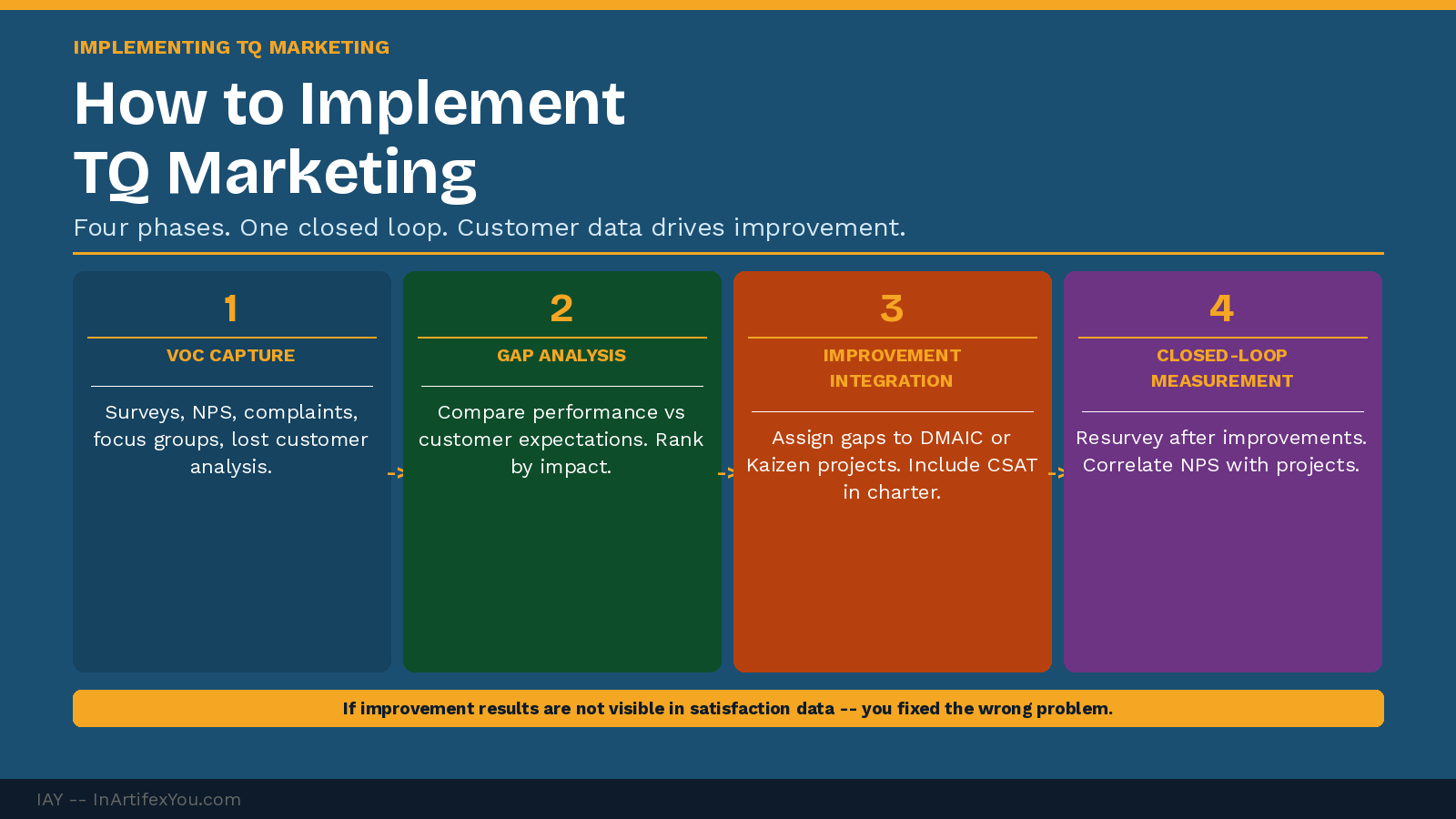
TQ Marketing implementation fails most often for one of two reasons: the organization collects VoC data but does not connect it to improvement priorities, or it improves processes internally without verifying that those improvements are visible to and valued by customers. The four-phase approach below prevents both failure modes by building the connection between customer data and improvement action at every step.
Phase 1: Voice of the Customer Capture
The first phase establishes the systematic data collection mechanisms that will feed the entire TQ Marketing system:
- Transaction surveys: short surveys sent immediately after a purchase or service interaction — captures satisfaction at the moment of truth when the experience is fresh.
- Relationship surveys: quarterly or annual surveys measuring overall satisfaction across all touchpoints — NPS, overall satisfaction, and quality dimension ratings.
- Complaint and escalation tracking: every complaint is logged, categorized by root cause, and analyzed for patterns — the most common complaint categories become improvement priorities.
- Lost customer analysis: exit interviews or surveys with customers who stopped buying — reveals dissatisfaction that never became a formal complaint.
- Competitive benchmarking: how do customers rate competitors on the same quality dimensions? The gap between competitor performance and your own defines the competitive quality opportunity.
Phase 2: Quality Gap Analysis
Gap analysis translates VoC data into actionable quality priorities:
|
Quality Dimension |
Customer Expectation |
Current Performance |
Gap |
Priority |
|
Response time. |
Same-day response. |
Average 2 days. |
High. |
1 — Immediate action. |
|
Order accuracy. |
100% correct. |
98.2% correct. |
Low. |
3 — Monitoring. |
|
Product reliability. |
Zero defects in 12 months. |
0.8% failure rate. |
Medium. |
2 — Improvement project. |
|
Communication clarity. |
Proactive updates. |
Reactive only. |
High. |
1 — Immediate action. |
Phase 3: Improvement Integration
This phase connects VoC gap analysis to the continuous improvement system:
- Rank gaps by customer impact — how much does closing this gap improve customer-perceived quality?.
- Assign each high-priority gap to an improvement project — DMAIC for complex root causes, Kaizen for quick wins.
- Include a customer-perceived quality metric in every improvement project charter — not just internal process metrics.
- Report improvement project results in customer language — 'response time improved from 2 days to 4 hours' communicates value more clearly than 'process cycle time reduced by 75%.
Phase 4: Closed-Loop Measurement
The final phase verifies that improvement projects are producing visible results for customers:
- Resurvey customers after improvement implementation — has the satisfaction score for the targeted dimension improved?
- Track NPS monthly and correlate movements with improvement initiatives — which projects moved the score?
- Report the VoC-to-improvement cycle at management review — how many VoC inputs were acted on, what was the improvement, and what was the customer response?
The Implementation Principle
If improvement project results are not visible in customer satisfaction data, one of two things is true: the project did not fix the right problem, or the customer does not value the improvement.
TQ Marketing's closed-loop measurement catches both failures — before the next planning cycle begins.
Back to hub: Implementing TQ Marketing.
| ||||||||||||||||||||||
The Continuous Improvement Certification at InArtifexYou gives you a complete, practical system to map, baseline, improve, and sustain any process — and the verified credential to prove you can lead it.
inartifexyou.com/continuous-improvement-certification-online.html | ||||||||||||||||||||||
|