FMS performance metrics: OEE, throughput, and
flexibility indices
FMS performance is measured through four categories of metrics. Equipment effectiveness: OEE (Overall Equipment Effectiveness) = Availability x Performance x Quality — world-class FMS target is 85%+ OEE. Throughput: actual parts produced per unit time versus theoretical maximum capacity — measured separately for each workstation and for the system as a whole. Flexibility indices: machine flexibility index (number of different part types the system can process), routing flexibility index (number of alternative routes available for each part type), and changeover time per product transition. System utilization: percentage of scheduled time that each workstation is actively processing parts — high utilization at the constraint workstation and balanced utilization across all stations indicates a well-designed system. The most important FMS metric is system throughput at the constraint — because constraint throughput determines total system output regardless of how well all other workstations perform.
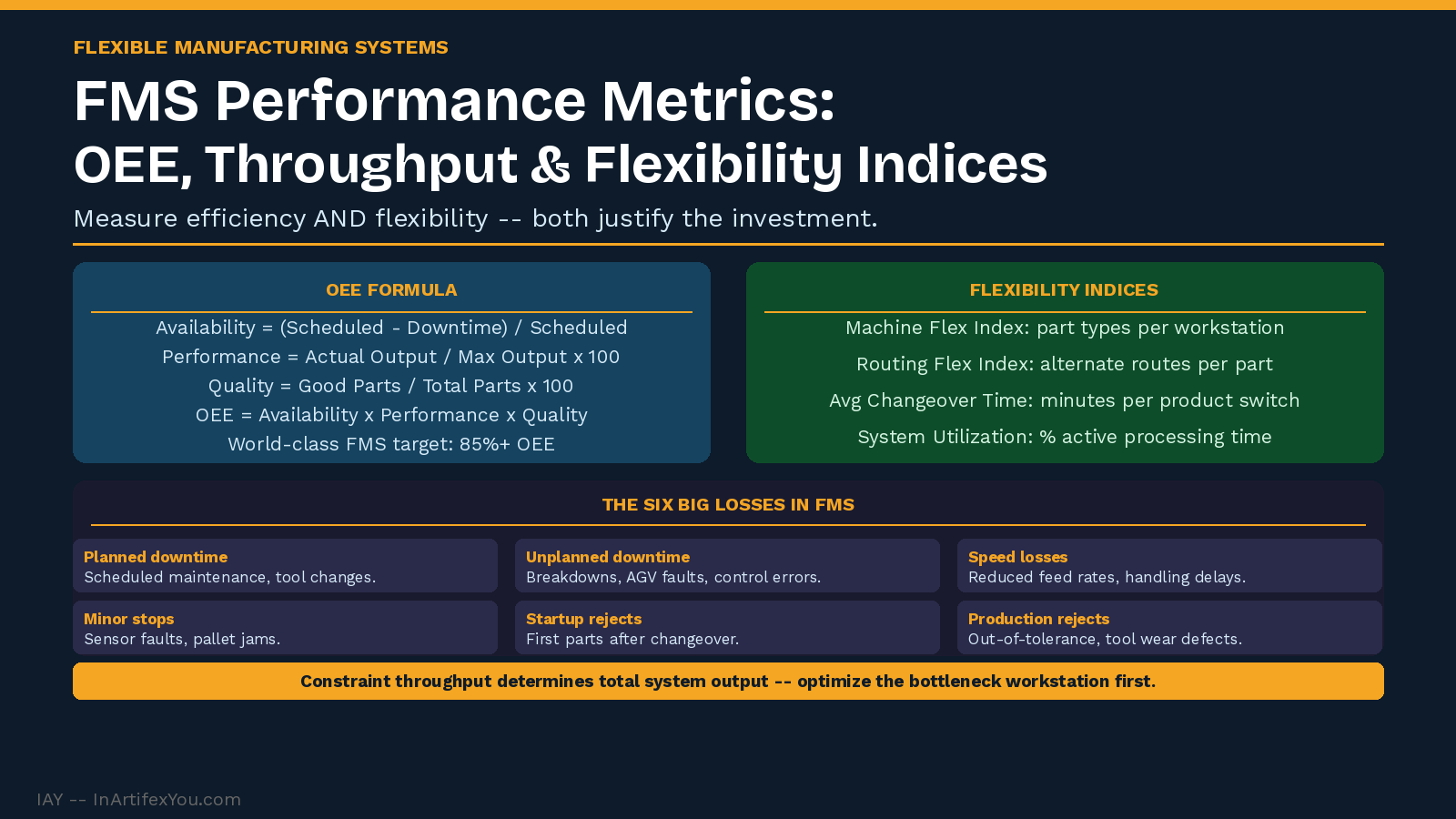
Measuring FMS performance requires metrics that capture both the efficiency of the equipment and the flexibility of the system — the two capabilities that justify the significant capital investment. An FMS that achieves high OEE but low flexibility is a dedicated line in disguise. An FMS that achieves high flexibility but low OEE is not delivering its economic promise.
OEE: The Equipment Effectiveness Foundation
OEE is calculated as the product of three ratios:
OEE Formula
Availability = (Scheduled Time - Downtime) / Scheduled Time.
Performance = (Actual Output / Theoretical Maximum Output) x 100.
Quality = (Good Parts / Total Parts Started) x 100.
OEE = Availability x Performance x Quality.
World-class FMS target: 85%+ OEE. Typical first-year FMS: 60–70% OEE.
The Six Big Losses in FMS
|
Loss Category |
OEE Component |
FMS-Specific Examples |
|
Planned downtime. |
Availability. |
Scheduled maintenance, tool changes, pallet loading. |
|
Unplanned downtime. |
Availability. |
Machine breakdowns, AGV faults, control system errors. |
|
Speed losses. |
Performance. |
Reduced feed rates, program errors, material handling delays. |
|
Minor stops. |
Performance. |
Sensor faults, pallet jams, tool breakage detection pauses. |
|
Startup rejects. |
Quality. |
First parts after changeover — fixture errors, program verification. |
|
Production rejects. |
Quality. |
Out-of-tolerance parts, tool wear defects, fixturing errors. |
Flexibility Indices
- Machine flexibility index: number of different part types each workstation can process without physical reconfiguration — a machining center that handles 50 different part programs scores higher than one limited to 10.
- Routing flexibility index: number of alternative process routes available for each part type — systems with higher routing flexibility recover faster from individual workstation failures.
- Average changeover time: time required to switch production from one part type to another — track as a trend metric and target continuous reduction through setup standardization.
System-Level Metrics
- System throughput rate: total parts delivered per shift across the entire FMS — the primary output metric that determines revenue impact.
- Work-in-process level: average number of parts in the system at any point — high WIP indicates scheduling imbalance or bottleneck accumulation.
- Mean time between failures (MTBF): average operating time between breakdowns — tracks equipment reliability improvement over time.
- Mean time to repair (MTTR): average time to restore a failed workstation to operation — tracks maintenance effectiveness.
Back to hub: Flexible Manufacturing Systems.
| ||||||||||||||||||||||
The Continuous Improvement Certification at InArtifexYou gives you a complete, practical system to map, baseline, improve, and sustain any process — and the verified credential to prove you can lead it.
inartifexyou.com/continuous-improvement-certification-online.html | ||||||||||||||||||||||
|