How to implement an FMS: planning, investment, and
integration
Implementing a Flexible Manufacturing System requires five sequential phases. Phase 1 — Business Case: define the product mix, volume requirements, and financial justification — FMS investment is only warranted when high-mix, medium-volume production economics support a 3–5 year payback period. Phase 2 — System Design: specify the workstation types and quantities, material handling system, part routing logic, and control system architecture. Phase 3 — Procurement and Integration: select equipment vendors, negotiate contracts, and develop the system integration specification that defines how all components communicate. Phase 4 — Installation and Commissioning: install equipment, integrate control systems, validate material handling sequences, and run acceptance tests against defined performance criteria. Phase 5 — Optimization: use production data to refine scheduling algorithms, reduce bottlenecks, and continuously improve OEE. FMS implementation typically takes 18–36 months from business case approval to full production capability.
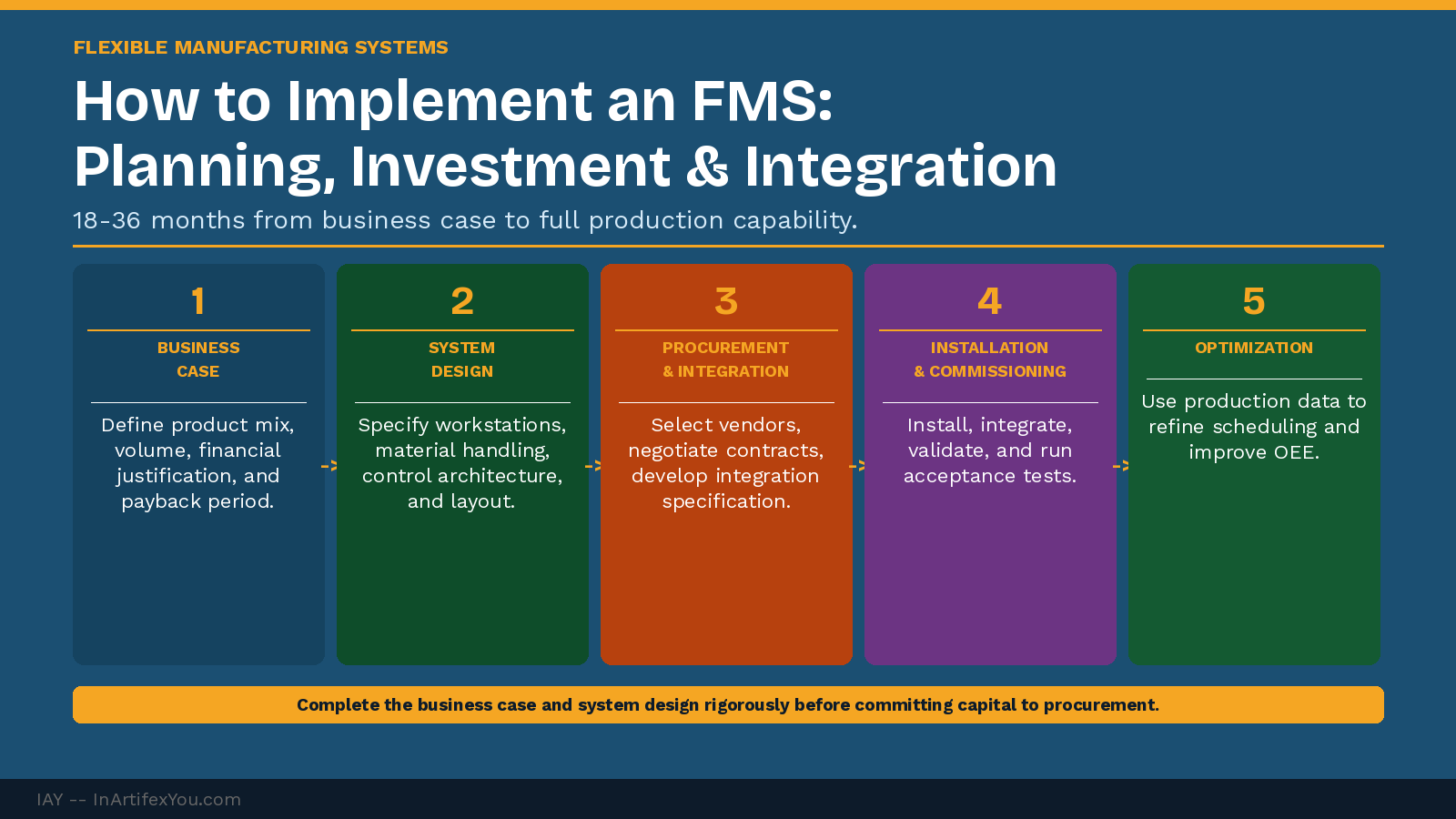
FMS implementation is one of the most complex manufacturing investment decisions an organization can make. The capital commitment is significant, the integration complexity is high, and the performance expectations are demanding. Organizations that succeed with FMS implementation share one characteristic: they complete the business case and system design work rigorously before committing capital to procurement.
Phase 1: Business Case Development
The FMS business case must answer five questions before any capital commitment is made:
- What is the target product mix — how many part families, how many variants, what range of sizes and materials?.
- What is the required annual throughput for each part family?.
- What is the current cost of producing this mix — labor, setup, material handling, quality — and what is the FMS target cost?.
- What is the capital investment required and what is the payback period at the target volume?.
- What is the volume sensitivity — does the business case hold if volume drops 20% or the mix shifts significantly?.
Phase 2: System Design
System design translates business requirements into a physical and technical specification:
- Workstation specification: number and type of CNC machining centers, their tool capacity, pallet capacity, and cycle time for each operation in the target part mix.
- Material handling design: AGV routes, conveyor layout, load/unload stations, pallet pool sizing, and buffer storage capacity at each workstation.
- Control system architecture: FMS controller software selection, integration interfaces to ERP and MES, real-time monitoring capability, and alarm management.
- Layout design: shop floor space requirements, utility connections, safety zones, and maintenance access.
Phase 3: Procurement and Integration
FMS procurement involves multiple vendors — machine tool builders, material handling suppliers, and control system integrators — whose equipment must all work together as a single system. The system integration specification is the most critical procurement document: it defines exactly how all components communicate, what data flows between systems, and who is responsible for integration testing.
Phase 4: Installation and Commissioning
Commissioning follows a defined sequence: individual machine acceptance tests, material handling system testing, control system integration testing, and finally full system performance testing against the contracted acceptance criteria. A typical FMS acceptance test runs the system for a defined period — often 72 hours — and measures actual OEE, part quality, and system availability against contracted targets.
Phase 5: Optimization
- Scheduling algorithm refinement: initial scheduling logic is based on estimates — actual production data reveals where queues form and how to rebalance the load.
- Bottleneck identification and elimination: use TOC five focusing steps to identify the constraint and subordinate all other system elements to it.
- OEE improvement: track availability, performance, and quality losses separately and apply targeted improvements to the largest loss category.
Back to hub: Flexible Manufacturing Systems.
| ||||||||||||||||||||||
The Continuous Improvement Certification at InArtifexYou gives you a complete, practical system to map, baseline, improve, and sustain any process — and the verified credential to prove you can lead it.
inartifexyou.com/continuous-improvement-certification-online.html | ||||||||||||||||||||||
|