FMS vs CIM: how flexible and computer-integrated
manufacturing compare
FMS (Flexible Manufacturing System) and CIM (Computer-Integrated Manufacturing) are related but operate at different levels of scope. An FMS is a production system — a group of computer-controlled machines and automated material handling equipment designed to produce a variety of parts efficiently. CIM is an enterprise-level integration concept — it connects all manufacturing functions, including design, production planning, scheduling, quality, and business systems, into a single integrated information environment. The relationship: an FMS is typically a component within a CIM architecture. CIM provides the information integration that allows an FMS to receive production orders from ERP, deliver quality data to the QMS, and report performance to management dashboards in real time. FMS without CIM produces parts efficiently but requires manual data transfer between systems. CIM without FMS provides information integration but depends on the flexibility of the manufacturing equipment it controls.
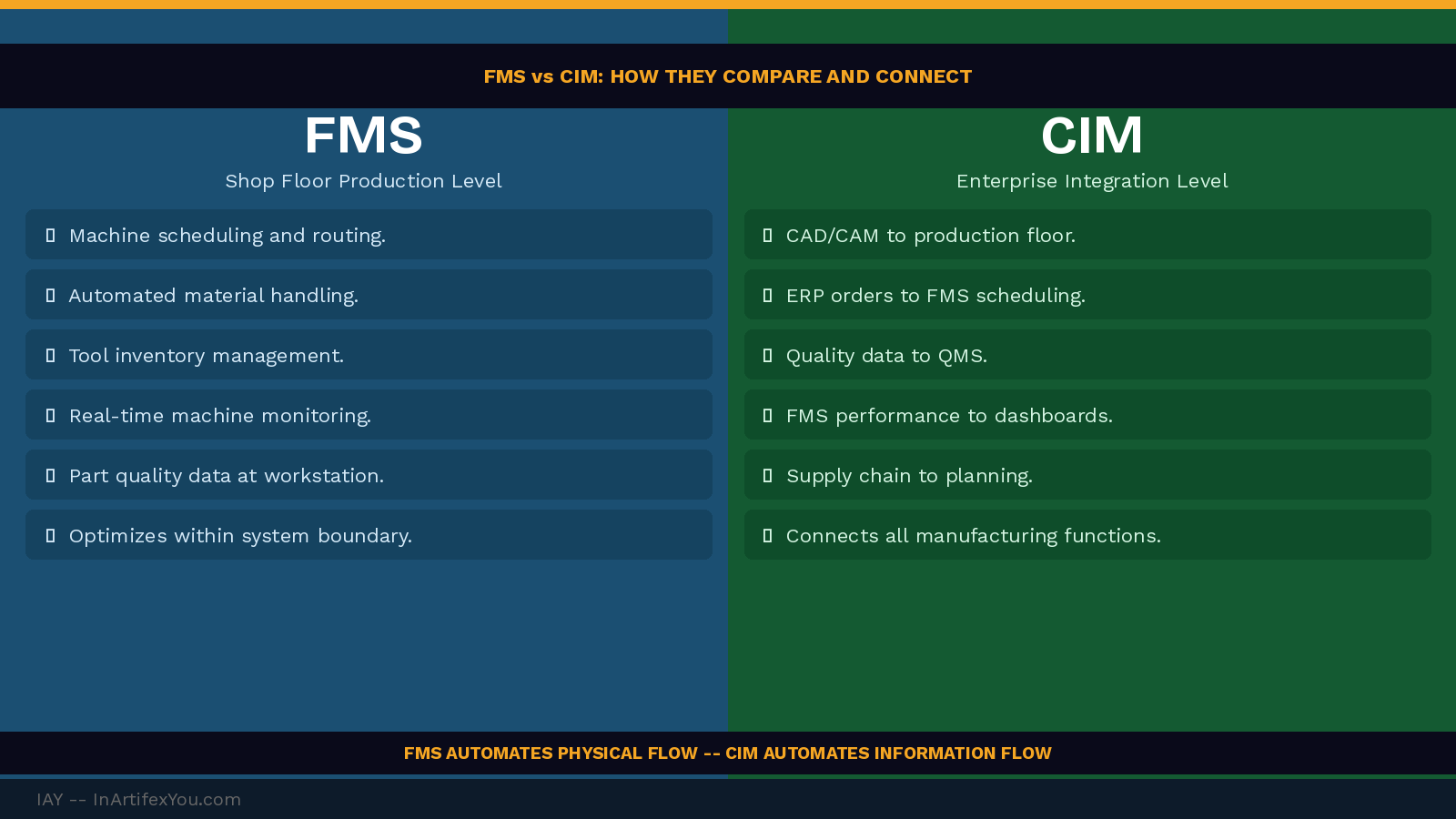
The FMS vs. CIM comparison is frequently framed as a choice — which one should we implement? This framing misunderstands the relationship. FMS and CIM are not alternatives — they operate at different levels of the manufacturing enterprise and are most powerful when implemented together.
FMS: The Production System Level
An FMS operates at the shop floor level. It is concerned with how parts are produced — which machines process them, in what sequence, with what tooling, and how they move between workstations. The FMS controller optimizes machine utilization, minimizes part travel time, and manages tool availability within the system boundary.
|
FMS SCOPE Shop floor production operations. |
CIM SCOPE Enterprise-wide information integration. |
The Integration Architecture
In a fully integrated manufacturing enterprise, CIM provides the information backbone that connects:
- Product design (CAD/CAM) to production planning — designs flow directly to manufacturing process plans without manual translation.
- ERP production orders to FMS scheduling — customer orders automatically generate production schedules that the FMS controller executes.
- FMS quality data to the QMS — inspection results from machining centers flow automatically to the quality management system for SPC analysis.
- FMS performance data to management reporting — OEE, throughput, and downtime data flow automatically to management dashboards.
Implementation Sequence
|
Phase |
What to Implement |
Value Delivered |
|
Phase 1. |
FMS — automate production operations and material handling. |
Machine efficiency, flexibility, reduced direct labor. |
|
Phase 2. |
MES — connect shop floor data to production management. |
Real-time visibility, quality data capture, production reporting. |
|
Phase 3. |
CIM integration — connect MES to ERP, QMS, and CAD/CAM. |
Enterprise data integration, closed-loop quality, automated scheduling. |
The Architecture Principle
FMS automates the physical flow. CIM automates the information flow.
Together they produce a manufacturing system where production decisions are made faster, quality data is captured automatically, and performance is visible in real time across the entire enterprise.
Back to hub: Flexible Manufacturing Systems.
| ||||||||||||||||||||||
The Continuous Improvement Certification at InArtifexYou gives you a complete, practical system to map, baseline, improve, and sustain any process — and the verified credential to prove you can lead it.
inartifexyou.com/continuous-improvement-certification-online.html | ||||||||||||||||||||||
|