FMS scheduling and production sequencing: how to
optimize routing
FMS scheduling determines which parts are processed at which workstations, in what sequence, and via which routes through the system at any given time. Effective FMS scheduling requires three decisions made simultaneously: part sequencing (which part to process next at each workstation, based on priority rules such as earliest due date, shortest processing time, or critical ratio), routing selection (which path through the available workstations a part will follow, based on current machine availability and queue lengths), and buffer management (how much work-in-progress to maintain ahead of each workstation to protect the constraint from starvation). The most common FMS scheduling mistake is treating scheduling as a static plan rather than a dynamic decision: an FMS that responds to real-time machine status, queue depths, and part priorities consistently outperforms one running a fixed daily schedule by 15–25% in throughput at equivalent OEE.
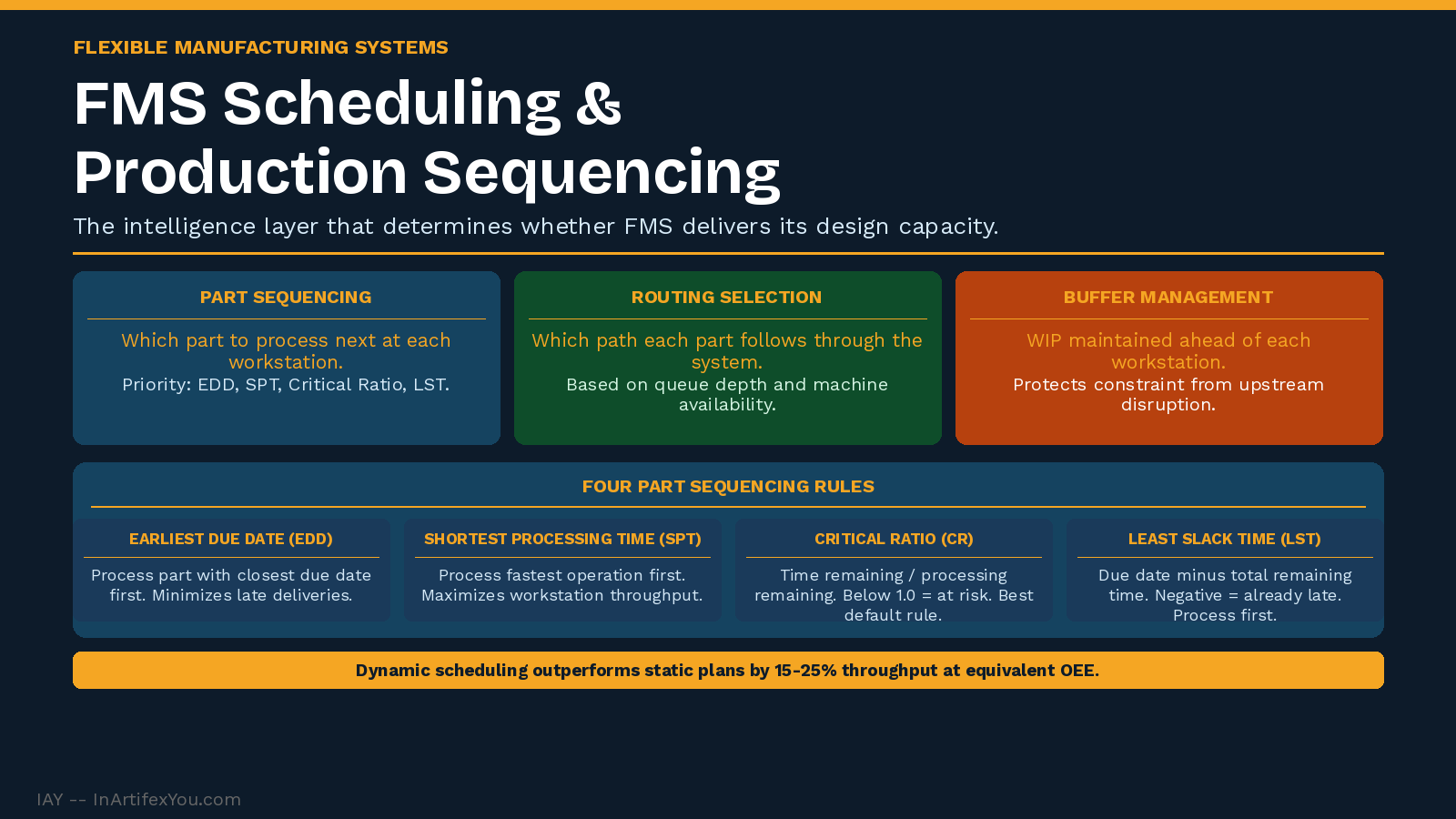
FMS scheduling is the intelligence layer that determines whether an FMS delivers its design capacity or underperforms relative to its capital cost. The machines, the material handling system, and the control infrastructure are the hardware. Scheduling is the operating logic that decides how to use them. Poor scheduling on excellent hardware produces mediocre results. Good scheduling on good hardware can approach theoretical maximum throughput.
The Three Scheduling Decisions
Every FMS scheduling system must make three decisions continuously — in real time, as production conditions change:
|
Decision |
What It Determines |
Primary Inputs |
|
Part sequencing. |
Which part to process next at each workstation. |
Due date, processing time, priority class, customer order status. |
|
Routing selection. |
Which path through available workstations each part will follow. |
Current machine availability, queue lengths, tool availability. |
|
Buffer management. |
How much WIP to maintain ahead of each workstation. |
Workstation cycle time, upstream reliability, constraint protection requirements. |
Part Sequencing Rules
Four priority rules are commonly used in FMS scheduling — each optimizes for a different objective:
- Earliest Due Date (EDD): process the part with the closest due date first — minimizes late deliveries but does not optimize machine utilization.
- Shortest Processing Time (SPT): process the part with the shortest operation time first — maximizes throughput at individual workstations but may delay complex parts with long processing times.
- Critical Ratio (CR): (time remaining until due date) / (total remaining processing time) — ratios below 1.0 indicate parts at risk of being late; process in ascending CR order.
- Least Slack Time (LST): due date minus total remaining processing time minus current time — negative slack means the part is already behind schedule; process in ascending LST order.
The Practical Rule
Use Critical Ratio as the primary sequencing rule — it dynamically updates as time passes and automatically escalates parts that are falling behind schedule.
Override with SPT at non-constraint workstations to maximize their throughput without delaying constraint-bound parts.
Routing OptimizationMinimize total travel distance — when two workstations are equally loaded, direct the part to the closer
In an FMS with multiple workstations capable of processing the same part type, the routing decision significantly impacts system throughput. The routing logic should:
- Direct parts to the workstation with the shortest current queue — balancing load across equivalent machines prevents one from becoming a bottleneck while others are idle.
- Protect the constraint workstation — parts that must pass through the constraint should be routed to other workstations for non-constraint operations first, arriving at the constraint ready to be processed immediately.
- Minimize total travel distance — when two workstations are equally loaded, direct the part to the closer one to reduce AGV travel time and system WIP.
Dynamic Rescheduling: Responding to Real-Time Events
Static FMS schedules — built once and executed as planned — degrade rapidly when machine breakdowns, tool failures, or demand changes occur. Dynamic scheduling continuously re-evaluates the plan based on current system state and adjusts routing and sequencing accordingly.
- Trigger 1: Workstation breakdown — reroute all queued parts to alternate workstations immediately. Reprioritize using Critical Ratio.
- Trigger 2: Tool depletion — redirect parts requiring that tool to a workstation with the tool available, or hold them in buffer until the tool is replaced.
- Trigger 3: Rush order insertion — assign the highest priority class, apply LST sequencing, and clear routing to the constraint workstation.
Buffer Sizing Rule:
Buffer size = average upstream disruption duration x constraint processing rate.
Example: if upstream disruptions average 45 minutes and the constraint processes 4 parts per hour, the buffer should hold at least 3 parts at all times.
Monitor buffer level continuously — a shrinking buffer is an early warning that an upstream disruption is occurring or about to occur.
Back to hub: Flexible Manufacturing Systems.
| ||||||||||||||||||||||
The Continuous Improvement Certification at InArtifexYou gives you a complete, practical system to map, baseline, improve, and sustain any process — and the verified credential to prove you can lead it.
inartifexyou.com/continuous-improvement-certification-online.html | ||||||||||||||||||||||
|