FMS and Lean manufacturing: how they work together
FMS and Lean manufacturing are complementary, not competing. FMS provides the automated infrastructure — computer-controlled machines, automated material handling, flexible routing — that makes Lean principles operationally achievable at high speed and variety. Lean provides the operating discipline — pull production, one-piece flow, waste elimination, visual management — that ensures the FMS investment delivers its maximum value. The key connections: FMS enables pull production at high mix by routing parts automatically based on actual downstream demand rather than forecast. FMS enables one-piece flow by eliminating the batch transfer delays that make flow impossible in manual high-mix environments. Lean improvement methods — particularly Kaizen and TPM (Total Productive Maintenance) — are the primary tools for improving FMS OEE after the system is commissioned. An FMS without Lean discipline produces parts efficiently but accumulates the same seven wastes as any other manufacturing system.
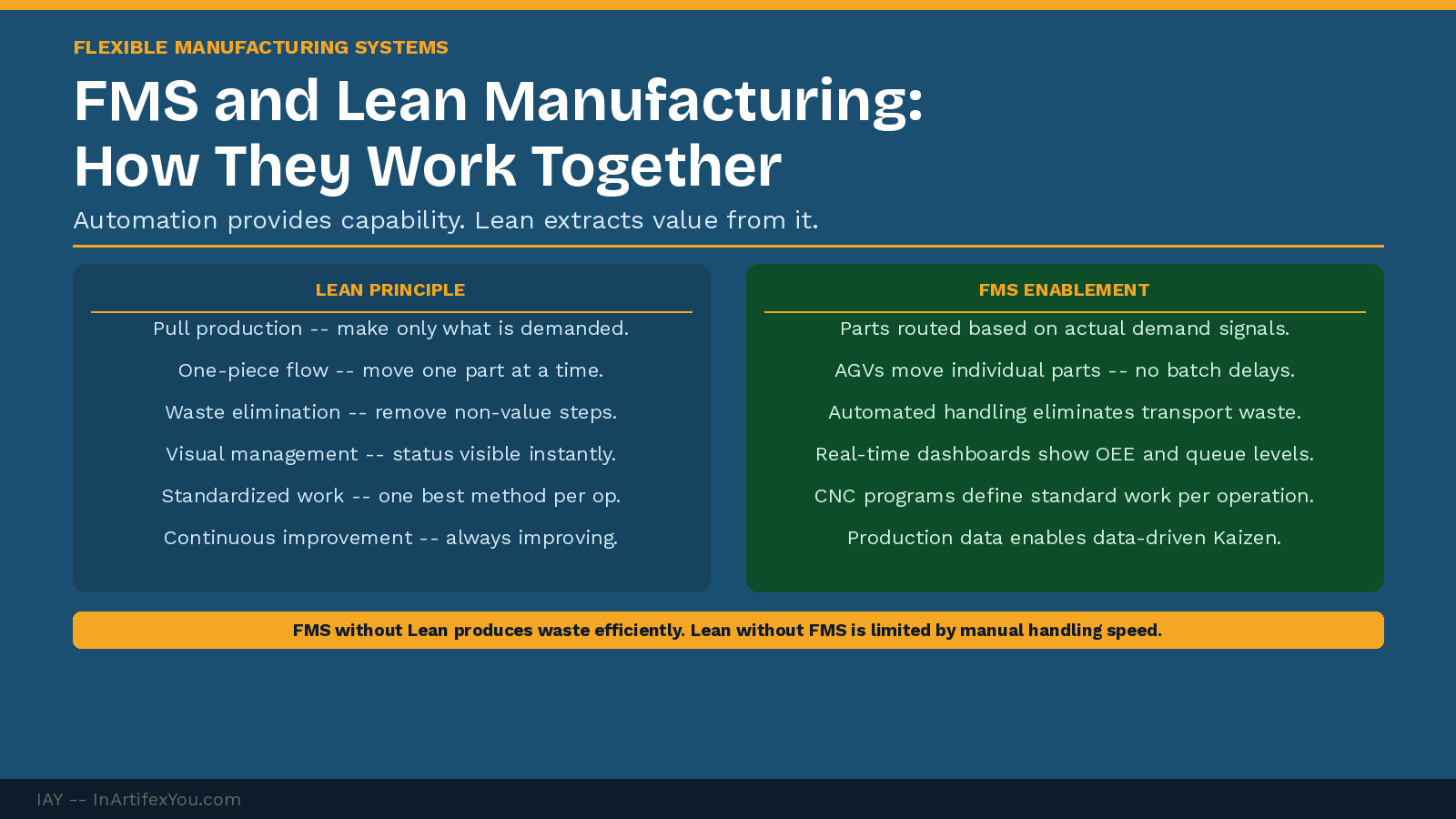
The most powerful flexible manufacturing systems in the world — Toyota's machining lines, Boeing's composites facilities, Airbus's assembly systems — are not just technologically advanced. They are also rigorously Lean. The automation provides capability. The Lean discipline extracts value from that capability. Without both, the system underperforms.
|
LEAN PRINCIPLE Pull production — make only what is demanded. |
FMS ENABLEMENT FMS routes parts based on actual demand signals from downstream. |
Total Productive Maintenance in FMS
TPM is the Lean approach to equipment reliability — and it is the most important Lean practice for FMS performance. An FMS with unreliable equipment cannot achieve the routing flexibility and throughput that justify its capital cost. TPM in an FMS context covers:
- Autonomous maintenance: operators trained to perform basic maintenance tasks — cleaning, lubrication, inspection — at the workstation level, catching problems before they cause breakdowns.
- Planned maintenance: scheduled preventive maintenance aligned to production schedules so that planned downtime is minimized and predictable.
- Focused improvement: Kaizen events targeting the workstation with the highest unplanned downtime — using OEE data to identify where TPM investment will produce the most throughput improvement.
Lean Scheduling in an FMS
Traditional FMS scheduling pushes production plans through the system based on forecast. Lean-influenced FMS scheduling uses pull signals — triggered by actual downstream demand — to authorize production only when the next workstation has capacity.
The practical implementation uses electronic kanban signals: when a part is consumed at the next workstation, a signal is sent to the FMS controller authorizing production of a replacement. The result is a self-regulating system that naturally limits WIP, reduces lead time, and responds to demand variation without requiring manual scheduler intervention.
The Integration Principle
FMS without Lean is a fast machine that produces waste efficiently.
Lean without FMS is an operating discipline limited by manual material handling speed.
FMS with Lean discipline is the combination that achieves high efficiency, high flexibility, and continuous improvement simultaneously.
Back to hub: Flexible Manufacturing Systems.
| ||||||||||||||||||||||
The Continuous Improvement Certification at InArtifexYou gives you a complete, practical system to map, baseline, improve, and sustain any process — and the verified credential to prove you can lead it.
inartifexyou.com/continuous-improvement-certification-online.html | ||||||||||||||||||||||
|