Kaizen vs Six Sigma: when to use which
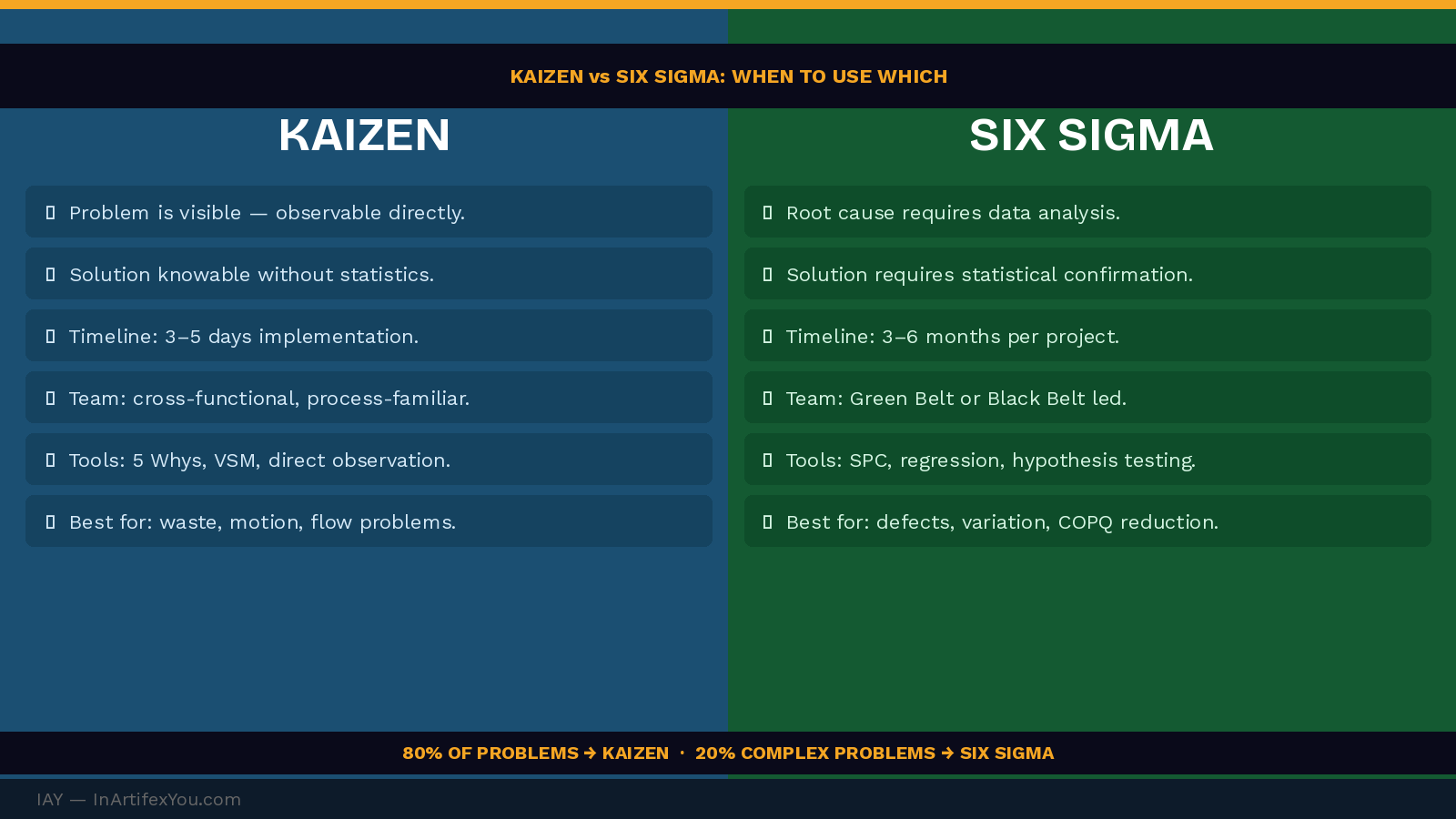
Kaizen and Six Sigma are complementary, not competing. Use Kaizen when the problem is visible, the solution is knowable without deep statistical analysis, and rapid implementation is more valuable than statistical rigor. Use Six Sigma (DMAIC) when the problem requires data analysis to identify root causes that are not obvious, when the financial stakes justify a 3–6 month project, or when the process variation needs statistical characterization. The practical decision rule: if a cross-functional team of people who work in the process could solve the problem in five days with direct observation and structured brainstorming, use Kaizen. If the root cause cannot be identified without statistical analysis of process data, use Six Sigma. Most improvement programs use both — Kaizen for the majority of problems, Six Sigma for the complex, high-stakes ones.
The Kaizen vs. Six Sigma question reflects a genuine methodological choice — not a competition between philosophies. Both approaches improve processes. The choice between them depends on the nature of the problem, the available data, and the improvement timeline.
The Core Difference
|
KAIZEN Problem is visible — waste can be observed directly. Solution is knowable without statistical analysis. Timeline: 3–5 days for implementation. Team: cross-functional, process-familiar. Tools: VSM, 5 Whys, fishbone, direct observation. Best for: waste elimination, layout improvement, flow. |
SIX SIGMA (DMAIC) Problem requires data to identify invisible root causes. Solution requires statistical analysis to confirm. Timeline: 3–6 months for a complete project. Team: Green Belt or Black Belt led. Tools: SPC, regression, hypothesis testing, Gage R&R. Best for: defect reduction, variation control, COPQ. |
The Decision Framework
|
Situation |
Use Kaizen |
Use Six Sigma |
|
Waste is visible and the team knows roughly where it is. |
✅ Primary choice. |
Not needed. |
|
Root cause is unknown and requires data analysis. |
Not sufficient. |
✅ Primary choice. |
|
You need results in less than one week. |
✅ Primary choice. |
Not feasible. |
|
The problem has significant financial impact and requires rigor. |
Support tool. |
✅ Primary choice. |
|
The team can observe and change the process directly. |
✅ Primary choice. |
Not needed. |
|
The variation source cannot be identified without statistics. |
Not sufficient. |
✅ Primary choice. |
Using Both Together
The highest-performing improvement programs use Kaizen and Six Sigma in sequence. A common pattern:
- Run a Value Stream Mapping session to identify all waste and variation sources in a process.
- Assign Kaizen events to address waste and flow problems — typically 70–80% of identified issues.
- Assign Six Sigma projects to address variation and defect problems that require statistical root cause analysis — typically 20–30% of identified issues.
- Use Kaizen to sustain Six Sigma results after the project closes — daily improvement habits prevent backsliding.
The 80/20 Rule for Improvement Methodology Selection
In most organizations, approximately 80% of improvement opportunities are best addressed by Kaizen — they are visible, solvable, and implementable quickly.
The remaining 20% require the statistical rigor of Six Sigma to diagnose and solve correctly.
Applying Six Sigma to a problem that Kaizen could solve in five days is an expensive way to be thorough.
Back to hub:KAIZEN.
- Kaizen tools: the practical toolkit every practitioner uses.
- How to run a Kaizen event step by step.
- Kaizen metrics: how to measure continuous improvement.
🔗 INTERNAL LINK SUGGESTIONS
|
||||||||||||||||||||||
The Continuous Improvement Certification at InArtifexYou gives you a complete, practical system to map, baseline, improve, and sustain any process — and the verified credential to prove you can lead it.
inartifexyou.com/continuous-improvement-certification-online.html |
||||||||||||||||||||||
|