How to run a Kaizen event step by step
A Kaizen event is a structured 3–5 day rapid improvement workshop where a cross-functional team focuses intensively on a specific process problem and implements solutions immediately — not in a future project. The five-day format runs as follows: Day 1 — kick-off, scope confirmation, current state mapping, and waste identification. Day 2 — root cause analysis and solution generation. Day 3 — solution implementation (the team physically changes the process during the event). Day 4 — testing, refinement, and standard work documentation. Day 5 — results presentation to leadership with documented before-and-after metrics. The most important rule of a Kaizen event: implementation happens during the event, not after. An event that produces a recommendation report rather than implemented changes is a workshop, not a Kaizen event.
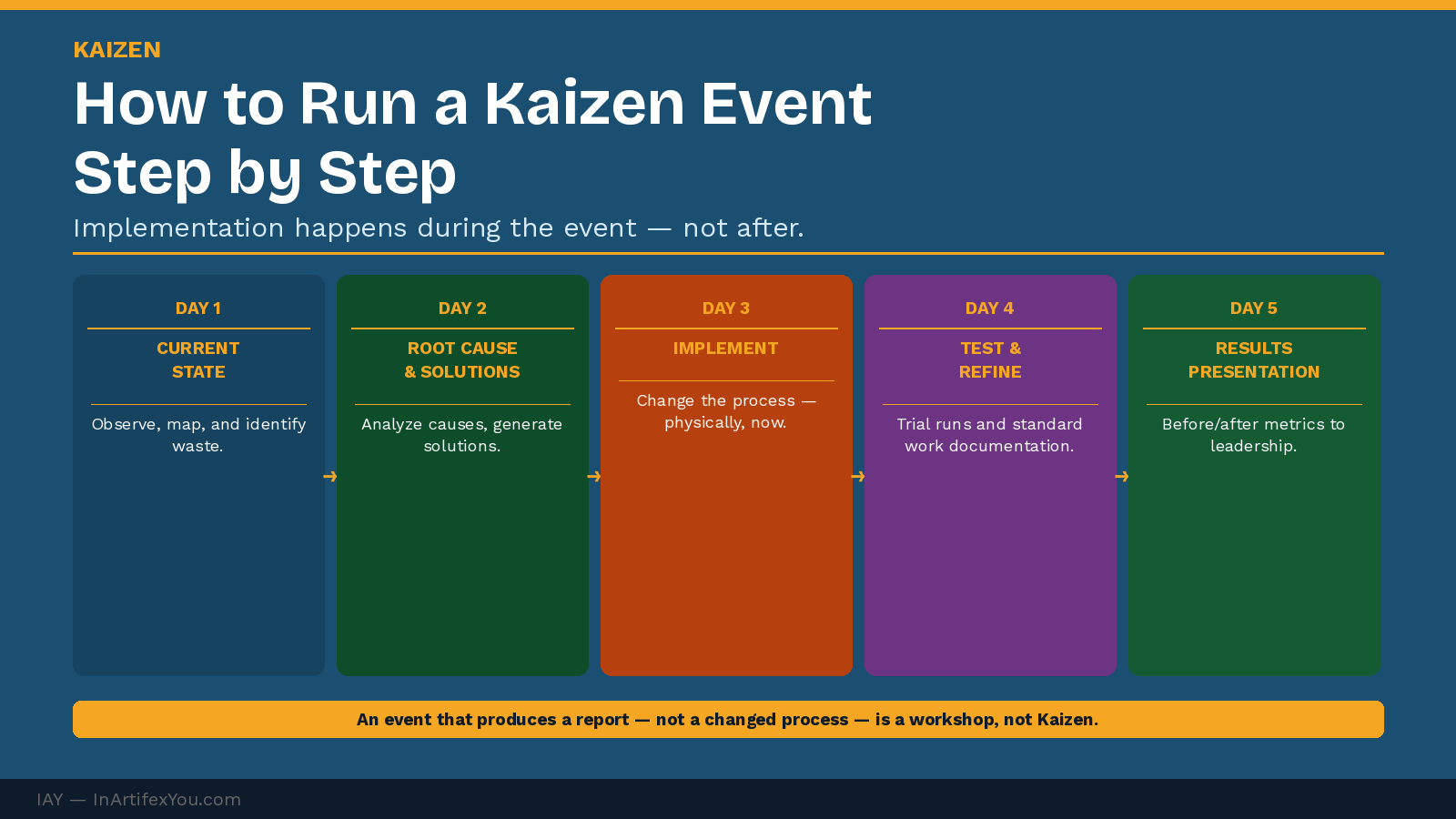
The Kaizen event is the most powerful rapid improvement tool available to a Lean practitioner. Done well, it transforms a problem that has existed for years into a solved process in five days — with the team that does the work leading every step of the change.
Pre-Event Preparation (1–2 Weeks Before)
A Kaizen event is only as good as its preparation. Under-prepared events waste the team's time and produce superficial results. Pre-event preparation covers:
- Scope definition: a one-page problem statement with the specific process, the baseline metric, and the improvement target.
- Team selection: 5–8 people, cross-functional, including at least 2–3 people who work directly in the target process.
- Data collection: current state performance data — defect rates, cycle times, lead times, customer complaints — collected before the event begins.
- Logistics: conference room booked for the full week, process area accessible for observation and changes, materials and tools available.
|
Day |
Focus |
Key Activities |
Output |
|
Day 1. |
Current state understanding. |
Kick-off, scope review, process observation, current state VSM, waste identification. |
Shared understanding of the problem — validated by data. |
|
Day 2. |
Root cause and solutions. |
Root cause analysis (fishbone + 5 Whys), solution brainstorming, solution prioritization. |
Ranked solution list with implementation assignments. |
|
Day 3. |
Implementation. |
Physical process changes, layout modifications, new standard work drafting, first trial runs. |
Changed process — running in new configuration. |
|
Day 4. |
Testing and refining. |
Trial runs, measurement of new performance, standard work finalization, training of non-event team members. |
Verified improved performance with documented standard work. |
|
Day 5. |
Results and handover. |
Before-and-after metrics, results presentation to leadership, 30-day follow-up action list, celebration. |
Leadership-presented results with ownership for sustained improvement. |
The Most Important Facilitation Rules
- Implementation happens during the event — not in a follow-up project plan.
- Leadership visits the team during the event — not just at the final presentation.
- The team owns the solution — the facilitator enables, never directs.
- Every change is trialed before it is finalized — 'test first, standardize second' is the operating rhythm.
- The 30-day follow-up list is assigned before the final presentation — never left open.
What Makes a Kaizen Event Fail
The most common Kaizen event failure modes are scope that is too large (five days cannot fix a plant-wide problem), team composition that excludes the people doing the work, and implementation that is deferred to a future project. When the event produces a PowerPoint deck instead of a changed process, the organization has run a workshop — not a Kaizen event.
Back to hub:KAIZEN.
|
||||||||||||||||||||||
The Continuous Improvement Certification at InArtifexYou gives you a complete, practical system to map, baseline, improve, and sustain any process — and the verified credential to prove you can lead it.
inartifexyou.com/continuous-improvement-certification-online.html |
||||||||||||||||||||||
|