Kaizen tools: the practical toolkit every practitioner
uses
The five core Kaizen tools that every practitioner uses in real improvement events are: the 5 Whys (root cause analysis by iterative questioning), A3 thinking (structured one-page problem solving), the spaghetti diagram (motion waste visualization by mapping actual movement paths), the suggestion system (structured employee idea capture and rapid response), and visual management (making process status immediately visible without asking). These tools are simple by design — Kaizen's foundational principle is that improvement should not require advanced technology or statistical expertise. Each tool can be applied by any team member with basic training, and each produces actionable insight in hours rather than weeks. Together they form a complete rapid improvement toolkit that addresses the most common types of waste: unnecessary motion, unclear root causes, invisible problems, and unacknowledged employee knowledge.
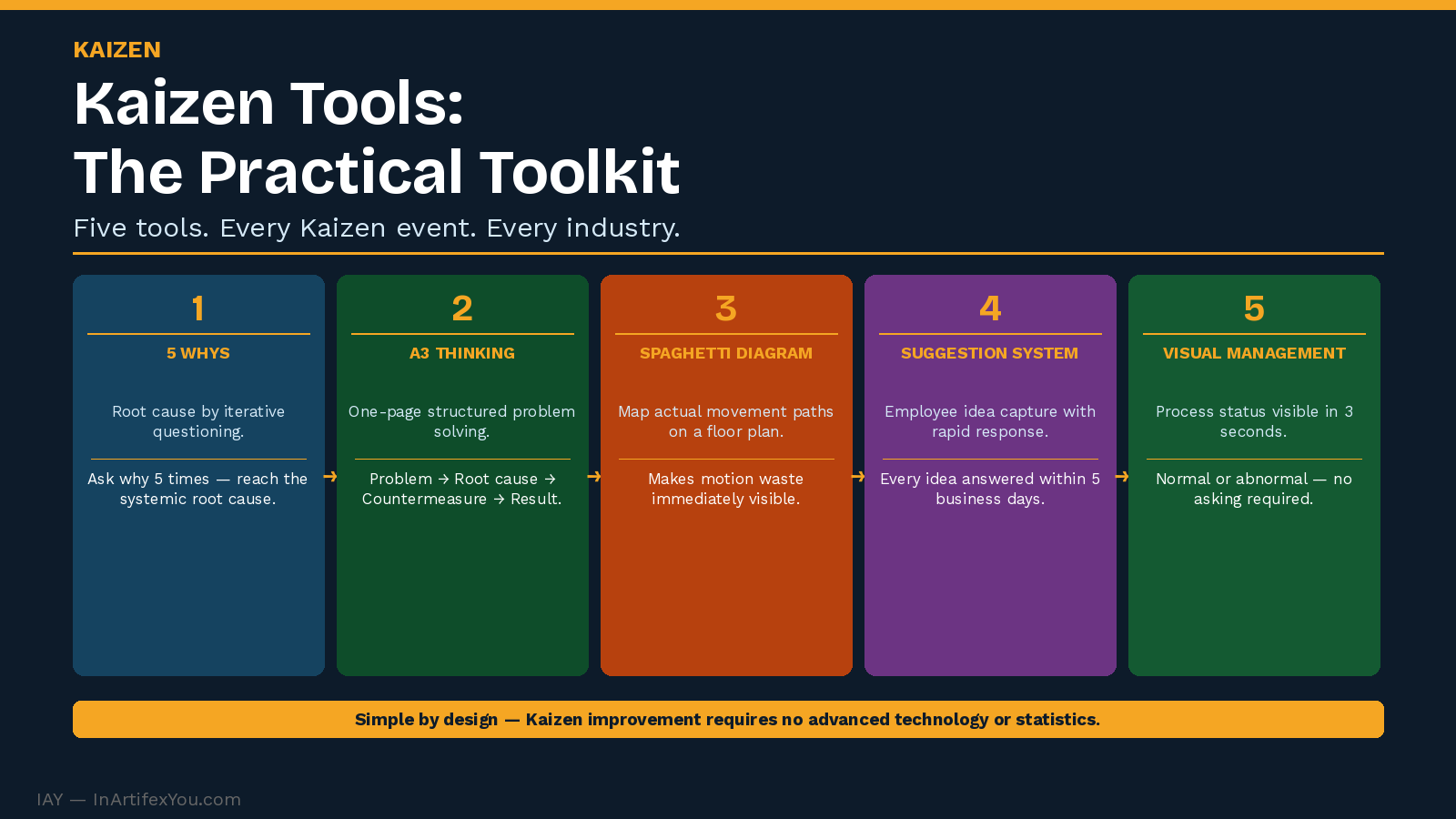
Kaizen is often described as a philosophy rather than a methodology — which is accurate but incomplete. The philosophy requires tools to translate into action. These five tools are the ones Kaizen practitioners reach for in virtually every rapid improvement event, regardless of industry or process type.
Tool 1: The 5 Whys
The 5 Whys is the simplest and most powerful root cause analysis tool in the Kaizen practitioner's toolkit. The method is exactly what the name suggests: ask 'why' five times in succession, with each answer forming the basis of the next question. By the fifth iteration, the team has typically moved from the visible symptom to the systemic root cause.
5 Whys Example — Production Defect
Why did the part fail? — The operator assembled it incorrectly.
Why did the operator assemble it incorrectly? — The assembly sequence was unclear.
Why was the assembly sequence unclear? — The work instruction had not been updated after the design change.
Why was the work instruction not updated? — There is no standard process for updating work instructions after design changes.
Why is there no standard process? — Engineering and production have never defined a formal change notification protocol.
Root cause: No formal engineering-to-production change notification protocol. Countermeasure: define and implement the protocol.
Tool 2: A3 Thinking
The A3 is a one-page problem-solving document — named after the paper size — that structures the complete improvement cycle: problem statement, current state, root cause analysis, target condition, countermeasures, implementation plan, and results verification. It forces disciplined thinking by limiting the practitioner to a single page, which prevents the analysis from expanding into a report that nobody reads.
A3 thinking is the documentation backbone of Kaizen. Every improvement event produces an A3 — which becomes the before-and-after record, the training document for the new standard, and the evidence base for the financial result.
Tool 3: The Spaghetti Diagram
The spaghetti diagram maps the actual physical movement of a person, product, or material through a process — drawn on a floor plan as a continuous line. The result typically looks like spaghetti: a tangled web of back-and-forth movement that makes waste immediately visible to anyone who looks at it.
The spaghetti diagram is used in the observation phase of a Kaizen event to quantify motion waste before proposing layout changes. A team that measures current state movement — often 1–3 kilometers per operator per shift — and then designs a layout that reduces it by 50% has a clear, defensible improvement result.
Tool 4: The Suggestion System
A well-designed suggestion system is Kaizen at its most fundamental: every employee contributes improvement ideas, management responds rapidly, and the best ideas are implemented immediately. The system requires three design elements to work:
- Simple submission: one form, one box, or one digital channel — not a multi-step approval process.
- Rapid response: every idea receives a decision within five business days — implement, defer with explanation, or decline with reason.
- Visible recognition: implemented ideas are posted publicly with the contributor's name — ideas that improve safety or quality receive priority recognition.
Tool 5: Visual Management
Visual management makes process status immediately visible to anyone — without asking, without reporting, without a meeting. A well-designed visual management system tells the team in seconds whether the process is running normally or abnormally.
|
Visual Tool |
What It Shows |
Where It Is Used |
|
Production board. |
Planned vs. actual output by hour. |
Manufacturing lines and service team workstations. |
|
Andon system. |
Real-time status: normal / abnormal / stopped. |
Production lines where rapid response is critical. |
|
Kanban board. |
Work in progress and queue status. |
Service teams and knowledge work environments. |
|
5S floor markings. |
Where everything belongs and what is missing. |
Any work area with shared tools or materials. |
|
KPI dashboard. |
Performance trend vs. target. |
Team areas and management review rooms. |
The Practitioner's Rule
If a team member has to ask how the process is performing, visual management has failed.
The answer should be visible from 3 meters away in under 3 seconds.
Back to hub:KAIZEN.
|
||||||||||||||||||||||
The Continuous Improvement Certification at InArtifexYou gives you a complete, practical system to map, baseline, improve, and sustain any process — and the verified credential to prove you can lead it.
inartifexyou.com/continuous-improvement-certification-online.html |
||||||||||||||||||||||
|