Kaizen metrics: how to measure continuous improvement
Kaizen performance is measured across three levels: activity metrics (how much improvement activity is happening), output metrics (what the improvement activity is producing), and impact metrics (what financial and operational results it is generating). Activity metrics include: number of improvement ideas submitted per employee per month (target: 1+), percentage of ideas implemented within 30 days (target: 80%+), and number of Kaizen events completed per quarter. Output metrics include: cycle time reduction per event, defect rate improvement per event, and lead time reduction per VSM project. Impact metrics include: annualized cost savings from completed improvements, COPQ reduction trend, and OEE improvement trend. The most common Kaizen measurement mistake is tracking only activity metrics — counting events and ideas without measuring whether they produced better processes and financial results.
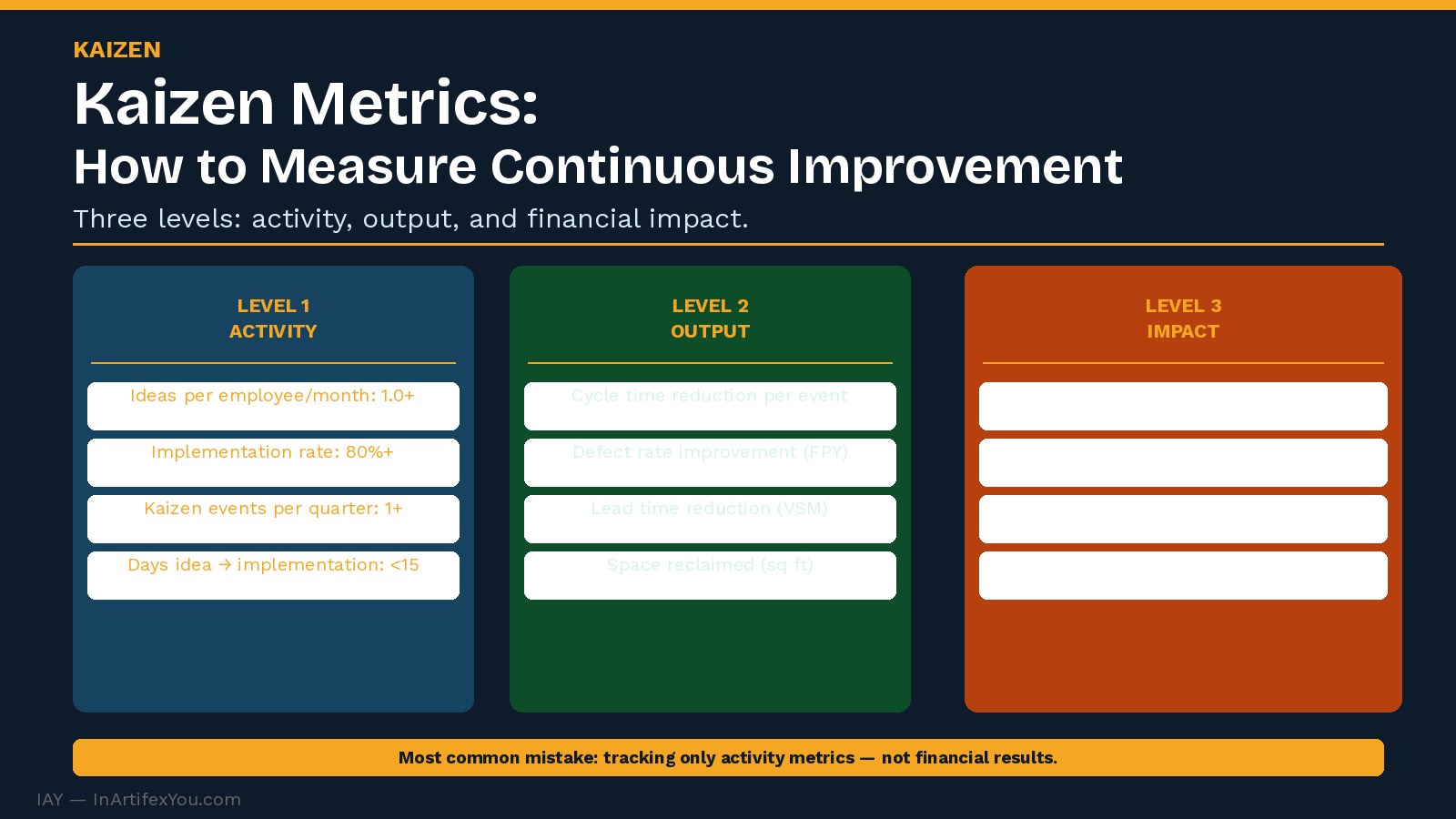
Kaizen without measurement is a cultural exercise — valuable, but not defensible to leadership. The practitioner who can show that the organization's continuous improvement activity is producing measurable operational and financial results is the one who keeps the program funded and expanding.
Level 1: Activity Metrics
Activity metrics measure the health of the improvement culture — whether people are engaged in Kaizen as a daily practice.
|
Activity Metric |
What It Measures |
Target |
|
Ideas submitted per employee per month. |
Engagement level — are people actively looking for improvements? |
1.0+ ideas per employee per month. |
|
Implementation rate within 30 days. |
Responsiveness — are ideas being acted upon? |
80%+ of submitted ideas implemented. |
|
Kaizen events per quarter. |
Improvement intensity — how many structured events are running? |
1 event per major process area per quarter. |
|
Average days from idea submission to implementation. |
System speed — how fast does the improvement engine run? |
Under 15 days for small improvements. |
Level 2: Output Metrics
Output metrics measure what the improvement activity is actually changing in the process.
- Cycle time reduction per Kaizen event: measure current state before the event, measure again 30 days after implementation.
- Defect rate improvement: track FPY or DPMO before and after each event targeting quality problems.
- Lead time reduction: measure end-to-end lead time before and after each VSM-driven Kaizen series.
- Space reclaimed: square footage recovered through 5S and layout Kaizen events — a tangible, visible result.
Level 3: Impact Metrics
Impact metrics connect improvement activity to business results — the language that earns executive sponsorship.
- Annualized cost savings: total financial value of implemented improvements for the year, verified by finance.
- COPQ reduction trend: total Cost of Poor Quality tracked quarterly — a declining trend confirms that Kaizen is eliminating root causes, not just symptoms.
- OEE improvement trend: Overall Equipment Effectiveness tracked monthly on lines where TPM-focused Kaizen has been applied.
- Customer satisfaction trend: CSAT or NPS tracked quarterly for processes where customer-facing Kaizen has been applied.
Building the Kaizen Metrics Dashboard
One-Page Kaizen Dashboard Structure
TOP: Activity — Ideas submitted this month | Implementation rate | Events completed this quarter.
MIDDLE: Output — Cycle time trend | Defect rate trend | Lead time trend.
BOTTOM: Impact — YTD savings | COPQ trend | OEE trend.
Update monthly. Review in leadership meetings. Connect every metric to a named project owner.
Back to hub: KAIZEN.
|
||||||||||||||||||||||
The Continuous Improvement Certification at InArtifexYou gives you a complete, practical system to map, baseline, improve, and sustain any process — and the verified credential to prove you can lead it.
inartifexyou.com/continuous-improvement-certification-online.html |
||||||||||||||||||||||
|