Kanban metrics: cycle time, lead time, and throughput
The three core Kanban metrics are cycle time, lead time, and throughput. Cycle time measures how long an item spends in active work — from when the team starts working on it to when it is done. Lead time measures the total elapsed time from when a request enters the system to when it is delivered — including any waiting time before work begins. Throughput measures how many items the team completes per unit of time — typically per week. The relationship between these metrics: if you reduce cycle time without changing throughput, lead time drops. If you increase throughput without reducing cycle time, lead time also drops. The most actionable metric for most teams is cycle time — because it is under the team's direct control, while lead time is partially determined by queue length and demand patterns outside the team's control.
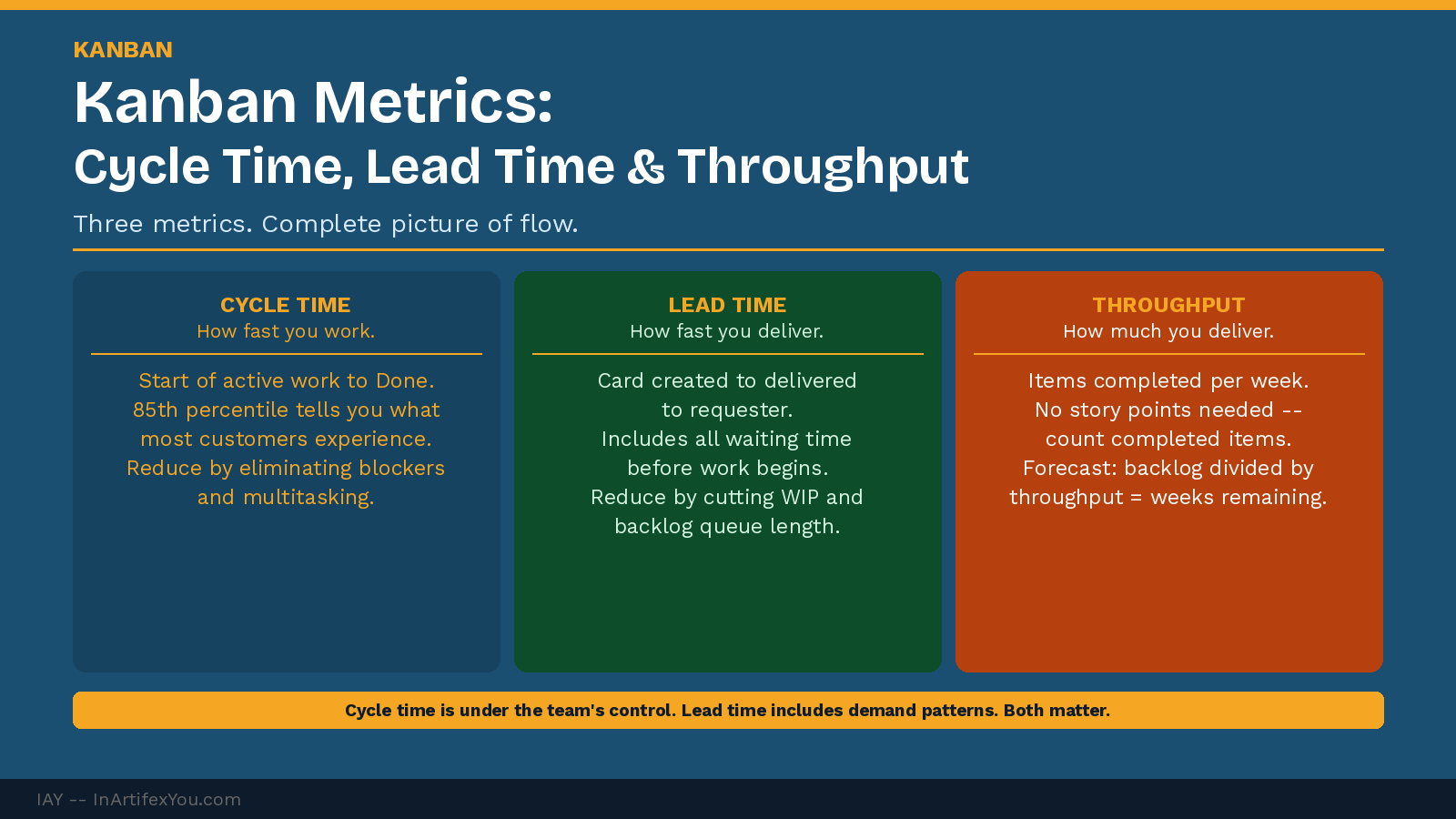
Kanban without metrics is activity without accountability. The three flow metrics — cycle time, lead time, and throughput — give the team a precise, quantitative view of how well their system is delivering. Together they answer the three questions that matter most: how fast do we work, how fast do we deliver, and how much do we deliver?
Cycle Time: How Fast You Work
Cycle time is measured from the moment a team member starts actively working on an item to the moment it is complete. It excludes waiting time before work begins. Cycle time is the metric most directly under the team's control because it reflects the efficiency of active work — not queue management or demand patterns.
Cycle Time Formula
Cycle Time = Date item moved to Done − Date item moved to In Progress.
Track cycle time for every item. Calculate the average, the median, and the 85th percentile — the 85th percentile tells you what most customers experience, not just the average case.
Lead Time: How Fast You Deliver
Lead time is measured from the moment a request enters the system — typically when a card is created in the backlog — to the moment it is delivered to the requester. It includes waiting time, which cycle time excludes. Lead time is the metric that customers care about most because it represents their experience of responsiveness.
- Reduce lead time by reducing WIP — fewer items in the system means faster delivery per item.
- Reduce lead time by reducing queue time — items that sit in the backlog for weeks before being started inflate lead time without any team productivity loss.
- Track lead time by item type — urgent requests, standard requests, and large features typically have very different lead time profiles that deserve separate analysis.
Throughput: How Much You Deliver
Throughput measures the number of items completed per unit of time — typically per week. It is the capacity metric of the Kanban system. Unlike velocity in Scrum, Kanban throughput does not require story point estimation — it counts completed items regardless of size.
Use throughput to forecast: if a team consistently completes 8 items per week and has 40 items in the backlog, the backlog is approximately 5 weeks of work. This makes commitment conversations with stakeholders honest and data-driven.
Reading All Three Together
|
Pattern |
What It Signals |
Improvement Action |
|
High cycle time, low throughput. |
Active work is slow — possible skill gaps or complexity. |
Identify the most complex item types and address root causes. |
|
Low cycle time, low throughput. |
Work completes fast but little enters the system. |
Check backlog health and demand management upstream. |
|
High lead time, normal cycle time. |
Items wait too long before work begins. |
Reduce backlog size or improve prioritization discipline. |
|
High throughput, increasing lead time. |
Demand exceeds capacity — the team is overwhelmed. |
Cap incoming demand or increase capacity. |
Back to hub: KANBAN.
- Kanban board design: columns, WIP limits, and card structure.
- Kanban WIP limits: how to set them and why they matter.
- Kanban vs Scrum: when to use which.
🔗 INTERNAL LINK SUGGESTIONS
| ||||||||||||||||||||||
The Continuous Improvement Certification at InArtifexYou gives you a complete, practical system to map, baseline, improve, and sustain any process — and the verified credential to prove you can lead it.
inartifexyou.com/continuous-improvement-certification-online.html | ||||||||||||||||||||||
|