OKR examples that reinforce quality and flow
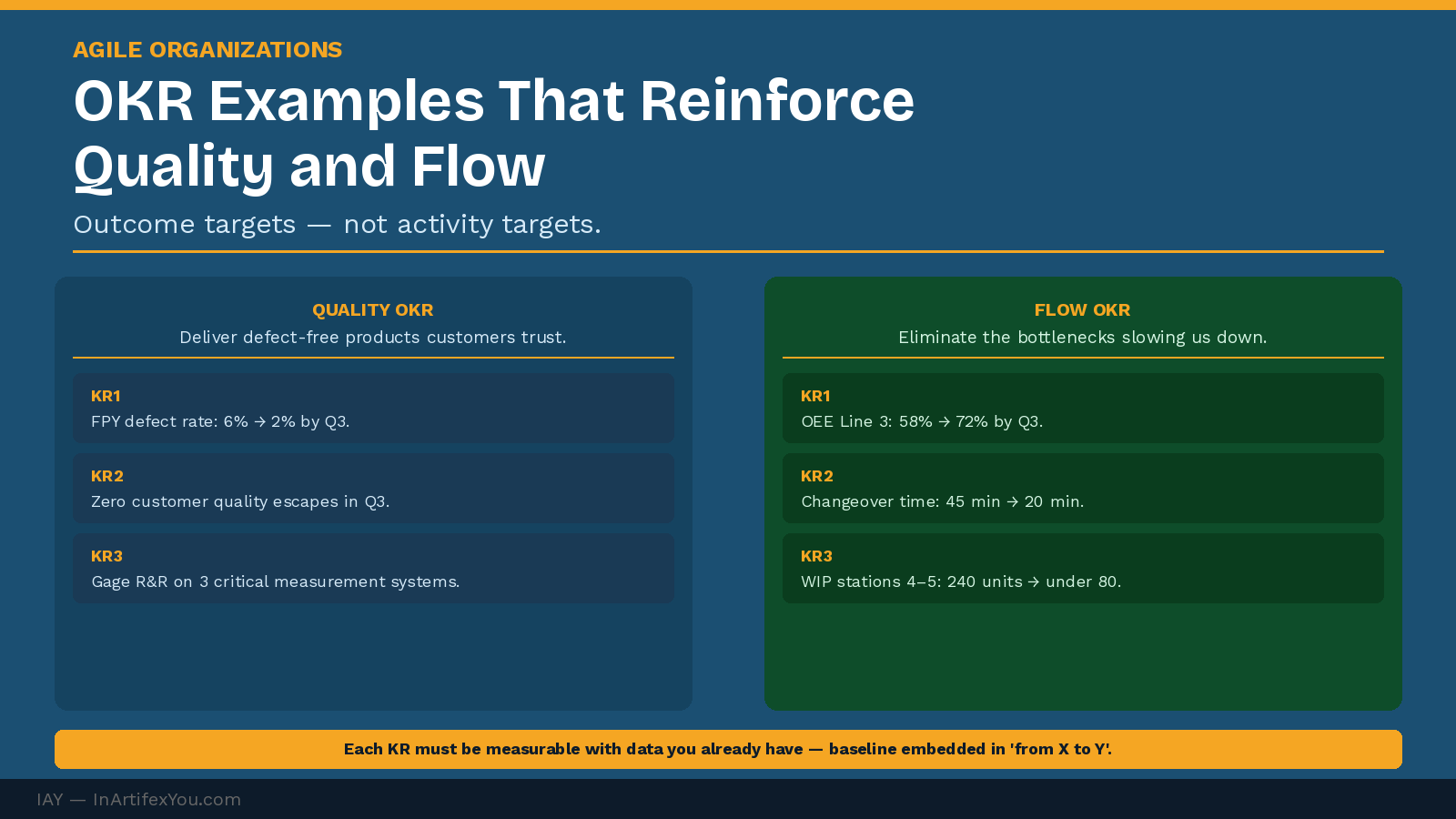
OKRs (Objectives and Key Results) reinforce quality and flow when they are specific, measurable, and directly connected to the improvement metrics your team is already tracking. A well-constructed quality OKR might read: Objective — 'Deliver consistently defect-free products that our customers trust'; Key Result 1 — 'Reduce first-pass yield defect rate from 6% to 2% by Q3'; Key Result 2 — 'Achieve zero customer-reported quality escapes in Q3'; Key Result 3 — 'Complete measurement system analysis on three critical process steps.' A flow OKR might read: Objective — 'Eliminate the bottlenecks that slow our team down'; Key Result 1 — 'Reduce end-to-end lead time from 14 days to 8 days'; Key Result 2 — 'Reduce WIP above limit incidents from 12 per week to under 3.' The key is connecting the OKR directly to improvement data — not to activity.
OKRs fail to reinforce quality and flow when they are written as activity targets ('implement Lean Six Sigma training for 80% of staff') rather than outcome targets ('reduce defect rate from 6% to 2%'). Activity-based OKRs can be achieved without any improvement in organizational performance. Outcome-based OKRs cannot.
Quality OKR Examples
|
OKR Example 1 — Manufacturing Quality Objective: Deliver consistently defect-free products that our customers trust. KR1: Reduce first-pass yield defect rate from 6% to 2% by Q3. KR2: Achieve zero customer-reported quality escapes in Q3. KR3: Complete Gage R&R analysis on all three
critical measurement systems by end of Q2. | |
|
OKR Example 2 — Service Quality Objective: Resolve every customer issue correctly the first time. KR1: Increase first-contact resolution rate from 67% to 82% by Q4. KR2: Reduce average handle time on escalated cases from 48 hours to 24 hours. KR3: Achieve a CSAT score of 4.5 or higher on 90% of resolved cases. |
Flow OKR Examples
|
OKR Example 3 — Manufacturing Flow Objective: Eliminate the bottlenecks that limit our output capacity. KR1: Increase OEE on Line 3 from 58% to 72% by Q3. KR2: Reduce average changeover time from 45 minutes to 20 minutes across all product transitions. KR3: Reduce WIP between stations 4 and 5 from an average of 240 units to under 80 units. | |
|
OKR Example 4 — Agile Team Flow Objective: Eliminate the delays that slow our team down. KR1: Reduce end-to-end lead time from 14 days to 8 days by Q3. KR2: Reduce WIP limit violations on the team Kanban board from 12 per week to under 3. KR3: Reduce blocked ticket duration from an average of 4 days to under 1 day. |
What Makes These OKRs Effective
Each example above shares four characteristics that make OKRs genuinely reinforce quality and flow:
- The objective is human and meaningful — it describes why the work matters, not what will be done.
- Each key result is directly measurable with data the team already has access to — no new measurement system required to track progress.
- The baseline is embedded in the KR — 'from X to Y' makes progress immediately visible.
- The KRs are outcomes, not activities — achieving them requires actual process improvement, not just program participation.
What to Avoid
- Activity KRs: 'Complete Lean training for 80% of staff' — training is an input, not an outcome.
- Vague KRs: 'Improve quality' — no baseline, no target, no measurability.
- Too many KRs: more than four per objective dilutes focus and creates reporting burden without improving clarity.
Back to hub: Agile Organization.
- Agile organization KPI targets: velocity, lead time, and adaptability baselines.
- Change management patterns that avoid initiative fatigue.
- Structuring cross-functional value streams.
🔗 INTERNAL LINK SUGGESTIONS
|
||||||||||||||||||||||
The Continuous Improvement Certification at InArtifexYou gives you a complete, practical system to map, baseline, improve, and sustain any process — and the verified credential to prove you can lead it.
inartifexyou.com/continuous-improvement-certification-online.html |
||||||||||||||||||||||
|