Takt vs cycle time: trade-offs in short runs
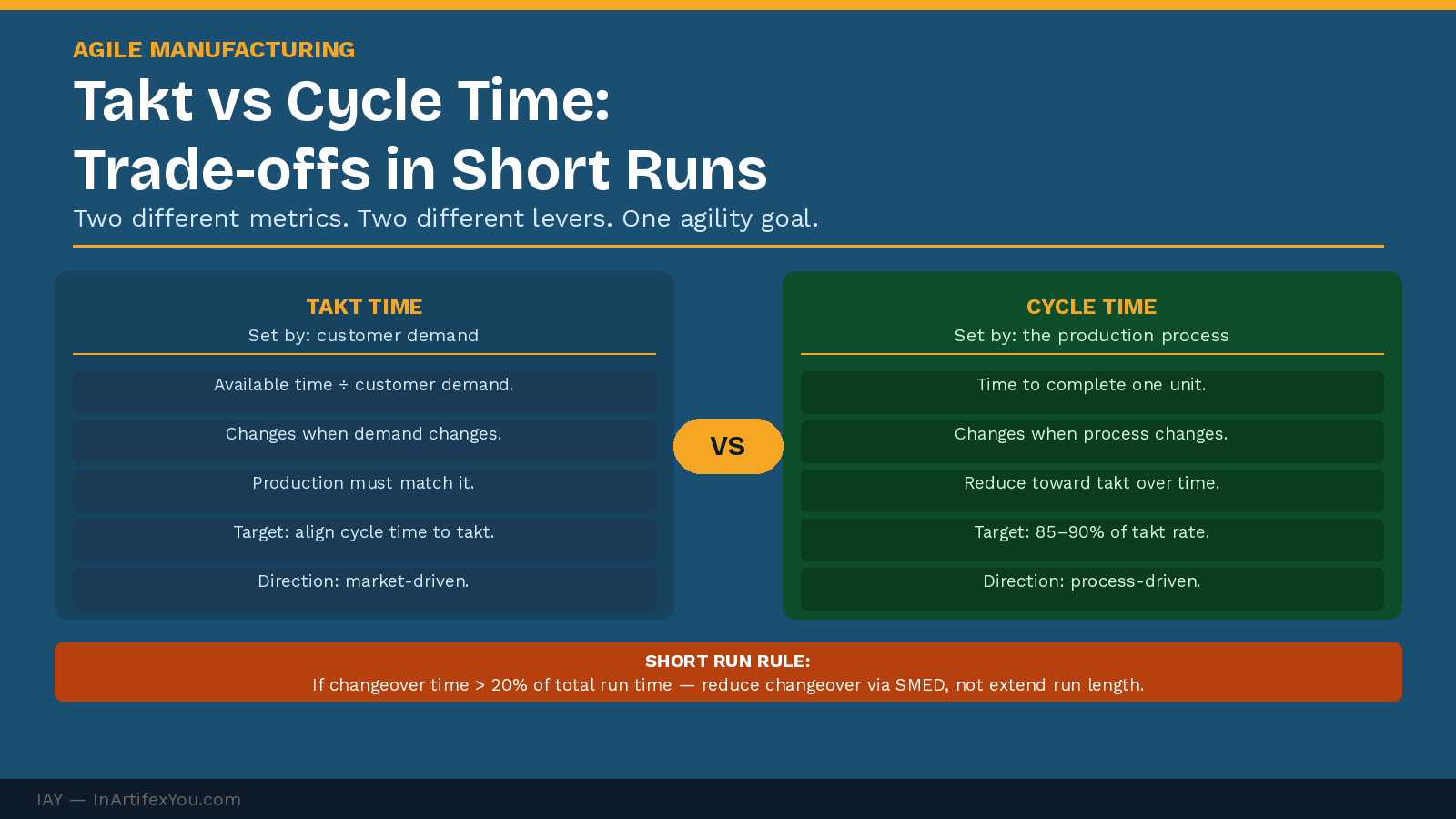
Takt time is the rate at which customers demand your product — it is set by the market, not by the factory. Cycle time is the rate at which your process produces — it is determined by your equipment, operators, and methods. In short production runs, the trade-off between takt and cycle time becomes critical: a short run that requires a significant changeover may not justify running at takt rate if the changeover time consumes more capacity than the run produces value. The practical rule for short runs: if changeover time exceeds 20% of total run time, the run is too short to be profitable at current changeover duration. Reducing changeover time via SMED is the solution — not extending the run length, which defeats the agility objective.
Takt time and cycle time are two of the most frequently confused metrics in lean and agile manufacturing. They measure different things, they respond to different improvement levers, and confusing them leads to the wrong corrective action.
Definitions: What Each Metric Actually Measures
|
TAKT TIME Set by: customer demand. Formula: Available production time ÷ customer demand quantity. Changes when: demand changes. Management action: align production rate to takt. Direction: takt sets the pace — production must match it. |
CYCLE TIME Set by: the production process. Formula: Time to complete one unit from start to finish. Changes when: process changes. Management action: reduce cycle time toward takt. Direction: cycle time should approach takt — not exceed it. |
The Relationship Between Takt and Cycle Time
- If cycle time = takt time: perfect flow — the process produces exactly at the rate of customer demand.
- If cycle time < takt time: the process is faster than demand — overproduction risk, or an opportunity to reduce capacity.
- If cycle time > takt time: the process cannot meet demand — a bottleneck that will cause missed deliveries.
Short Runs: Where the Trade-Off Gets Critical
In a standard long production run, changeover time is amortized across thousands of units — its impact on effective cycle time is negligible. In a short run of 50 or 100 units, changeover time becomes a significant portion of total production time, effectively inflating the cost per unit and reducing capacity available for other products.
Short Run Break-Even Rule
If changeover time > 20% of total run time, the run economics are unfavorable at current changeover duration.
Example: A 60-minute changeover on a 300-minute run consumes 20% of capacity — marginal.
Same 60-minute changeover on a 200-minute run consumes 30% — unprofitable.
Solution: reduce changeover time via SMED, not extend run length.
Managing the Takt-Cycle Relationship in Agile Operations
Agile manufacturing requires running more changeovers per shift, which means managing the takt-cycle relationship dynamically. Three practices define how high-performing agile operations manage this:
1. Update takt time weekly — demand changes, and the production pace must adjust with it.
2. Track cycle time at the work center level — aggregate plant cycle times hide local bottlenecks.
3. Target cycle time at 85–90% of takt — a small buffer absorbs variation without falling behind demand.
Practical Application: Setting Short Run Schedules
For mixed-model lines running frequent short runs, schedule effectiveness depends on accurate takt time calculation for each product configuration. Calculate takt time separately for each product in the mix using its specific demand volume and available production time allocation.
A product with low demand volume has a long takt time — meaning it can be produced slowly without missing customer expectations. A high-demand product has a short takt time — meaning it requires faster cycle times and lower changeover frequency to remain profitable.
Back to hub: Agile Manufacturing.
- SMED targets for mixed-model lines: setting and achieving goals.
- Agile manufacturing KPI targets and baseline: what to track first.
- When to use Lean vs TOC for agility in factories.
🔗 INTERNAL LINK SUGGESTIONS
|
||||||||||||||||||||||
The Continuous Improvement Certification at InArtifexYou gives you a complete, practical system to map, baseline, improve, and sustain any process — and the verified credential to prove you can lead it.
inartifexyou.com/continuous-improvement-certification-online.html |
||||||||||||||||||||||
|
||||||||||||||||||||||
|
IAY — InArtifexYou.com | SBI MasterCraft v2.8 | T3: Agile Manufacturing |