Agile manufacturing KPI targets and baseline: what to
track first
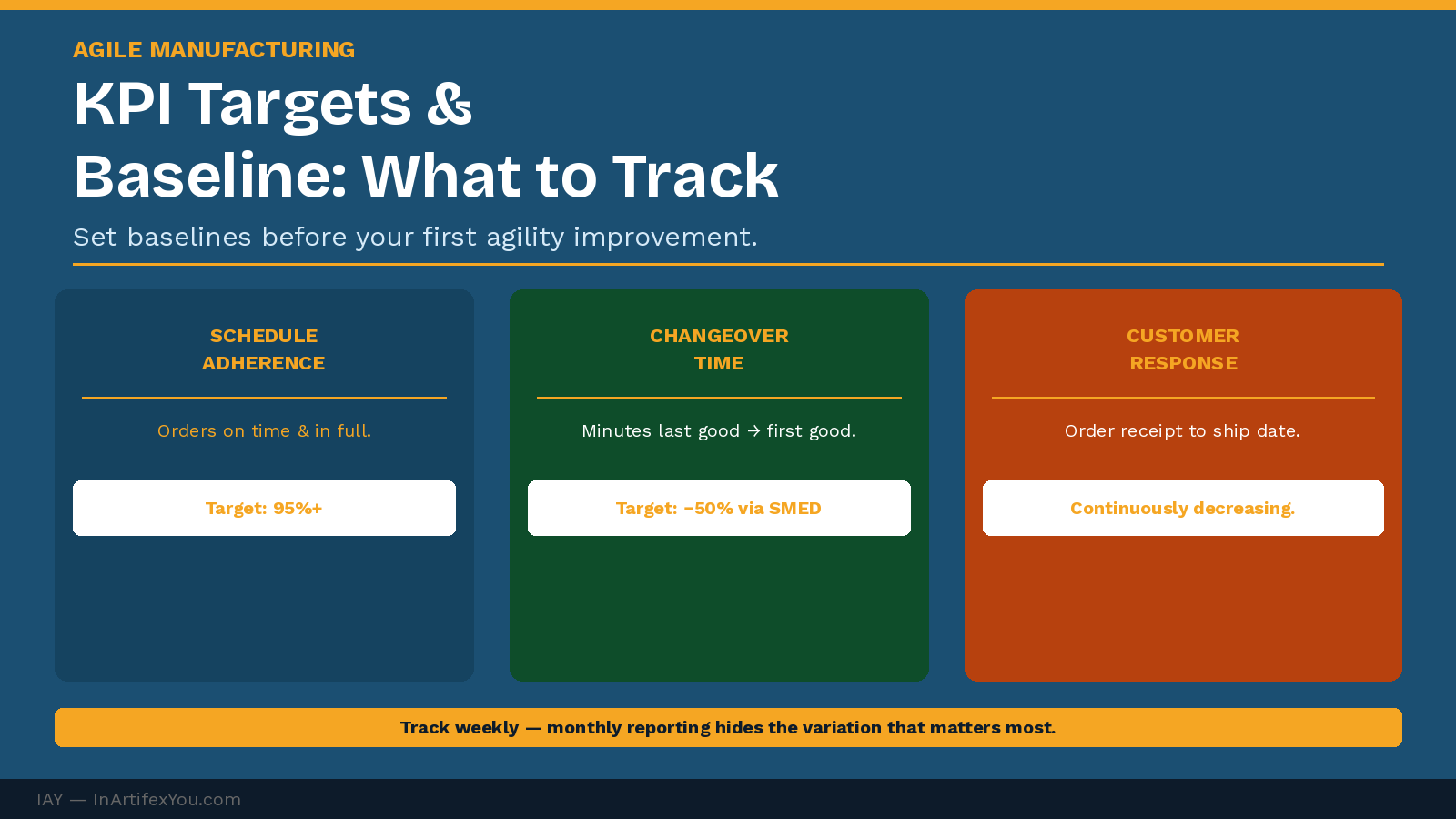
Agile manufacturing performance is measured through three primary KPIs established before improvement begins: schedule adherence rate, average changeover time, and customer order response time. Schedule adherence measures the percentage of production orders completed on time and in full — target 95% or higher. Average changeover time measures the elapsed time between the last good part of one run and the first good part of the next — track in minutes and target a 50% reduction through SMED methodology. Customer order response time measures elapsed time from order receipt to confirmed ship date — target varies by industry but trending downward is the signal. Secondary KPIs — mix flexibility index, capacity utilization rate, and on-time delivery — are added after the primary three stabilize. Track weekly to capture the variation that monthly reporting hides.
Agile manufacturing is defined by responsiveness — the ability to change product mix, volume, and configuration faster than competitors without sacrificing cost or quality. That responsiveness is only measurable if you establish a baseline before you begin. Without a baseline, you cannot prove that your agility is improving.
The Three Primary Agile Manufacturing KPIs
|
KPI |
What It Measures |
Starting Benchmark |
Target |
|
Schedule Adherence. |
% of orders completed on time and in full. |
Establish current state — typically 75–90%. |
95%+. |
|
Average Changeover Time. |
Minutes from last good part to first good part of next run. |
Measure current average over 20+ changeovers. |
50% reduction via SMED. |
|
Customer Order Response Time. |
Hours/days from order receipt to confirmed ship date. |
Establish current average — varies by industry. |
Continuously decreasing trend. |
Schedule Adherence: The Agility Proof Point
Schedule adherence is the primary indicator of manufacturing agility because it captures whether the system can execute changing demands reliably. A plant with high mix variability and 95% schedule adherence has demonstrated that its agility is real — it can respond without sacrificing execution.
Calculate schedule adherence weekly at the production line level, not the plant level. A plant-level rate of 88% may hide a single line consistently missing targets — which is your highest-priority improvement focus.
Schedule Adherence Formula
Schedule Adherence = (Orders Completed On Time and In Full ÷ Total Orders Scheduled) × 100.
Track at line level first. Aggregate to plant level only after line-level visibility is established.
Changeover Time: The Flexibility Engine
In agile manufacturing, the ability to change over quickly between products is what enables mix flexibility. A line that requires four hours to change over between products can only run a limited number of different products per week. A line that changes over in 20 minutes can respond to demand shifts the same day.
Use SMED (Single-Minute Exchange of Die) methodology to attack changeover time. Track every changeover for four weeks before beginning SMED work to establish a valid baseline — including minimum, maximum, and average times. The variation itself reveals where improvement effort should focus first.
Customer Order Response Time: The Market Signal
Customer order response time connects manufacturing agility to commercial competitiveness. When a customer places an order, how quickly can you confirm a ship date? That window is a direct function of your manufacturing flexibility. Reducing it requires improving schedule visibility, reducing lead times, and increasing capacity confidence.
- Track in business hours, not calendar days — it reveals the actual responsiveness of the system.
- Segment by product type — standard products versus configured products often have very different response times.
- Trend downward consistently — absolute target varies by industry, but the direction must be improvement.
Secondary KPIs to Add After 60 Days
- Mix flexibility index: number of different product configurations run per week — increasing trend signals growing agility.
- Capacity utilization rate: actual output versus theoretical capacity — target 80–85% for sustainable agile operations.
- On-time delivery (OTD) to customer: the downstream confirmation that internal schedule adherence is translating to customer experience.
|
||||||||||||||||||||||
The Continuous Improvement Certification at InArtifexYou gives you a complete, practical system to map, baseline, improve, and sustain any process — and the verified credential to prove you can lead it.
inartifexyou.com/continuous-improvement-certification-online.html |
||||||||||||||||||||||
|
||||||||||||||||||||||
|
IAY — InArtifexYou.com | SBI MasterCraft v2.8 | T3: Agile Manufacturing |