Agile manufacturing in manufacturing vs services: what
actually changes
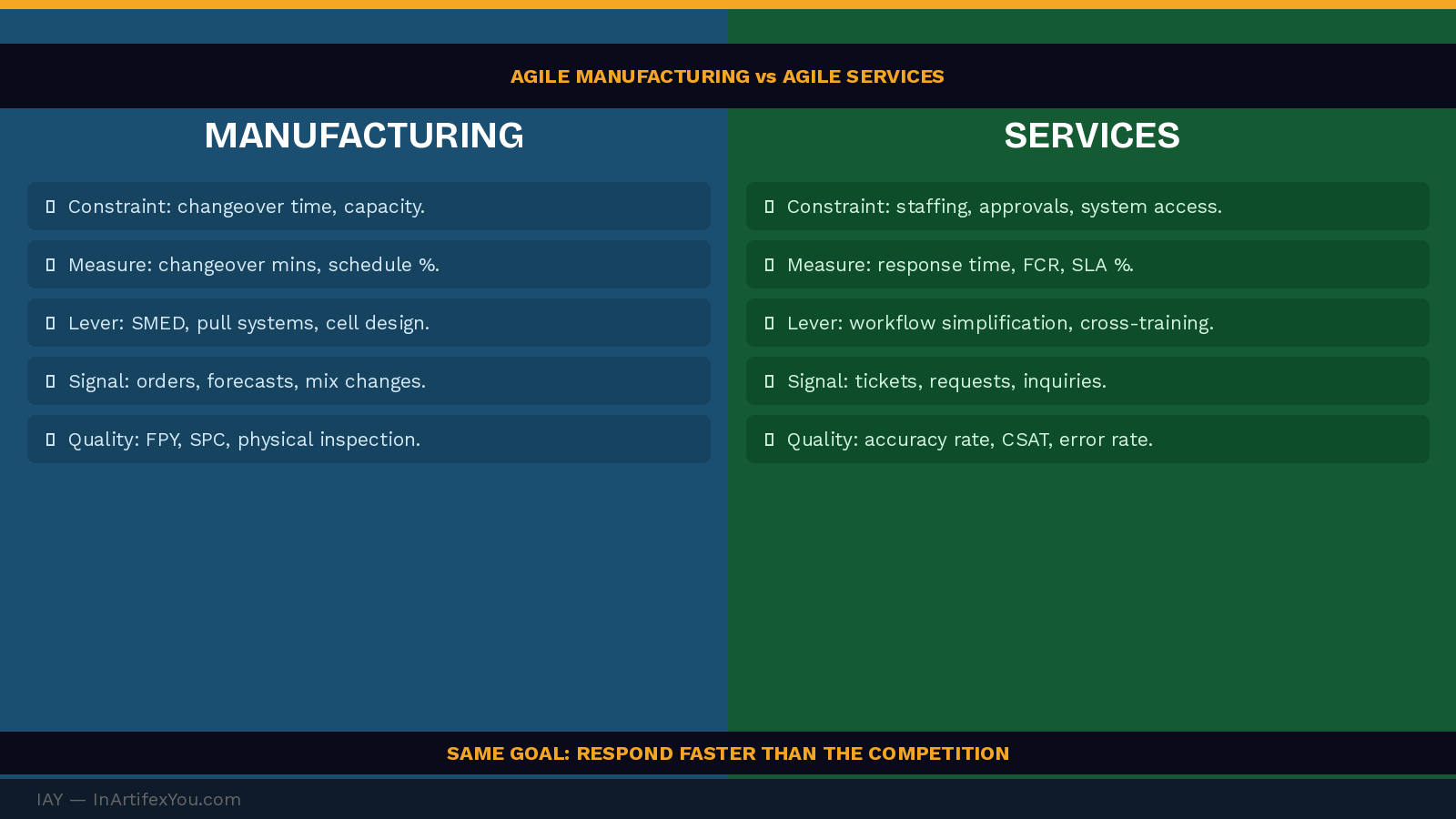
Agile manufacturing and agile service delivery share the same core principle — rapid response to changing demand — but differ in three fundamental ways. First, the constraint: in manufacturing, agility is constrained by physical changeover time, machine capacity, and material lead times. In services, agility is constrained by knowledge worker availability, approval workflows, and system access. Second, the measurement: manufacturing agility is measured in changeover minutes, schedule adherence rates, and OTD percentages. Service agility is measured in response time hours, first-contact resolution rates, and service level agreement compliance. Third, the improvement lever: manufacturing agility improves through SMED, pull systems, and flexible cell design. Service agility improves through workflow simplification, cross-training, and digital queue management. The goal — responding faster than the competition without sacrificing quality — is identical in both environments.
The word 'agile' has been applied to so many business contexts that it risks losing its operational meaning. In manufacturing, agility has a precise definition: the ability to change product mix, volume, or configuration faster than the competition while maintaining cost and quality targets. In services, the equivalent definition is: the ability to respond to changing customer demand faster than the competition while maintaining service quality and cost efficiency.
Both definitions point to the same core discipline — eliminating the friction that slows response. The friction just looks different in each environment.
The Three Key Differences
|
MANUFACTURING AGILITY Constraint: changeover time, machine capacity, material lead times. Measurement: changeover minutes, schedule adherence, OTD %. Improvement lever: SMED, pull systems, flexible cell design. Demand signal: customer orders, forecasts, mix changes. Response unit: production batch or individual work order. Quality check: physical inspection, SPC, FPY. |
SERVICE AGILITY Constraint: knowledge worker availability, approval workflows, system access. Measurement: response time hours, FCR rate, SLA compliance. Improvement lever: workflow simplification, cross-training, digital queues. Demand signal: service requests, tickets, customer inquiries. Response unit: transaction, case, or service request. Quality check: accuracy rate, customer satisfaction, error rate. |
SMED in Manufacturing vs. Service Workflow Simplification
In manufacturing, SMED (Single-Minute Exchange of Die) reduces changeover time by separating internal from external elements and converting internal steps to external ones. The result is a faster transition between product runs.
In services, the equivalent methodology is service workflow simplification. A service process with 12 approval steps before a customer request is fulfilled has a hidden 'changeover' embedded in every transaction — the time between request receipt and first productive action. Reducing that time through approval consolidation, pre-authorization, and cross-training produces the same agility gain as SMED does in manufacturing.
Pull Systems: The Same Principle, Different Signals
- Manufacturing pull: kanban cards, bin replenishment signals, or electronic pull triggers drive production — nothing is made without a downstream signal.
- Service pull: incoming requests drive work allocation — nothing is queued without an active demand signal — controlled through WIP limits on digital Kanban boards.
- Both approaches eliminate overproduction: manufacturing avoids building inventory nobody ordered; services avoid processing work nobody yet needs.
What Does Not Change
The discipline of waste elimination, the focus on customer value, the use of standard work to reduce variation, and the relentless pursuit of shorter lead times — these principles are identical whether the output is a machined part or a resolved customer inquiry.
The most effective agile practitioners are those who understand the principles deeply enough to translate them fluently between contexts — which is exactly the capability a Continuous Improvement certification develops.
Back to hub: Agile Manufacturing.
|
||||||||||||||||||||||
The Continuous Improvement Certification at InArtifexYou gives you a complete, practical system to map, baseline, improve, and sustain any process — and the verified credential to prove you can lead it.
inartifexyou.com/continuous-improvement-certification-online.html |
||||||||||||||||||||||
|
||||||||||||||||||||||
|
IAY — InArtifexYou.com | SBI MasterCraft v2.8 | T3: Agile Manufacturing |