When to use Lean vs TOC for agility in factories
Lean and Theory of Constraints (TOC) are both agility methodologies, but they target different types of manufacturing problems. Use Lean when waste is distributed across the entire value stream — many small improvements across multiple steps will compound into significant agility gains. Use TOC when a single bottleneck is constraining the entire system's output — one resource is limiting throughput regardless of how efficient every other step is. In practice, the best agile manufacturing systems use both: TOC identifies and manages the constraint, while Lean eliminates the waste that surrounds it. The decision rule is straightforward: if your capacity utilization is relatively uniform across all steps, start with Lean. If one step consistently runs at 90%+ utilization while others run at 60–70%, start with TOC.
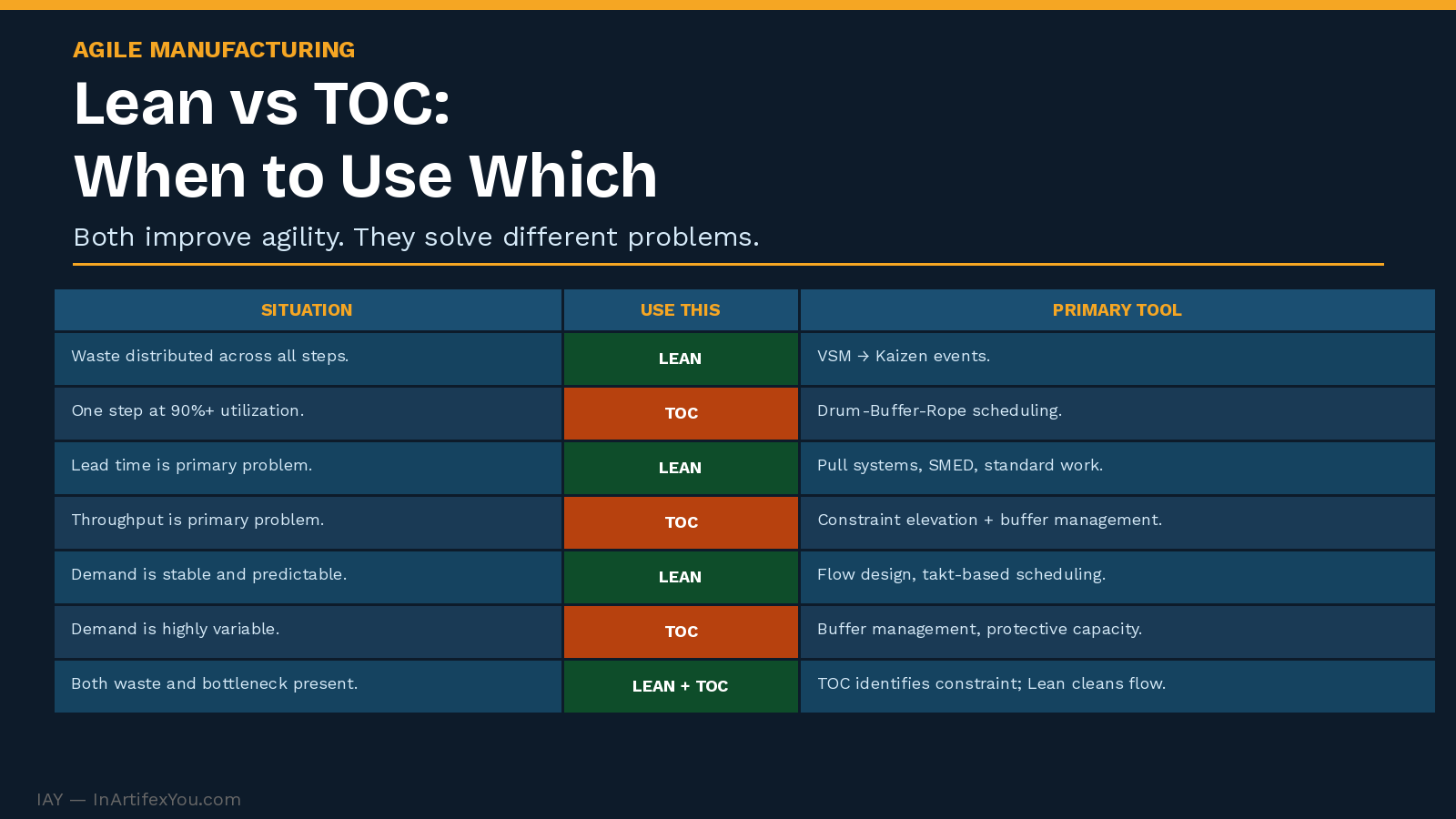
The choice between Lean and Theory of Constraints is one of the most common strategic decisions in agile manufacturing management — and one of the most frequently made on instinct rather than analysis. Both methodologies improve factory agility. They just do it differently, and applying the wrong one to the wrong situation produces frustration rather than results.
Lean: Distributed Waste Elimination
Lean assumes that waste exists throughout the value stream and that eliminating it step-by-step will improve overall flow. This assumption is valid when:
- No single step is significantly more constrained than others.
- Lead time reduction is the primary agility goal.
- The value stream has many small inefficiencies rather than one dominant bottleneck.
- Customer demand is relatively stable and predictable — Lean flow works best when takt time is consistent.
Theory of Constraints: Bottleneck Optimization
TOC assumes that every system has one constraint that limits its total throughput — and that improving anything other than that constraint produces zero system-level improvement. This assumption is valid when:
- One step consistently runs at near-full capacity while others have spare capacity.
- Throughput increase is the primary agility goal — you need to produce more, not just faster.
- Customer demand exceeds current output capacity — the constraint is limiting revenue, not just efficiency.
- Demand is variable and unpredictable — TOC's buffer management handles variability better than Lean flow.
The Decision Framework
|
Situation |
Use This Methodology |
Primary Tool |
|
Waste distributed across all steps. |
Lean. |
Value Stream Mapping → Kaizen events. |
|
One step at 90%+ utilization. |
TOC. |
Drum-Buffer-Rope scheduling. |
|
Lead time is primary problem. |
Lean. |
Pull systems, standard work, SMED. |
|
Throughput is primary problem. |
TOC. |
Constraint elevation, buffer management. |
|
Demand is stable. |
Lean. |
Flow design, takt-based scheduling. |
|
Demand is highly variable. |
TOC. |
Buffer management, protective capacity. |
|
Both waste and bottleneck exist. |
Lean + TOC combined. |
TOC identifies constraint, Lean cleans the flow. |
Using Both Together: The High-Performance Approach
The most agile factories do not choose between Lean and TOC — they use both in a deliberate sequence. TOC's Five Focusing Steps (Identify, Exploit, Subordinate, Elevate, Repeat) provide the strategic sequence; Lean tools provide the tactical execution.
- 1Identify the constraint using capacity utilization data.
- Exploit the constraint: apply Lean tools to maximize output from the constrained resource.
- Subordinate everything else to the constraint: use pull systems to feed the bottleneck without overloading it.
- Elevate the constraint: if Lean tools have been fully applied, invest in additional capacity.
- Repeat: once the constraint moves, return to step 1.
This integrated approach delivers agility improvements faster than either methodology applied in isolation — because it focuses improvement energy where the system is most sensitive to change.
|
||||||||||||||||||||||
The Continuous Improvement Certification at InArtifexYou gives you a complete, practical system to map, baseline, improve, and sustain any process — and the verified credential to prove you can lead it.
inartifexyou.com/continuous-improvement-certification-online.html |
||||||||||||||||||||||
|
||||||||||||||||||||||
|
IAY — InArtifexYou.com | SBI MasterCraft v2.8 | T3: Agile Manufacturing |