SMED targets for mixed-model lines: setting and
achieving goals
Setting SMED targets for mixed-model lines requires a four-step approach: establish a valid changeover baseline, benchmark against industry standards, set phased improvement targets, and track weekly until the target is sustained. The baseline requires a minimum of 20 timed changeover observations — including minimum, maximum, average, and standard deviation. Industry benchmarks for mixed-model automotive lines average 8–15 minutes for world-class operations; discrete manufacturing typically targets under 30 minutes. The standard SMED target-setting rule: target 50% reduction from current baseline in Phase 1 (60–90 days), then 50% of the remaining time in Phase 2 (another 90 days). A line currently averaging 60-minute changeovers targets 30 minutes in Phase 1 and 15 minutes in Phase 2. Sustaining the target requires standard work documentation, operator certification, and a changeover audit every 30 days.
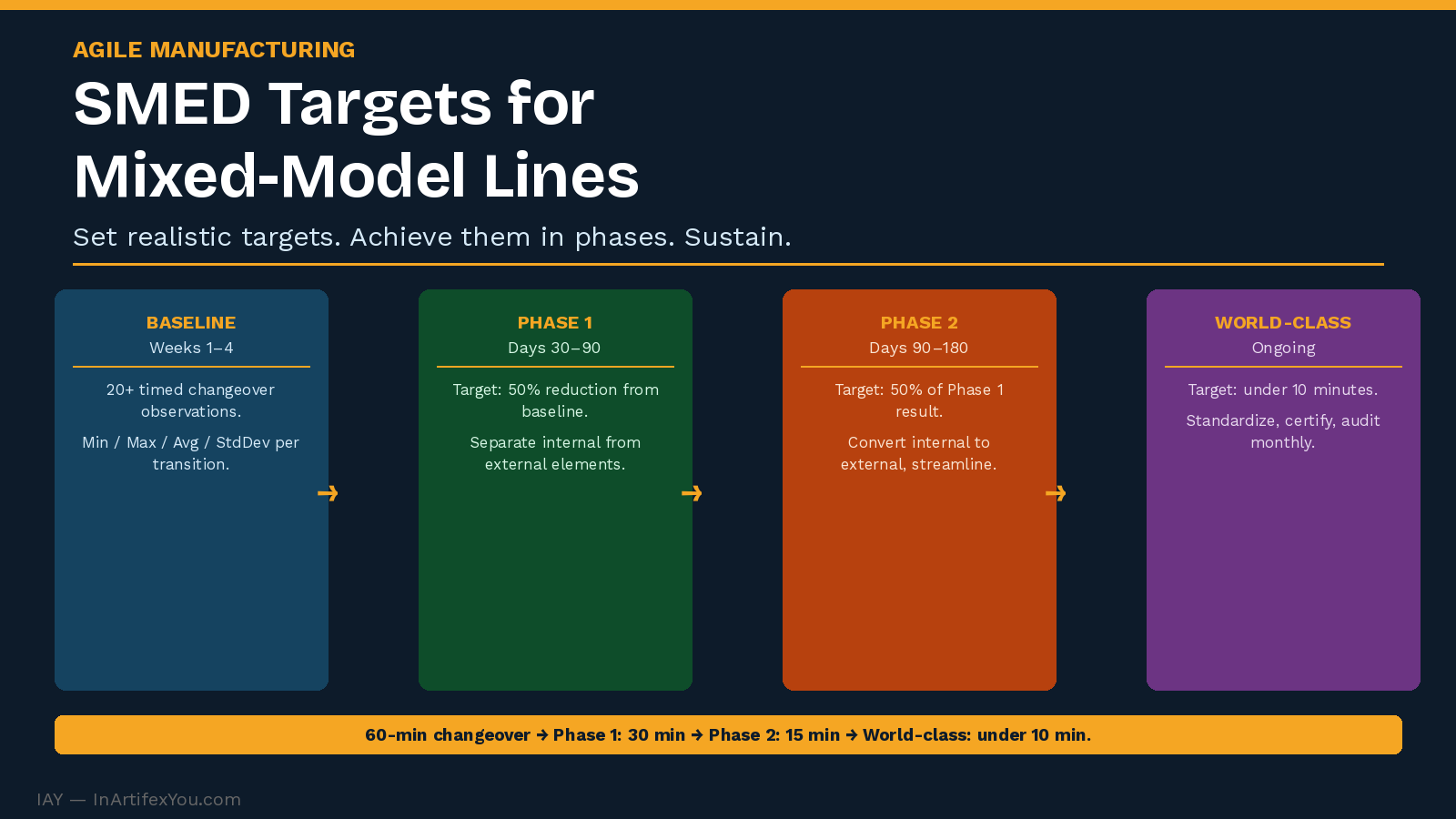
Mixed-model production lines face a changeover challenge that single-product lines do not: every changeover is different. The transition from product A to product B may require different tooling, different fixtures, different material feeds, and different quality parameters than the transition from product B to product C. Setting a single SMED target that accounts for this variability requires a structured approach.
Step 1: Establish a Valid Baseline
A SMED baseline is only valid if it captures the real distribution of changeover times — not just the best-case or average-case scenario. Collect the following data over a minimum of 20 changeover observations:
- Total changeover time: from last good part of prior run to first good part of new run.
- Breakdown by changeover type: A-to-B, A-to-C, B-to-C — each transition may have different complexity.
- Internal vs. external time split: what is currently done while the machine is stopped versus what could be done while it is running.
- Variation range: minimum, maximum, average, and standard deviation — high variation signals inconsistent execution, not just a long average.
Step 2: Set Phased Targets
|
Phase |
Target Time |
Frame |
Primary Method |
|
Baseline. |
Establish current average and range. |
Weeks 1–4. |
Observation and time study. |
|
Phase 1. |
50% reduction from baseline average. |
Days 30–90. |
Separate internal from external elements. |
|
Phase 2. |
50% reduction from Phase 1 result. |
Days 90–180. |
Convert internal to external, streamline remaining. |
|
World-Class. |
Under 10 minutes for most changeovers. |
Ongoing. |
Standardize, certify operators, audit monthly. |
The SMED Method Applied to Mixed-Model Lines
On mixed-model lines, SMED implementation requires an additional step: changeover routing. Not all transitions are equal — some product combinations require more changeover complexity than others. The SMED team should:
- Map all product-to-product transition combinations and rank by frequency and changeover time.
- Focus initial SMED effort on the highest-frequency, longest-duration transitions first.
- Develop a changeover matrix that documents the specific internal and external elements for each transition type.
- Create a standardized changeover instruction card for each transition — one page, with photographs.
Sustaining SMED Results
SMED targets are achieved once and sustained consistently only when three conditions are met:
- Standard work documentation: every changeover step is documented, sequenced, and time-targeted.
- Operator certification: each operator is verified against the standard — not just trained on it.
- Monthly changeover audit: a supervisor times at least two changeovers per month against the standard and documents any variance.
Without the audit, changeover times drift upward within 90 days as informal workarounds reappear and documentation falls out of use.
|
||||||||||||||||||||||
The Continuous Improvement Certification at InArtifexYou gives you a complete, practical system to map, baseline, improve, and sustain any process — and the verified credential to prove you can lead it.
inartifexyou.com/continuous-improvement-certification-online.html |
||||||||||||||||||||||
|
||||||||||||||||||||||
|
IAY — InArtifexYou.com | SBI MasterCraft v2.8 | T3: Agile Manufacturing |